Microservices communication is the set of protocols and patterns that govern how independently deployed services exchange data, negotiate state, and propagate failures across a distributed system.
Three patterns dominate production architectures: gRPC for binary-efficient internal RPC, REST over HTTP for human-readable external surfaces, and message queues for asynchronous event-driven workflows. Each pattern carries a distinct cost profile in latency, coupling, operational overhead, and failure semantics, and the architectural choice between them determines the blast radius of every downstream outage. The selection rarely settles on a single pattern; most large systems run all three, separated by traffic role and contract type, with a service mesh layered underneath to unify identity and observability.
How Microservices Communicate

Microservices communication divides cleanly along two root axes. Synchronous communication binds caller and callee in time: the caller issues a request and blocks until the response arrives, which keeps the mental model simple but propagates downstream slowness back up the call graph. Asynchronous messaging breaks that temporal coupling by routing messages through a broker that buffers, persists, and fans out to consumers at their own pace. The axis a service-to-service communication path lives on dictates its retry semantics, latency budget, and failure blast radius across the distributed system.
Synchronous vs Asynchronous Patterns
The two patterns differ on the properties practitioners trade against each other on every architecture review. The definition list below isolates the attributes that decide which axis a given path should sit on.
- Synchronous request-response (gRPC, REST)
- Caller blocks until a response or timeout. Tight coupling on availability. Simple mental model for request-response flows. Cascading failure risk when a downstream slows or errors. Retry budgets and circuit breakers required at every hop.
- Asynchronous messaging (Kafka, RabbitMQ, NATS, SQS, Pub/Sub)
- Caller publishes to a broker and proceeds. Loose coupling on availability and lifecycle. Operational overhead of broker tuning, partition planning, and consumer offset management. Failure isolation through durable buffering. Idempotent consumer pattern required to absorb at-least-once delivery.
The choice is rarely abstract. A payment authorization on the checkout path needs blocking semantics because the customer waits on the result; a downstream fraud-scoring fan-out belongs on asynchronous messaging because the result can land seconds later without blocking the purchase. The gRPC, REST, and message queue evaluations that follow read through this lens.
gRPC: Binary-Efficient Synchronous Communication
REST is a microservices communication pattern that exchanges JSON or XML payloads over HTTP using the protocol's verbs (GET, POST, PUT, DELETE, PATCH) and a stateless server constraint. Contracts are defined in OpenAPI (formerly Swagger), idempotent methods carry retry semantics directly in the verb choice, and any HTTP client speaks the protocol natively, which is why REST remains the default for external-facing surfaces, partner APIs, and mixed-stack environments.
The operational advantages drive most of the adoption. Human-readable payloads simplify debugging across logs, API gateways, and tracing tools; curl, Postman, and HTTPie cover most diagnostic needs without code generation. Browser, mobile, and CLI clients consume REST endpoints with no transport adapter, which removes a category of integration friction that gRPC introduces. OpenAPI tooling generates client SDKs in dozens of languages from a single specification, and the contract sits in source control as plain text rather than a compiled artifact.
- JSON serialization overhead
- Text encoding inflates payload size and consumes CPU at high request rates; at 10,000 requests per second the cost shows up in serialization profiles and network egress bills.
- HTTP/1.1 head-of-line blocking
- Sequential request ordering on a single connection limits throughput; connection pooling helps but does not match binary stream concurrency on burst workloads.
- No native streaming
- Server-sent events and WebSockets cover specific cases, but a generic push or long-running result channel requires bolt-on infrastructure that gRPC handles natively.
- Schema drift risk
- Implicit contracts diverge across services without OpenAPI enforcement in CI; field renames and removed properties surface only at runtime.
REST stays the right default for public-facing APIs, partner integrations, webhooks, and any surface where debuggability and client diversity outweigh raw throughput. Internal east-west paths can run REST too when team familiarity matters more than payload efficiency, though the throughput ceiling arrives faster than most architects expect. See also: webhook.
Message Queues: Asynchronous Event-Driven Communication
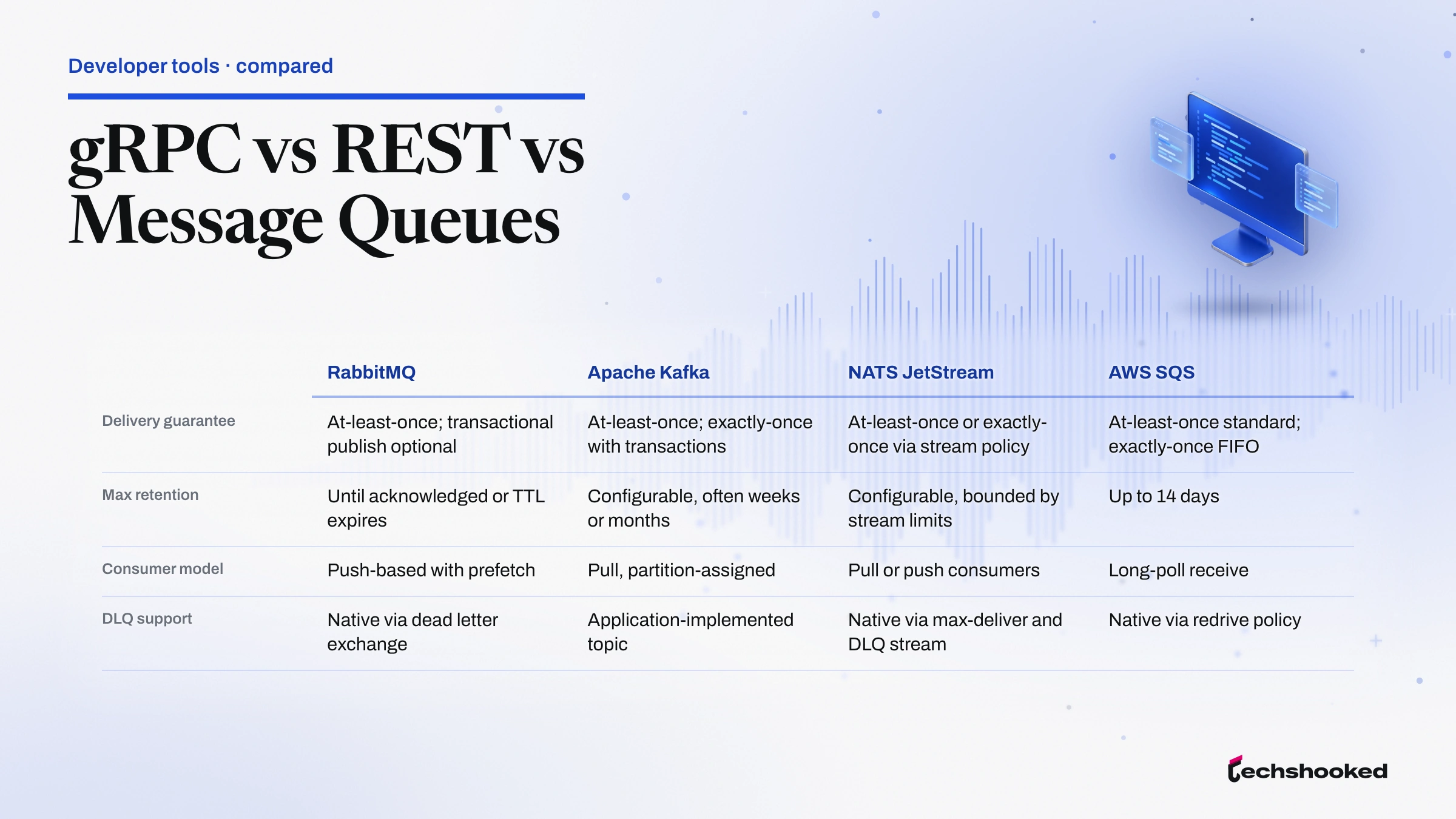
Message queues are an asynchronous microservices communication mechanism that routes records through a broker so producers and consumers operate on independent lifecycles. The broker family chosen sets the delivery semantics: RabbitMQ runs AMQP with push-based delivery and transient queue semantics; Apache Kafka treats the log itself as the primary abstraction with pull-based subscriptions and configurable retention; NATS JetStream emphasizes cloud-native footprint and at-least-once or exactly-once delivery; AWS SQS offers managed standard and FIFO message queue tiers; Google Pub/Sub handles global fan-out with at-least-once delivery. The Apache Kafka Documentation is the authoritative reference for partition models, subscription coordination, and log compaction.

Every implementation must address the same operational concepts. At-least-once delivery is the realistic default, so consumers run an idempotent consumer pattern that deduplicates on a stable message key or business identifier. A dead letter queue catches poison messages that exceed retry budgets, preserving them for manual inspection rather than blocking the partition. Consumer group semantics control horizontal scaling: each partition assigns to one consumer in the group, so throughput scales with partition count. Backpressure surfaces as consumer lag in pull-based brokers and as flow-control frames in push-based ones, and unmonitored backpressure is the single most common path to unbounded queue growth. Routing the dead letter queue into an alerting topic, rather than letting it accumulate silently, is the operational discipline that separates resilient consumers from quietly broken ones.
Delivery Guarantees and Failure Semantics
| Broker | Delivery guarantee | Max retention | Consumer model | DLQ support | Managed offering |
|---|---|---|---|---|---|
| RabbitMQ | At-least-once; transactional publish optional | Until acknowledged or TTL expires | Push-based with prefetch | Native via dead letter exchange | CloudAMQP, Amazon MQ |
| Apache Kafka | At-least-once; exactly-once with transactions | Configurable, often weeks or months | Pull, partition-assigned | Application-implemented topic | Confluent Cloud, MSK |
| NATS JetStream | At-least-once or exactly-once via stream policy | Configurable, bounded by stream limits | Pull or push consumers | Native via max-deliver and DLQ stream | Synadia Cloud |
| AWS SQS | At-least-once standard; exactly-once FIFO | Up to 14 days | Long-poll receive | Native via redrive policy | Fully managed by AWS |
| Google Pub/Sub | At-least-once; exactly-once on subscription opt-in | Up to 31 days | Pull or push subscriptions | Native via dead letter topic | Fully managed by Google Cloud |
The idempotent consumer pattern is the universal mitigation for at-least-once delivery. Implementations store a processed-message ledger keyed on a stable identifier (an event UUID, a business key) and short-circuit duplicates on lookup. Kafka pairs this with offsets committed only after the side effect succeeds, which gives effectively-once processing semantics without paying the latency cost of broker-level exactly-once transactions. Petabyte-scale workloads on Kafka routinely sustain sub-10ms p99 latency for streaming workloads, with the operational tradeoff being partition rebalancing skill, replication factor tuning, and broker upgrade choreography across KRaft or ZooKeeper coordination.
Choosing the Right Communication Pattern
Pattern selection here comes down to five axes that interact with each other rather than to a single property. The checklist below maps each axis to the option it favors and the threshold where the answer flips.
- Coupling requirement. Known caller and callee schemas with synchronous dependency tolerance favor gRPC. Loose coupling and temporal decoupling favor a message queue. REST sits between for external-facing surfaces where contract stability matters but blocking is acceptable.
- Throughput and latency SLA. Sub-millisecond p99 for internal RPC favors gRPC with stream concurrency on a persistent connection. Moderate throughput tolerates REST. Burst absorption and fan-out beyond synchronous capacity belong on asynchronous messaging, accepting a broker latency floor in exchange for buffering.
- Streaming requirement. Native push channels with deadline propagation favor gRPC. Polling, webhooks, or server-sent events cover REST. High-volume event streams with replay belong on Kafka or NATS JetStream.
- Operational expertise available. REST is the lowest barrier and the most forgiving of inexperienced teams. gRPC requires .proto discipline and a code-generation pipeline. Kafka operations demand cluster ops fluency: partition planning, replication tuning, and consumer group recovery.
- Scale tier. At petabyte event volumes, Kafka's log compaction and consumer group model remains the only viable pattern. gRPC stays viable for synchronous RPC paths at any scale when paired with a service mesh that handles retries and mTLS. REST scales horizontally but hits CPU and serialization ceilings earlier than the binary alternatives.
Service Mesh and the Transport Layer
A service mesh changes the calculus by lifting cross-cutting concerns out of application code and into a sidecar proxy. Istio, Linkerd, and Consul Connect terminate mutual TLS at the sidecar, apply retry and circuit-breaker policy as mesh configuration, and emit distributed tracing spans without service code changes. When the mesh is present, the choice between gRPC and REST collapses to contract semantics and payload efficiency rather than transport security; the sidecar enforces mTLS uniformly regardless of which application protocol the workload speaks. NIST SP 800-207A codifies zero-trust service-to-service identity at the workload level as the model these proxies implement, and the Google Cloud Microservices Architecture Guide walks through the integration patterns for cloud-native deployments. See also: Kubernetes Deployment.
The mesh also reshapes which decisions live in application code. Retries, timeouts, and circuit breakers move to mesh policy. Authentication and authorization for service-to-service communication run as proxy filters rather than middleware. Observability emits from the proxy layer, so traces capture every hop including those across language boundaries. The cost is operational: every workload gets a sidecar, control-plane upgrades touch every namespace, and policy misconfiguration can drop traffic in ways that are harder to debug than equivalent application logic. For teams without an existing mesh, adopting one alongside a new gRPC rollout often produces a steeper learning curve than introducing either change in isolation.
Practitioners building out a polyglot architecture should also review the Full-Stack Development Learning Path for the application-layer skill ladder, and the CI/CD Pipeline and Programming Languages guide for the build-and-release tooling that keeps .proto generation, OpenAPI publication, and broker client libraries aligned across services.
Further reading
- Role of TLS/SSL in Data Protection (protocol foundation for mTLS on inter-service channels)
- infrastructure as code tools (workload-identity model behind sidecar mTLS)
- Full-Stack Development Learning Path (application-layer skill ladder for polyglot teams)
- CI/CD Pipeline and Programming Languages (release tooling that keeps .proto and OpenAPI artifacts aligned)
- C++ vs Rust Speed Comparison (systems-language context for low-level broker and proxy clients)
Frequently Asked Questions
When does gRPC outperform REST for microservices communication?
gRPC outperforms REST in high-throughput internal service-to-service communication where Protobuf's compact binary encoding and HTTP/2 multiplexing reduce both payload size and connection overhead. In practice, the advantage compounds with message volume: at 10,000 requests per second, Protobuf payloads running 3 to 10 times smaller than equivalent JSON translate to measurable reductions in network cost and serialization CPU. gRPC's bidirectional streaming also eliminates the polling or webhook workarounds that REST requires for push semantics, making it the default choice for internal RPC paths in latency-sensitive pipelines such as ML inference serving or real-time telemetry ingestion.
Why use broker queues instead of direct service-to-service calls?
Queue brokers decouple the producer and consumer lifecycle so that a spike in upstream traffic does not cascade into downstream service failure. When a service calls another service directly through gRPC or REST, the caller blocks or errors if the callee is slow or unavailable; a event queue absorbs that burst into a durable buffer the consumer drains at its own pace. This temporal decoupling is the primary reason event-driven architectures using Kafka or RabbitMQ handle fan-out workloads and variable traffic patterns that synchronous RPC cannot absorb without circuit breakers and aggressive retry budgets.
Can gRPC, REST, and messaging queues coexist in one microservices architecture?
Yes, and most production systems at scale use all three for different communication roles. gRPC handles internal synchronous service-to-service RPC where schema contracts are known and latency matters. REST handles external-facing endpoints where client diversity across browsers, mobile, and third-party partners demands human-readable interoperability. Queue systems handle asynchronous workflows: order processing, event sourcing, audit log fan-out, and any flow where the sender must not block on the receiver. The practical challenge is operational coherence; a sidecar proxy such as Istio or Linkerd can unify observability, mutual TLS, and retry policy across all three patterns at the transport layer. For systems-language performance context on low-level broker clients, see C++ vs Rust Speed Comparison.