Webhook is an HTTP callback mechanism that delivers data to a registered endpoint the moment a triggering event occurs on the source system. Polling does the opposite: the client initiates a request on a fixed schedule, regardless of whether new data exists. Both are valid API integration patterns, but the wrong choice compounds into wasted quota, delayed pipelines, and fragile integrations. The decision rests on who initiates the transfer and when, not on which pattern sounds cleaner in a design doc. See also: Kubernetes Deployment. Provisioning the endpoints on either side is its own decision, set out in the infrastructure as code tooling comparison.
How Webhook and Polling Deliver Data
Webhook and polling solve the same problem through opposite initiation models. A webhook delivers an event notification the instant the source system produces one. Polling retrieves whatever the server holds at the moment the client asks. Understanding the mechanical difference between push and pull is the prerequisite for every architectural decision that follows. For internal service-to-service communication the comparison extends further, into message queues and gRPC streams; that scope is covered in Microservices Communication: gRPC vs REST vs Message Queues. This article focuses on the outbound integration case: a developer choosing how to receive data from a third-party system such as Stripe, GitHub, or an IoT sensor network.
Push vs Pull: The Initiation Model
The two models differ on who moves first and when data crosses the wire.
- Webhook (Push)
- The source system fires an HTTP POST to a registered webhook endpoint when a qualifying event occurs. The consumer is passive until the event arrives. Network traffic scales with event frequency, not elapsed time. Data latency is bounded by the provider's dispatch lag, typically sub-second for major platforms.
- Polling (Pull)
- The client fires an HTTP GET to the provider API at a fixed polling interval. The server responds whether or not new data exists. Network traffic scales with time and resource count, independent of event frequency. Data latency is bounded by the interval length: a five-minute polling interval means five-minute-old data at worst.
The push model shifts operational load to the receiver. The pull model shifts quota cost to the requester. That asymmetry drives every tradeoff examined below.
Webhook Architecture and Operational Requirements
Webhook is an HTTP callback pattern with a precise execution contract: the source system detects a qualifying event, serializes the event payload as JSON, and dispatches an HTTP POST to the registered webhook endpoint. The consumer's server must return an HTTP 2xx status within a provider-defined timeout window, usually five to thirty seconds, or the provider treats the delivery as failed. GitHub and Stripe both document this timeout constraint in their GitHub Webhooks documentation and Stripe webhook signature verification references respectively. When the consumer misses the window, the provider retries with exponential backoff: Stripe attempts up to three retries at increasing delay intervals before marking the delivery failed. Routing webhook traffic through an API gateway adds authentication, rate limiting, and logging before events reach application code; that architecture is covered in API Gateway Comparison: AWS vs Kong vs Zuul.
Security: Payload Signature Verification
Payload signature verification using HMAC-SHA256 is the standard defense against spoofed webhook deliveries. Stripe, GitHub, and Shopify all use the same pattern: the provider computes an HMAC-SHA256 digest of the raw request body using a shared secret, then attaches the result as a request header (Stripe uses Stripe-Signature, GitHub uses X-Hub-Signature-256). The consumer recomputes the digest from the raw body and shared secret, then compares the two values. Comparing digests with a constant-time function is mandatory: hmac.compare_digest in Python and crypto.timingSafeEqual in Node.js prevent timing-attack extraction of the secret. Skipping constant-time comparison is the single most common security gap in production webhook implementations. Each request must also carry an idempotency key so that duplicate deliveries from provider retries do not double-process payments, fulfillments, or access grants.
Webhook implementation checklist, in order of execution:
- Register a TLS-only webhook endpoint with the provider
- Validate the TLS certificate chain on the incoming connection
- Verify payload signature via HMAC-SHA256 verification before reading event data
- Return HTTP 200 immediately; do not block on processing logic
- Enqueue the raw payload to an internal queue and process asynchronously
- Check the idempotency key against a deduplication store before acting
- Log the raw payload for replay and audit purposes
- Monitor delivery failure rates in the provider dashboard
Polling Architecture and Operational Costs
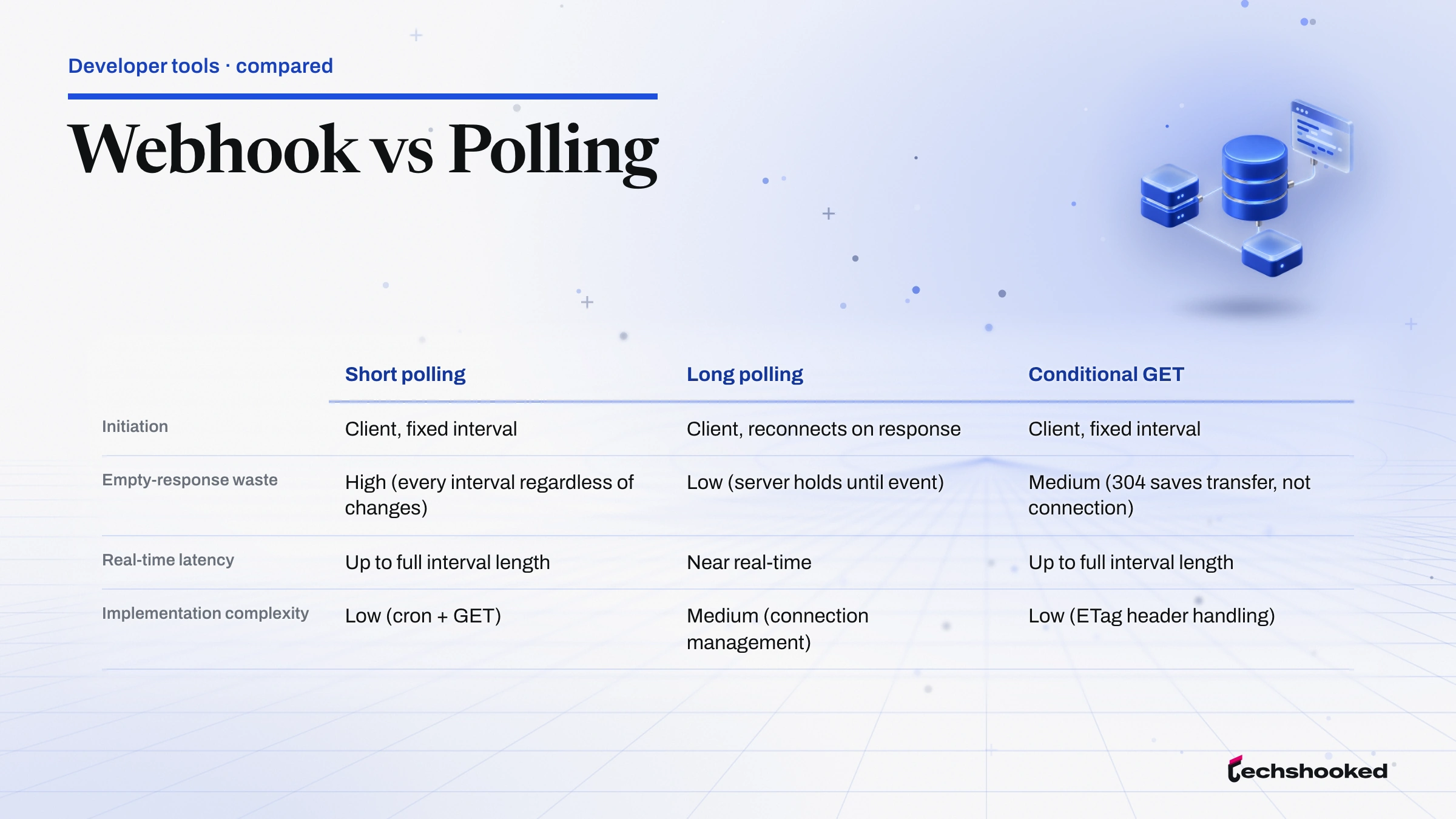
Webhook latency is event-bounded; polling latency is interval-bounded. Three polling variants exist, each with a different overhead profile under IETF RFC 9110 (HTTP Semantics).
Short polling fires a GET request at a fixed polling interval regardless of state. It is the simplest implementation and the most wasteful. At a one-minute interval against an endpoint that changes once per hour, 59 of 60 requests per hour return empty or unchanged responses.
Long polling holds the HTTP connection open on the server until new data is available or a timeout fires. It reduces empty response volume compared to short polling but holds server-side connections open for the duration of each held request. The WHATWG XMLHttpRequest specification documents the connection-hold semantics underlying long polling implementations in browser clients. Long polling is defined by implementation convention rather than a formal RFC; the XHR spec is the closest standards-body reference for the connection behavior. For real-time data delivery requirements where event latency must stay under two seconds and websockets are unavailable, long polling is the standard fallback.
Conditional GET attaches an ETag or Last-Modified header from a prior response. The server returns HTTP 304 Not Modified when the resource has not changed since that marker, eliminating body transfer cost. This is the most efficient polling variant for read-heavy, low-change-frequency resources and is explicitly governed by the conditional GET semantics in IETF RFC 9110 (HTTP Semantics). For query flexibility beyond GET semantics, GraphQL vs REST for Beginners covers GraphQL subscriptions as an alternative event-notification model.
Rate Limits and Polling Cadence
Polling cadence must be calculated against the provider's rate limit window, not chosen arbitrarily. GitHub's authenticated REST API allows 5,000 requests per hour. A naive one-second polling loop against a single endpoint burns the entire allowance in 83 minutes, with more than 99% of responses returning no new commits during quiet periods. Back-calculate the sustainable polling interval by dividing the rate limit window by the number of monitored resources: with 50 watched repositories and 5,000 requests per hour, the maximum sustainable interval per repository is 36 seconds. A webhook from GitHub fires one HTTP POST per push event and consumes zero API quota until an event occurs. The API integration pattern choice directly determines whether rate limits become a constraint or a non-issue.
| Variant | Initiation | Empty-response waste | Real-time latency | Implementation complexity |
|---|---|---|---|---|
| Short polling | Client, fixed interval | High (every interval regardless of changes) | Up to full interval length | Low (cron + GET) |
| Long polling | Client, reconnects on response | Low (server holds until event) | Near real-time | Medium (connection management) |
| Conditional GET | Client, fixed interval | Medium (304 saves transfer, not connection) | Up to full interval length | Low (ETag header handling) |
Comparing Webhook and Polling Across Key Dimensions
Webhook and polling diverge across eight operational dimensions. The comparison table below maps each dimension to the practical implication for a developer choosing an API integration pattern.
| Dimension | Webhook | Polling |
|---|---|---|
| Data latency | Sub-second (event-bounded) | Up to full polling interval |
| Server load on provider | Low (push on event only) | Scales with interval frequency and resource count |
| Implementation complexity | High (endpoint, TLS, signatures, idempotency) | Low (scheduler + GET loop) |
| Failure handling | Provider retries with exponential backoff; consumer must handle at-least-once delivery | Consumer controls retry logic entirely |
| Security surface | Requires payload signature verification; spoofing risk if skipped | Standard API authentication (key, OAuth) |
| API quota consumption | Zero until event fires | Constant drain against rate limit window |
| High-event-frequency suitability | Excellent (cost proportional to events) | Poor (quota exhausted before data arrives) |
| Low-event-frequency suitability | Good (idle cost is zero) | Acceptable (low volume, manageable quota burn) |
Webhooks deliver real-time data delivery with costs proportional to events, but they demand operational investment: the receiver must be publicly reachable, handle provider retries, verify payload signatures, and implement idempotency key storage. Polling's overhead scales with time and resource count regardless of event volume, but the operational surface stays narrow: a cron job or sleep loop with standard API authentication. Teams choosing an API integration pattern are choosing which of those two cost profiles fits their system better.
Choosing Between Webhook and Polling
Webhook or polling? The answer follows from five axes. Work through them in order; the first axis that yields a definitive answer ends the decision.
- Does the source system offer webhooks? If not, polling is the only option. Evaluate whether long polling or short polling better fits the acceptable latency and rate limit window for the integration.
- How frequently do events occur? High-frequency events (IoT telemetry streams, payment state changes, CI/CD pipeline events) strongly favor webhook-based event-driven integration because polling overhead compounds with frequency. Low-frequency events (weekly report generation, infrequent status updates) are viable candidates for polling if webhook setup is unavailable or disproportionately complex for the expected volume.
- Can the receiver maintain a public HTTPS endpoint? Internal tools, local development environments, and firewalled systems cannot receive webhooks without a tunnel. Tools such as ngrok, smee.io, and Cloudflare Tunnel expose local ports, but they introduce a dependency that should not persist in production. In constrained environments, polling is often the pragmatic choice during development and for internal consumers that cannot expose a stable public endpoint.
- What is the failure tolerance? If missing a single event notification is unacceptable (payment processed, order fulfilled, access granted), webhook delivery with idempotency key handling is the correct model. Providers guarantee at-least-once delivery and retry with exponential backoff. Polling with conditional GET is safer only when the source system maintains a full event history and the consumer can catch up on reconnect without gaps. AWS Lambda and similar serverless runtimes are a natural fit for webhook receiver endpoints because they are event-triggered and require no persistent process; see How To Deploy Applications On AWS: EC2 vs Lambda vs ECS for the deployment tradeoffs.
- What is the team's operational maturity? Webhook receivers require endpoint monitoring, structured logging, payload replay infrastructure, and exponential backoff handling for outbound acknowledgments. Polling requires only a scheduler and an HTTP client. Teams without established observability tooling or on-call runbooks should factor the operational surface into the build estimate. Python frameworks are the most common implementation base for webhook receivers; How To Build a REST API With Python: Flask vs Django vs FastAPI covers the framework selection decision for that endpoint.
Hybrid Patterns: Webhooks With Polling Fallback
High-reliability production integrations combine both models. Webhooks serve as the primary event-driven integration channel. A periodic reconciliation poll runs against the provider's event history endpoint to catch any deliveries missed during webhook downtime. Stripe explicitly recommends this pattern in its Stripe webhook best practices documentation: poll the /v1/events endpoint using a stored cursor (the last-seen event ID) as a fallback when the registered endpoint was unreachable. The cursor-based poll fetches only events created after the last successfully processed ID, keeping request volume low even during extended outages. This hybrid eliminates event-loss risk without making polling the primary data path. The payload serialization efficiency of this fallback channel is addressed in IETF RFC 8949, which covers binary payload encoding as a bandwidth optimization when JSON transfer costs become significant at scale. See also: full stack development.
Implementation Checklist and Common Pitfalls
Webhook receivers and polling loops each carry a distinct failure surface. The checklists below surface the gaps that cause the most production incidents.
Webhook implementation
- Serve the receiver endpoint over TLS only; reject plain HTTP connections at the load balancer
- Verify the HMAC-SHA256 payload signature on every inbound request before reading event data; never skip on the assumption that the source IP is trusted
- Return HTTP 200 before processing; long-running handlers cause timeouts that trigger provider retries
- Store the idempotency key from each event before acting; compare on retry to prevent double-execution
- Log the raw request body before parsing; parsed objects lose byte-level fidelity needed for replay and HMAC-SHA256 verification recompute
- Monitor event notification delivery failure rates in the provider dashboard; elevated failure rates indicate endpoint health issues before they appear in application metrics
- Use the provider's replay tool (Stripe Dashboard event resend, GitHub webhook redeliver) to test the full verification path in staging
Polling implementation See also: React vs Vue vs Angular.
- Calculate the polling interval from acceptable data latency and the rate limit window; never set it shorter than the ceiling the math allows
- Use conditional GET with ETag or Last-Modified headers to reduce transfer overhead on unchanged resources
- Store a cursor or timestamp of the last processed record; re-processing seen records on each poll is a common source of duplicate side effects
- Implement exponential backoff on transient HTTP 5xx responses; fixed-interval retry loops amplify load on an already stressed upstream
- Alert when consecutive empty responses exceed a threshold; sustained emptiness on a normally active endpoint may signal a broken upstream filter or a misconfigured query parameter, not genuine silence
Further reading: IETF RFC 9110 (HTTP Semantics) defines the conditional GET, idempotency, and status code semantics that underpin both patterns. For teams running high-throughput event pipelines, profile payload serialization formats against IETF RFC 8949 before committing to JSON at scale.