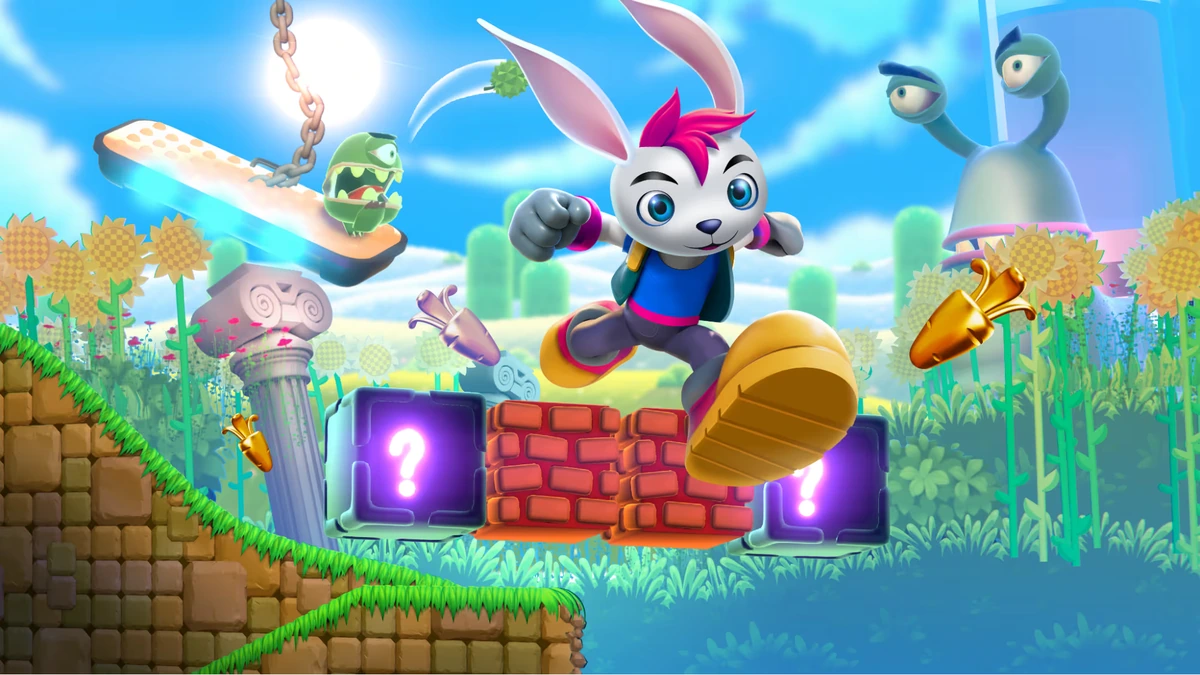
Unity released Bunny Blitz, a free sample built to show 2D developers how to fold 3D objects into a 2D game without giving up sprite-based rendering.
The workaround developers have leaned on for years is closer to a stage trick than a rendering feature: swap in a 3D model for one shot, then fake the same look by hand for the next, the kind of layered illusion behind Square Enix's "HD-2D" titles and countless billboard-sprite tricks in indie platformers. Keeping that blend consistent, so a 3D object still sorts, lights, and masks like a sprite, has usually meant bolting a custom shader stack onto the outside of an engine's own 2D pipeline rather than working inside it.
Per Unity, the trick behind Bunny Blitz is now built into the engine instead of bolted onto it. Starting with version 6.3, its Universal Render Pipeline can treat a 3D model as ordinary artwork once it carries a Mesh-2D-filter material or a Shader Graph shader built for the mode: the object slots into the same sorting layers as flat art, takes the same lighting, and can be clipped with a mask, all inside one render path instead of two.
For solo and small teams, the appeal is less code to maintain. Reaching for that kind of depth inside a 2D project has usually meant either faking it with hand-placed parallax layers or importing a full 3D pipeline that a 2D-focused team may not otherwise touch. Bunny Blitz reads more like an argument for the feature than a benchmark: it says nothing about performance cost on lower-end hardware, and Unity has not published numbers on how the new render path compares to a traditional 2D-only scene.
Bunny Blitz itself is a modest platformer, not a flashy demo built to impress on its own. Players steer a rabbit past hazards, shoot at enemies, gather collectibles, and face a boss fight against an oversized snail near the end. The level exists to give the render setup a real scene to run in: a custom out-of-focus blur pass, shadow-camera rendering, and MatCap materials all get exercised along the way.
The whole Bunny Blitz release, including its source files, is a free download mirrored on the Unity Asset Store, letting developers inspect the technique for themselves rather than take a blog post's word for how it behaves. Written and video walkthroughs covering the 3D-as-2D approach in more depth are still in progress, according to Unity; until then, the sample's own source is the only documentation available.