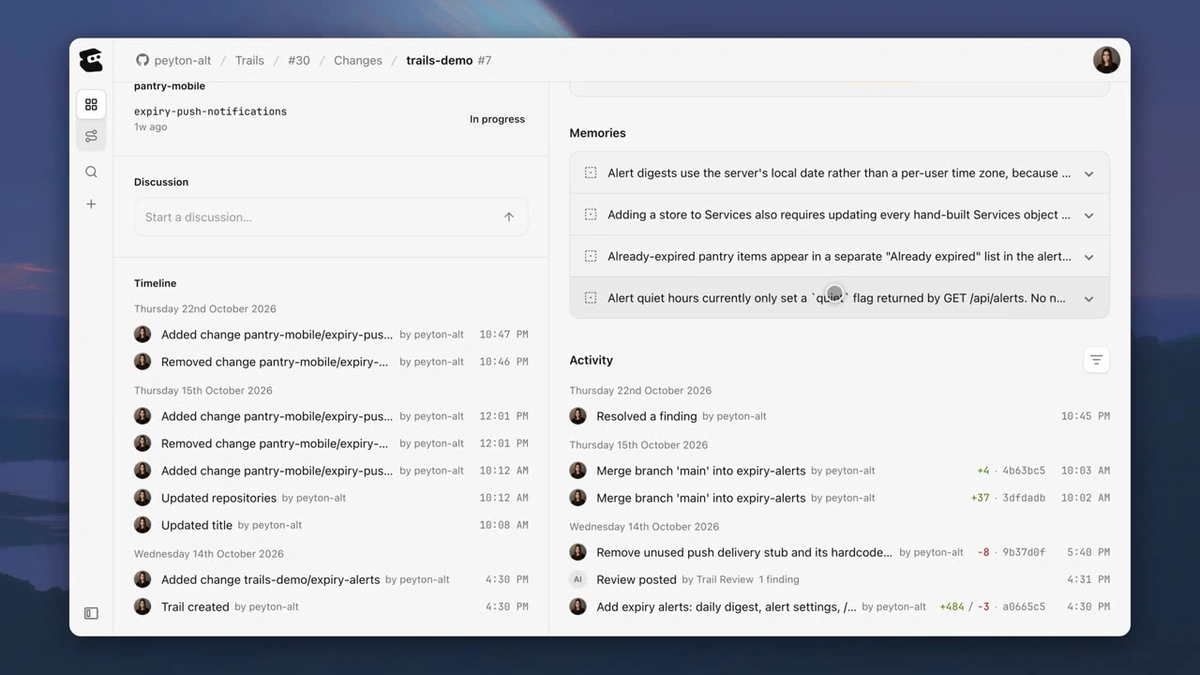
Entire opened a Git forge to every developer on October 26, replacing the pull request with a review object it calls a Trail. Thomas Dohmke, GitHub's former chief executive, now runs Entire, which calls the product a GitHub alternative built for agents and humans to work together.
In a Trail, agents score every push against evals that a team customizes. The findings appear in Entire's web interface and in its open-source CLI, so a coding agent can work through them in a loop while a person checks progress. Once every eval passes, Entire says, a team can merge without needing to look at the code itself. Dohmke's reasoning is that agents now write almost all code, so the original idea and the agent trace belong in review beside the change.
The Git server underneath stays compatible with Git and takes pushes up to 89 times faster than GitHub and 6 times faster than Cursor Origin, per Entire. Entire attributes both multiples to its open-source ForgeMark benchmark, which measures push throughput under many concurrent writers, and its results put the forge at 418 pushes per second against 4.7 for GitHub. The figures apply to repositories hosted on Entire, since pushes to a mirrored repository route back through GitHub. Private repositories can be hosted in the US, EU, India or Australia, with more regions planned.
A feature called Continuous Memory syncs agent sessions into the repository. In Entire's testing, a codebase graph cut agents' token use by up to 71 percent, and an agentic brain turns earlier sessions and prompts into memories that agents can query so they stop repeating mistakes.
Builds run through partner CI; with Buildkite, a push builds on Buildkite's infrastructure or the team's own. A team leaving GitHub Actions can convert workflows with Buildkite's bk pipeline convert or with Depot CI, which runs existing GitHub Actions workflows, then subscribe the repository in Entire. Builds start on every push and results land in the Trail. Buildkite chief executive Kevin Gounden said Entire already runs its own CI on Buildkite.
Mirrored GitHub repositories keep a split workflow. Per Entire, merging and CI for those repos go through a linked GitHub pull request, approvals in Entire and GitHub count separately, and GitHub branch rules can still block a merge after Entire's gates pass. The basic migration workflow Entire documents copies branches and tags only, and Git LFS payloads and submodules need separate handling.
Entire raised $60 million in February at a $300 million valuation, in a round led by Felicis. It has grown from 15 employees at the time to 50. Self-hosted Git nodes, live-streamed sessions and public repositories are still on its roadmap, and Entire says it will expand to open-source maintainers and the largest enterprises in the near future.