Go is a compiled programming language that delivers predictable latency, built-in concurrency primitives, and a minimal operational footprint for backend HTTP services and microservice APIs. Rust enforces memory safety at compile time through its borrow checker, producing binaries with no garbage collection overhead. Python accelerates iteration with a vast ecosystem and the largest global developer pool, but its concurrency model carries a ceiling that matters at scale. The choice between them is not a matter of taste; it is an architectural decision that affects p99 tail latency, hiring timelines, and long-term codebase risk.
How Go, Rust, and Python Approach Backend Concurrency
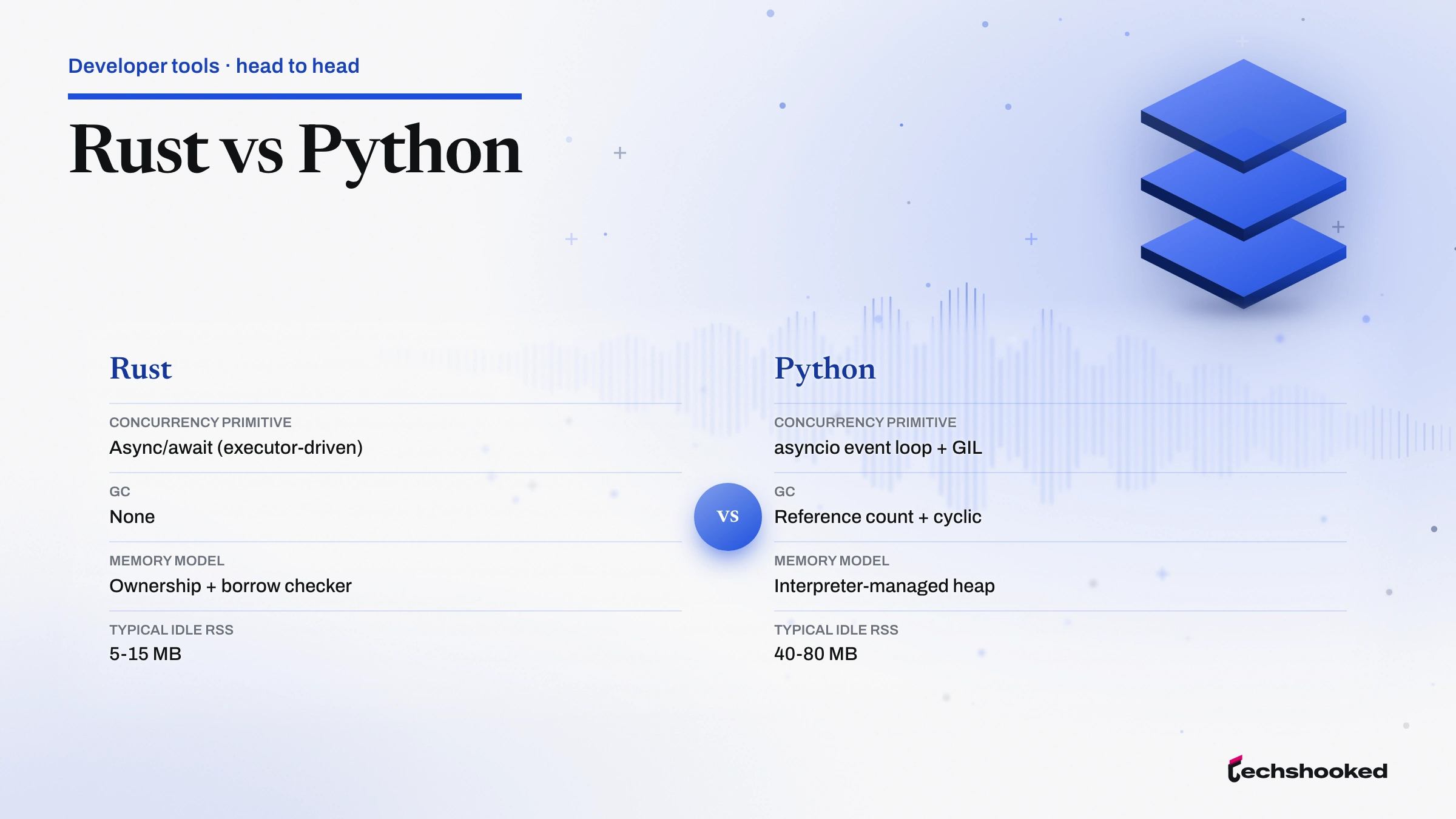
Go multiplexes goroutines (lightweight user-space threads) across available OS threads using an M:N scheduler built into the runtime, making its concurrency model fundamentally different from both Rust and Python. Each goroutine starts with a 2-8 KB stack that grows on demand, so a backend API service can sustain tens of thousands of concurrent in-flight requests without the per-thread memory cost of OS thread pools. Rust uses an ownership-based async runtime (Tokio and async-std are the two dominant executors) with zero-cost abstractions: no garbage collection (GC), no runtime scheduler overhead beyond the executor itself. Python's CPython interpreter enforces the global interpreter lock (GIL), which restricts true parallelism to one OS thread at a time; asyncio and multiprocessing are the standard workarounds, but neither eliminates the GIL for CPU-bound work. For teams building microservices where concurrency model affects service-to-service communication patterns, the choice sets a hard ceiling on what the runtime can deliver. See how these concurrency characteristics play out at the transport layer in microservices communication with gRPC, REST, and message queues.
| Language | Concurrency Primitive | GC | Memory Model | Typical Idle RSS |
|---|---|---|---|---|
| Go | Goroutine (M:N scheduler) | Tricolor mark-sweep GC | Shared heap, race detector | 15-30 MB |
| Rust | Async/await (executor-driven) | None | Ownership + borrow checker | 5-15 MB |
| Python | asyncio event loop + GIL | Reference count + cyclic | Interpreter-managed heap | 40-80 MB |
Throughput and Latency: Benchmark Context
Go frameworks such as Gin and Fiber consistently appear at the high end of throughput benchmarks for JSON serialization and database query workloads, a pattern documented across multiple iterations of the TechEmpower Framework Benchmarks, which measure plaintext, JSON, and multi-row database query tiers under standardized load. On plaintext endpoints, Go reaches roughly 300,000-500,000 requests per second (request-per-second (RPS)); Actix-web in Rust reaches 400,000-700,000 request-per-second; Python with uvicorn and FastAPI reaches 50,000-100,000 RPS due to GIL contention and GC pauses on the reference-count collector. Rust's outlier RPS advantage traces to the absence of GC: latency spikes in Rust services come from allocator behavior and async-executor scheduling, not from stop-the-world collection. Research on language performance in server workloads confirms that raw throughput benchmark numbers are poor predictors of production p99 latency once real workloads introduce database I/O and serialization overhead (ACM SIGPLAN, language performance study). The five variables that most distort throughput benchmark extrapolation to production are:
- Database driver async maturity. Drivers without a native async runtime interface block the event loop in Rust and Python, collapsing the RPS advantage measured on in-memory endpoints.
- GC pause impact on p99 tail latency. Go's garbage collection pauses average 0.1-1ms at high heap occupancy; Rust has no GC; Python's reference-count GC adds overhead at high object-allocation rates.
- Connection pool sizing. Undersized pools create queue starvation that appears in the throughput benchmark as reduced RPS but in production as latency spikes at load.
- Serialization format. JSON serialization overhead is measurable at 100k+ RPS; switching to Protobuf (used natively in gRPC) reduces CPU per request for all three languages.
- Cold-start latency for serverless deployments. Go binaries on AWS Lambda start in 50-200ms; Python with typical package sets starts in 400-1000ms; Rust produces the smallest binary but requires cross-compilation tooling for Lambda targets.
Framework Ecosystem for Backend API Services
Go's framework ecosystem offers a range of options for backend API service construction, each targeting a different point on the throughput-ergonomics tradeoff, with ecosystem maturity that reflects Go's position as a production-grade backend language across cloud-native infrastructure at Google and AWS (Google Cloud: microservices with Go). All Go frameworks compile to single binary deployment with no runtime dependencies, which reduces container image size and eliminates interpreter installation from the deployment path. Rust frameworks require longer compile cycles but produce the smallest production binaries with no GC overhead, a tradeoff examined in depth in the C++ vs Rust performance and safety comparison. Python frameworks require runtime and dependency installation at container build time; images are larger and startup overhead is higher than Go or Rust equivalents.
The static type system each language enforces (or makes optional) shapes framework guarantees at compile time. Go and Rust enforce static type systems at the language level; Python's static type system via mypy and Pyright is opt-in and applies inconsistently across large codebases. Assessing ecosystem maturity across all three requires separating framework age from production adoption breadth.
- Go
- Gin (high-throughput minimal router, largest ecosystem, de-facto production standard), Fiber (Express-style routing, ultrafast), Echo (middleware-focused, strong plugin model), Chi (idiomatic Go, close to stdlib). All compile to a single binary with zero runtime dependencies. Strong integration coverage for gRPC, OpenTelemetry, and Kubernetes clients.
- Rust
- Actix-web (highest RPS in benchmarks, actor-model heritage, mature production record), Axum (Tokio-native, ergonomic type-safe routing, fastest-growing adoption), Rocket (annotation-based, lower barrier for teams new to Rust). Build times are the primary workflow friction; incremental compilation and cargo-watch reduce the iteration penalty. For Python REST framework internals, see Flask vs Django vs FastAPI for Python REST APIs.
- Python
- FastAPI (asyncio-native, automatic OpenAPI docs, pydantic v2 validation), Django REST Framework (full ORM plus authentication batteries included), Flask (minimal, highly composable). Container images are larger; cold-start latency is highest of the three. Python frameworks compensate with the fastest onboarding and the widest third-party integration catalog.
Memory Safety and Operational Risk
Go's garbage collection eliminates the two most common memory safety vulnerabilities in unmanaged languages: use-after-free and buffer overflow at the application layer. The GC pause is the operational risk teams must plan for: at high heap occupancy, Go's tricolor mark-sweep collector can pause for 0.1-1ms, tunable via the GOGC environment variable. AWS adopted Rust for Firecracker VMM and Lambda runtime components precisely because the borrow checker enforces memory safety at compile time, eliminating GC pauses and reducing per-function runtime overhead (AWS Open Source Blog: sustainability with Rust). Python manages reference counts and a cyclic collector at the interpreter layer; memory safety issues in Python services trace to C-extension vulnerabilities in packages such as NumPy and Pillow rather than to Python application code directly. The five memory safety properties mapped across all three languages:
- Use-after-free protection. Go: pass (GC retains live objects). Rust: pass (ownership rules prevent dangling pointers at compile time). Python: pass (interpreter-managed heap).
- Data race prevention. Go: partial (race detector available at test time via
go -race; not enforced at compile time). Rust: pass (ownership model prohibits shared mutable state without synchronization primitives). Python: partial (GIL prevents thread-level data races in CPython; multiprocessing introduces IPC complexity). - Buffer overflow prevention. Go: pass (slice bounds checked at runtime). Rust: pass (bounds checked;
unsafeblocks are the only gap). Python: partial (Python layer is safe; C-extension layer is not). - GC pause risk. Go: present (0.1-1ms stop-the-world at high heap occupancy). Rust: none (no GC; allocator determinism). Python: low at application layer; reference-count GC adds per-object overhead at scale.
- Unsafe-code surface. Go: small (
unsafepackage exists but is rarely needed in backend API code). Rust: bounded (unsafeblocks are syntactically explicit and auditable). Python: wide (any C extension can execute arbitrary memory operations without Python's knowledge).
Team Adoption, Hiring, and Long-Term Maintenance
Go's intentional minimalism makes it the fastest of the three languages for an experienced backend developer to reach productivity: 25 keywords, explicit error handling, and a static type system that catches type errors at compile time without requiring annotations beyond function signatures. Research on language-level bug rates and maintainability across large codebases found that statically typed languages produce measurably fewer defect-inducing commits than dynamically typed equivalents at comparable project scale (IEEE Software: Ray et al., programming languages and code quality). For engineering teams choosing a backend API service language under hiring and onboarding constraints, see the Full-Stack Development Learning Path for a developer progression framework.
| Language | Learning Curve | Hiring Depth | Error Handling Model | Refactoring Safety |
|---|---|---|---|---|
| Go | 2-4 weeks from Java/Python | Large, growing fast | Explicit return values | High (compiler-enforced) |
| Rust | 2-4 months for borrow checker | Smaller, premium compensation | Result and Option types | Very high (ownership model) |
| Python | Days to productive | Largest global pool | Exceptions | Medium (opt-in type hints) |
Decision Matrix: Choosing the Right Backend Language
Go's single binary deployment and fast cold-start latency make it the default starting point for teams building containerized backend API services on Cloud Run, Lambda, or GKE, but the correct language choice depends on five decision axes that the team must evaluate in order of constraint severity. For gRPC service communication patterns and deployment topology that interact with this decision, see microservices communication with gRPC, REST, and message queues.
- Throughput SLA and p99 tail latency. Sub-5ms p99 at high RPS favors Rust or Go over Python. At under 10,000 RPS, Python's ergonomics and ecosystem depth outweigh the throughput gap. The inflection point where Go becomes the practical minimum is roughly 30,000-50,000 RPS with p99 requirements under 20ms.
- Team size and hiring timeline. Teams of five or fewer with a short runway favor Python's onboarding speed. Teams planning to scale beyond 20 backend engineers should evaluate Go's simplicity-driven codebase consistency against Rust's compile-time safety guarantees for long-term refactoring safety.
- Serverless and containerized deployment. Go's single binary deployment and low startup overhead make it the lowest-friction choice for Lambda and Cloud Run. Rust produces smaller binaries but adds build-time complexity. Python benefits most from provisioned concurrency or pre-warmed container pools to offset its higher startup cost.
- Memory-constrained environments. Rust and Go carry lower RSS baselines than CPython at equivalent request volume. Rust is the right choice when memory footprint is a hard constraint, such as edge API gateways or embedded service sidecars with fixed memory ceilings.
- AI and ML integration path. Python remains the only practical choice when the backend must embed model inference directly in the service process via PyTorch, NumPy, or Hugging Face libraries. If the inference workload runs in a sidecar or a dedicated gRPC inference server, the primary backend API service layer is free to use Go or Rust. For AI development language selection in ML-heavy stacks, see best programming languages for AI development.
Further reading
Frequently Asked Questions
Does Go's garbage collector cause latency spikes in high-RPS backend services?
Go's garbage collector can introduce stop-the-world pauses of 0.1-1ms at high heap occupancy, but these are tunable and rarely visible at p95 for most backend API workloads. The primary lever is the GOGC environment variable, which controls when GC triggers relative to live heap size; setting GOGC=200 roughly halves GC frequency at the cost of higher peak memory. For p99 tail latency requirements below 1ms, Rust (which has no GC) is a more reliable choice because latency outliers trace to allocator behavior rather than GC scheduling, and allocator overhead is deterministic.
Can Python's asyncio replace Go goroutines for concurrent backend services?
Python's asyncio achieves non-blocking I/O concurrency but does not bypass the global interpreter lock (GIL), which means CPU-bound work still runs on a single thread and async/await coroutines cannot exploit multiple cores without multiprocessing. Go goroutines are multiplexed across all available OS threads by the runtime scheduler, so Go scales CPU-bound request handling linearly with core count without any configuration. For I/O-bound services such as database reads and external API calls, FastAPI with asyncio is competitive; for services with any CPU-bound path including request parsing and serialization at high volume, the GIL makes Python a ceiling rather than a starting point.
Is Rust's compile time a practical barrier for backend API development teams?
Rust's compile times are a real operational friction point during iterative backend development: a medium-sized Actix-web service with 30 dependencies can take 2-4 minutes for a clean build versus 10-15 seconds for an equivalent Go service. Incremental compilation via cargo check and warm build caches in CI substantially reduce the gap. Rust's ownership model learning curve is the more durable adoption friction; compile time is manageable with cargo-watch for on-save recompilation and Docker layer caching for CI pipelines. Teams that have internalized Rust's compile-time safety guarantees consistently report that the initial investment pays back in reduced production incidents.