Swift is a compiled programming language that Apple designed for iOS and macOS development, combining Automatic Reference Counting memory management with a strict type system to deliver native app performance without manual memory allocation. Kotlin is JetBrains' statically typed language and Google's preferred choice for Android. Choosing between them is not a preference exercise. It is a runtime architecture decision with measurable consequences for battery drain, frame consistency, and build latency. This comparison covers the three axes that matter most on constrained mobile hardware: memory management, concurrency, and the compilation pipeline.
What Swift and Kotlin Are Built For
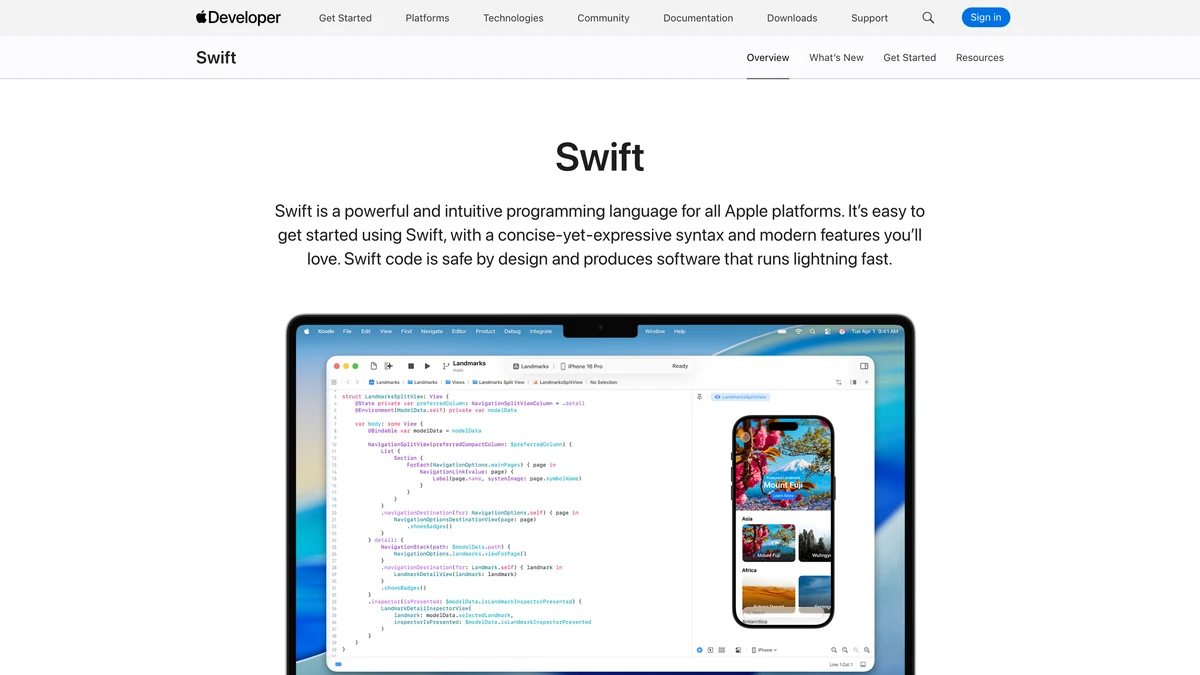
Swift compiles through the LLVM backend directly to ARM machine code targeting Apple Silicon and x86 simulators, so its binary runs with no intervening runtime layer on the device. Kotlin compiles to JVM bytecode and executes on Android Runtime (ART), the managed runtime that replaced Dalvik in Android 5.0 (Lollipop). ART performs ahead-of-time compilation of that bytecode during app installation, so production Android apps also run native code, but the path there involves an extra translation step that shapes how memory and concurrency behave. That architectural difference is why comparing native app performance across the two languages requires examining the runtime model, not just benchmark wall-clock times.
The comparison in this article focuses on three axes:
- Memory management model: Automatic Reference Counting (Swift) versus garbage-collected heap (Kotlin on ART)
- Concurrency runtime: cooperative async/await pool (Swift) versus coroutine dispatcher model (Kotlin)
- Compilation pipeline: Xcode and LLVM versus kotlinc, D8, and R8
For teams building services that span multiple platforms, understanding how each language handles inter-process communication is also relevant. The microservices communication guide covering gRPC, REST, and message queues provides useful framing for the network layer that sits below both mobile runtimes.
Memory Management: ARC vs Garbage Collection
Swift manages heap objects through Automatic Reference Counting, inserting retain and release instructions at compile time rather than at runtime. Every object reference increment and decrement is a CPU instruction. In object-heavy workloads with high allocation churn, those instructions accumulate into real battery drain. Research published in IEEE Software by Pereira et al. (2017) on energy efficiency across programming languages Related platform guidance lives in the NIST Mobile Threat Cataloge. provides empirical grounding: managed runtimes and native-compiled languages differ measurably in energy consumption per operation, with object lifecycle costs a primary driver.
The developer-visible hazard is the ARC retain cycle. When two objects hold strong references to each other, their reference counts never reach zero and neither object is deallocated. Swift requires the developer to break cycles explicitly using weak or unowned qualifiers. Miss one cycle in a view controller graph and the leak compounds across navigation stacks. Instruments' memory graph debugger surfaces these, but prevention requires deliberate ownership discipline at design time.
Kotlin on Android uses ART's garbage collector rather than reference counting. ART ships a concurrent compacting GC (CCGC) on Android 8.0 and later, with a G1-style collector targeting a garbage collection pause window of approximately 5 ms per cycle according to Android Runtime documentation from Google's Android Open Source Project. That pause is short, but it lands unpredictably within a frame. At 60 fps the UI frame budget is 16 ms. At 120 Hz it is 8 ms. A 5 ms garbage collection pause consumes a third to a half of the frame budget, which can surface as a dropped frame in latency-sensitive UI work.
ART's escape analysis optimizer can stack-allocate short-lived objects that do not escape a method scope, bypassing the heap and reducing GC pressure. This partially mitigates pause frequency for well-scoped allocations, but it requires the JIT or AOT compiler to prove non-escape, which is not guaranteed at all optimization levels.
| Attribute | Swift (ARC) | Kotlin (ART GC) |
|---|---|---|
| Memory model | Automatic Reference Counting; compile-time retain/release | Managed heap; concurrent garbage collector |
| Pause characteristics | No stop-the-world pause; retain/release are inline instructions | GC pause windows; CCGC targets ~5 ms on ART |
| Developer burden | Must break ARC retain cycles with weak/unowned references | Cycle-safe by default; GC handles circular graphs |
| Battery impact | Per-reference CPU cost; high churn elevates drain | GC work batched; escape analysis reduces frequency |
| Memory pressure risk | Leak risk from missed retain cycles; deterministic dealloc otherwise | GC frequency rises under memory pressure on constrained heaps |
Concurrency Performance: Swift Concurrency vs Kotlin Coroutines
Swift Concurrency, introduced in Swift 5.5, models asynchronous work through async/await and actors. The runtime maintains a cooperative thread pool sized to the device's active CPU core count rather than spawning threads on demand. On an Apple A-series SoC with four performance cores and four efficiency cores, sustained parallelism stays bounded. Thermal throttle on mobile SoCs kicks in when sustained core utilization drives junction temperature above the thermal design point; Swift's bounded pool avoids the oversubscription that accelerates throttle onset.
Kotlin Coroutines dispatch work through CoroutineScope and named dispatchers: Dispatchers.Main for UI work, Dispatchers.Default for CPU-bound tasks, and Dispatchers.IO for blocking I/O with a thread pool capped at 64 by default. The Dispatchers.IO pool can exhaust threads under heavy load, spilling work to platform threads. That matters for thermal throttle because a Snapdragon SoC under heavy thread pressure activates thermal management that scales down clock speed, degrading throughput for all concurrent work.
Swift actors enforce mutual exclusion at compile time through actor isolation. Passing mutable state across actor boundaries requires explicit await at each hop, which the compiler enforces. Kotlin requires the developer to select the correct dispatcher for each coroutine; nothing prevents UI-state mutation from a Dispatchers.Default context except discipline and code review. Both models support structured concurrency and cancellation propagation, though the enforcement point differs.
Four concurrency decision criteria for mobile practitioners:
- UI responsiveness: Swift Concurrency's
@MainActorannotation pins work to the main actor with compile-time verification. Kotlin requireswithContext(Dispatchers.Main)at each touch point, verified only at runtime. - Background work isolation: Kotlin's coroutine dispatcher model offers finer-grained isolation between CPU-bound and I/O work. Swift's cooperative pool handles both via priority queues without explicit dispatcher selection.
- Cancellation propagation: Both models propagate cancellation through structured scopes. Swift uses
TaskGroupcancellation; Kotlin usesCoroutineScopelifecycle cancellation. The mechanisms are equivalent in capability. - Structured lifecycle: Swift Concurrency ties task lifetime to the enclosing scope automatically. Kotlin Coroutines require the developer to scope coroutines to a
viewModelScopeorlifecycleScopeto avoid leaks.
Compilation Pipeline and Build Speed
Swift's compilation pipeline runs through Xcode's build system and into the LLVM backend. Release builds apply whole-module optimization (WMO), which gives the optimizer visibility across the entire module for dead-code elimination and inlining. The tradeoff is compilation latency: WMO requires all source files to be parsed and type-checked before optimization begins. Large Swift codebases historically suffer from slow incremental builds because the type checker is sensitive to type inference complexity. Swift's value type semantics (structs and enums are value types by default) reduce pointer aliasing, enabling aggressive compiler optimizations, but they also increase copy overhead in generic code paths. That value type semantics advantage directly informs how the LLVM backend eliminates aliasing hazards during optimization passes.
Kotlin's build pipeline runs kotlinc to JVM bytecode, then D8 (the dexer that converts bytecode to DEX format for ART) and R8 (the shrinker and optimizer that replaces ProGuard). R8 applies dead-code elimination, inlining, and obfuscation in a single pass. Kotlin's null safety type system catches null dereference errors at compile time, with the compiler requiring explicit nullable types (String? versus String). Kotlin Multiplatform extends this pipeline to additional targets: JVM, JavaScript, and native binaries via Kotlin/Native, from a shared source set. For teams building for both iOS and Android, that shared pipeline is a significant architectural lever. The CI/CD pipeline and programming languages guide covers the build-tooling layer in detail for teams integrating either compiler chain into automated pipelines.
Pipeline stage mapping:
- Parse: Swift frontend (swiftc) / kotlinc frontend
- Type-check: Swift type checker with bidirectional inference / Kotlin type checker with null safety enforcement
- IR generation: Swift Intermediate Language (SIL) / Kotlin IR
- Optimization: LLVM backend passes (release + WMO) / R8 optimizer (DEX shrink, inline, rename)
- Code emission: ARM / x86 machine code via LLVM / DEX bytecode via D8, then ART AOT to native
Runtime Benchmarks: What the Numbers Actually Show
Swift's native app performance advantage is most visible in compute-bound workloads. Apple's Swift benchmark suite at swift.org documents object-heavy and numeric workloads where ARC overhead is visible but contained. In JSON parsing, image processing, and cryptographic operations, Swift's direct ARM output through its LLVM-based compiler typically posts faster wall-clock times than Kotlin running on Android Runtime. The ARC overhead per object in tight loops is a real cost, but it is deterministic and bounded.
In I/O-bound and network-heavy workloads, the gap narrows. Kotlin Coroutines' structured concurrency allows Kotlin apps to handle high concurrency with low thread overhead, matching the throughput of Swift's async model in scenarios dominated by waiting rather than computation. Peer-reviewed work on GC pause behavior in mobile runtimes, indexed in the ACM Digital Library under proceedings of MobiSys and PLDI, shows that ART's CCGC pause impact is most pronounced in frame-critical UI work rather than background compute.
Production metrics tell a different story than synthetic benchmarks. Startup time, UI frame consistency, Application Not Responding (ANR) rate on Android, and Hang rate on iOS are the metrics that affect user retention. Both languages, when used correctly, can meet 60 fps frame budgets. The question is where developer discipline is required: avoiding ARC retain cycles in Swift, or selecting the right dispatcher and managing memory pressure carefully in Kotlin.
Ecosystem, Tooling, and Long-Term Trajectory
Swift's ecosystem trajectory is shaped by the Swift Evolution process, a community-driven proposal system that has shipped macros and parameter packs in Swift 5.9. Apple's investment extends beyond iOS: Swift on Server (Vapor, Hummingbird) and Swift AWS Lambda integrations signal that the language is designed to outlive any single platform cycle. For developers interested in systems-language native compilation as context for LLVM parity, the C++ vs Rust performance and safety comparison covers that toolchain from the systems angle. Swift also targets embedded microcontrollers as of Swift 5.10, widening the addressable context beyond the Apple developer program's approximately 4 million registered members.
Kotlin Multiplatform became stable with Kotlin 1.9.20 in November 2023. KMP allows shared business logic to compile to JVM, JS, and native targets from one codebase, with platform-specific UI written in SwiftUI on iOS and Jetpack Compose on Android. Google declared Kotlin the preferred language for Android documentation in 2019. Compose Multiplatform extends the UI sharing story. For teams evaluating mobile-native options alongside broader programming language choices, the Best Programming Languages for AI Development guide is relevant as on-device ML inference (CoreML on iOS, TFLite on Android) increasingly drives mobile feature differentiation.
| Attribute | Swift | Kotlin |
|---|---|---|
| Official backing | Apple; open-source via Swift.org | JetBrains; Google Kotlin-first Android docs |
| Cross-platform story | Apple platforms + server + embedded Swift | Kotlin Multiplatform (iOS, Android, JVM, JS, native) |
| Server-side viability | Growing (Vapor, Swift AWS Lambda) | Mature (Spring Boot on JVM; Ktor native) |
| Hiring market | ~4M Apple developer program members; iOS-focused | Broad JVM ecosystem cross-training; larger pool |
| Stability signal | Swift Evolution proposals; ABI stable since Swift 5.0 | Kotlin Language Committee; strong backward compat |
| null safety | Optional types enforced by compiler | Nullable/non-nullable enforced at compile time |
Choosing Between Swift and Kotlin for Your Mobile Project
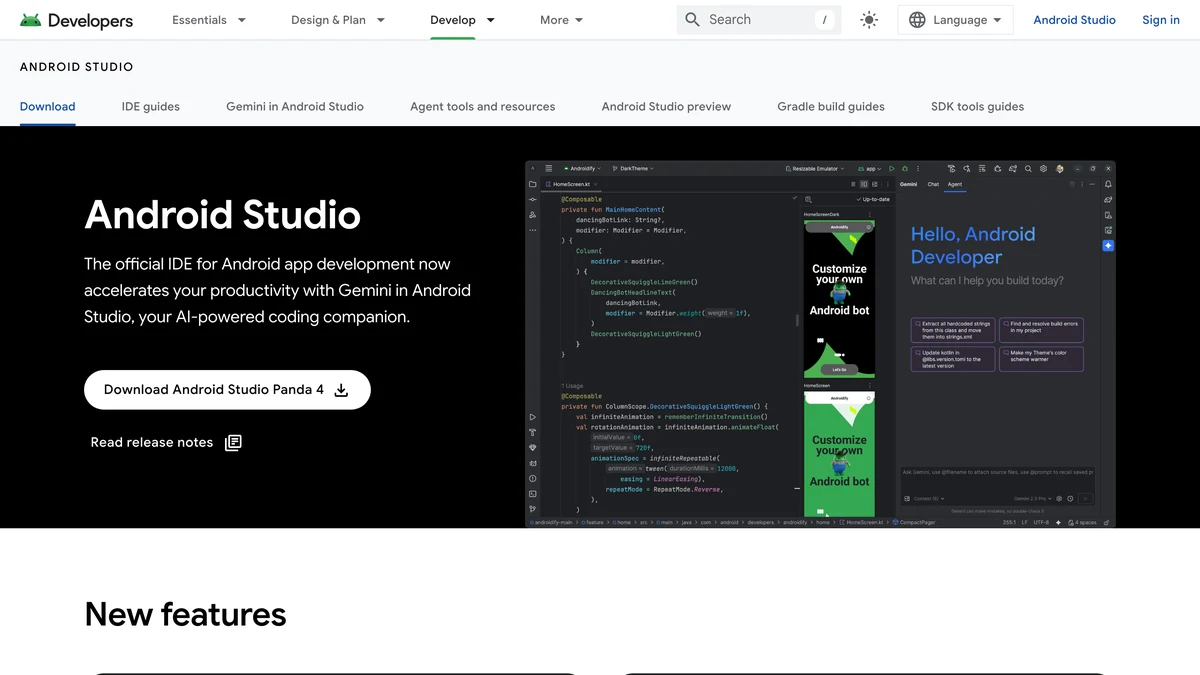
Swift is the answer for any project that lives exclusively on Apple platforms, particularly where native app performance, tight heap budgets, or real-time workloads are constraints. Kotlin is the answer for Android-only work and a strong candidate for cross-platform business logic through Kotlin Multiplatform. The decision criteria below address the scenarios where the choice is genuinely ambiguous.
- iOS-only app, performance-critical (games, camera, AR): Swift. Automatic Reference Counting fits the constrained heap without GC pause risk, and the LLVM toolchain's codegen advantage is largest in compute-bound loops. Swift Concurrency's bounded thread pool also limits thermal throttle risk during sustained GPU and CPU overlap.
- Android-only app: Kotlin. No meaningful debate. Kotlin is the platform language, Kotlin Coroutines are the standard async model, and Jetpack Compose is Kotlin-native.
- Shared business logic, native UI on both platforms: Kotlin Multiplatform with a SwiftUI layer on iOS. Business logic compiles to native code for both platforms; each platform retains its idiomatic UI layer. The async/await model on iOS and Kotlin Coroutines on Android handle async boundaries within each platform layer.
- Cross-platform team, JVM expertise, targeting both platforms: Kotlin Multiplatform with Compose Multiplatform. The shared UI layer reduces platform-specific code surface area, though iOS rendering fidelity still trails SwiftUI for complex animations.
- Apple ecosystem products (watchOS, tvOS, visionOS): Swift exclusively. No KMP path exists for watchOS or visionOS.
- On-device ML inference: Swift for CoreML integration (Apple Neural Engine access, on-device privacy model); Kotlin for TFLite on Android. The runtime for each framework aligns with its platform language.
- Greenfield project, no platform bias: Evaluate team background first. A team with strong JVM experience will be faster in Kotlin even targeting iOS through KMP. A team from the Apple ecosystem will produce more reliable code in Swift. Language runtime differences matter less than team fluency in production. For developers mapping the full stack, the full-stack development learning path contextualizes mobile-native choices within a broader skill progression.
The performance gap between Swift and Kotlin in production is narrower than benchmark suites suggest. The more durable distinction is operational: Swift's Automatic Reference Counting gives deterministic deallocation with developer-managed cycle discipline; Kotlin's garbage collection pause behavior demands attention to frame budgets and memory pressure on constrained Android hardware. Pick the runtime model your team can reason about correctly at scale, then optimize from there. The Coroutines documentation at kotlinlang.org and Swift language documentation at swift.org are the canonical references for each model's concurrency guarantees.
Additional refs: IETF RFC 7159 JSON; NIST SP 800-163 Mobile App Vetting.