A blockchain programming language is a formal specification system that defines the syntax, memory model, and execution semantics used to write smart contracts, chain clients, and decentralized applications on distributed ledger networks. Unlike general-purpose languages, every blockchain development language must satisfy constraints absent in conventional software: determinism across independent nodes, a constrained execution environment with metered compute, and an immutability model that makes deployed code permanent. The choice of language is driven by the target runtime, not by team preference. For developers already familiar with how service layers communicate, the tradeoffs here parallel those covered in Microservices Communication: gRPC vs REST vs Message Queues, where the transport contract shapes every downstream design decision.
What Makes a Language Suitable for Blockchain
A blockchain programming language must satisfy three selection axes that have no equivalent in conventional software development. First, the target execution environment: on-chain code runs inside a virtual machine (EVM, SVM, or Wasm interpreter) and is bounded by that machine's compute meter. Off-chain code runs in chain clients, indexers, and application servers without those constraints. Second, determinism: every instruction executed on-chain must produce the same result across all validator nodes. Floating-point arithmetic, system clock reads, random number generators, and non-deterministic syscalls are all prohibited inside the virtual machine boundary. Third, the memory safety model: a bug in a deployed contract cannot be patched. Unlike a web server where a memory-corruption vulnerability triggers a crash that engineers can hot-fix within hours, a flawed on-chain program is immutable. Exploits run until an admin pause key (if one exists) is triggered or until the funds are drained.
These three axes collapse into a single architectural question: does the code run inside the virtual machine, or outside it? EVM bytecode, BPF bytecode, and WebAssembly are the three dominant compilation targets for on-chain code. Native binaries serve the off-chain consensus layer and client tooling. Understanding which target a language compiles to determines every subsequent design decision.
Solidity: The Dominant On-Chain Language for EVM Networks
Solidity is the primary blockchain programming language for every EVM-compatible network: Ethereum, Polygon, Avalanche C-Chain, BNB Chain, Arbitrum, and Optimism all share the same Ethereum Virtual Machine specification. Code written in Solidity compiles to EVM bytecode via solc, the Solidity compiler, and that bytecode is what validators actually execute. The version pragma at the top of every Solidity file (pragma solidity ^0.8.20;) is not decorative; the Solidity compiler changes behavior between minor versions, and auditors pin to exact releases to reproduce findings.
Solidity uses static typing with a storage/memory/calldata distinction that is simultaneously a gas optimization tool and a security surface. Data stored in contract storage costs orders of magnitude more gas than temporary memory. Developers who misplace reference types between these locations produce contracts that are both expensive and vulnerable. The Solidity documentation details the full type system and storage layout model.
The most consequential property of Solidity's external call model is the reentrancy vulnerability. When a contract sends Ether to an external address, that address can call back into the sender before the sender updates its own state. The DAO exploit of 2016, which drained US$50 million worth of Ether, is the canonical case. The Checks-Effects-Interactions pattern and OpenZeppelin's ReentrancyGuard are the standard mitigations. Solidity's type safety model enforces value-type constraints at compile time but cannot prevent logical reentrancy paths. On-chain security on EVM chains is, in large part, the practice of managing this gap. For readers evaluating memory-safety tradeoffs across backend languages more broadly, see Choosing Go vs Rust vs Python for Backend.
Five properties that shape every Solidity project:
- EVM bytecode target: all on-chain execution is compiled to opcodes with fixed gas costs; storage slot packing and loop bounds are first-class design concerns.
- Version-pinned compiler: the Solidity compiler version is part of the security surface; auditors re-run
solcat the exact pragma version. - Storage/memory/calldata distinction: reference types must be explicitly placed; misplacement introduces both cost bugs and vulnerability vectors.
- Reentrancy vulnerability model: external calls transfer execution control before state is finalized; Checks-Effects-Interactions is mandatory, not optional.
- Ecosystem depth: Hardhat and Foundry for development and testing; OpenZeppelin Contracts for audited ERC-20, ERC-721, and ERC-1155 token standards.
Rust for Blockchain: Memory Safety at the Execution Layer
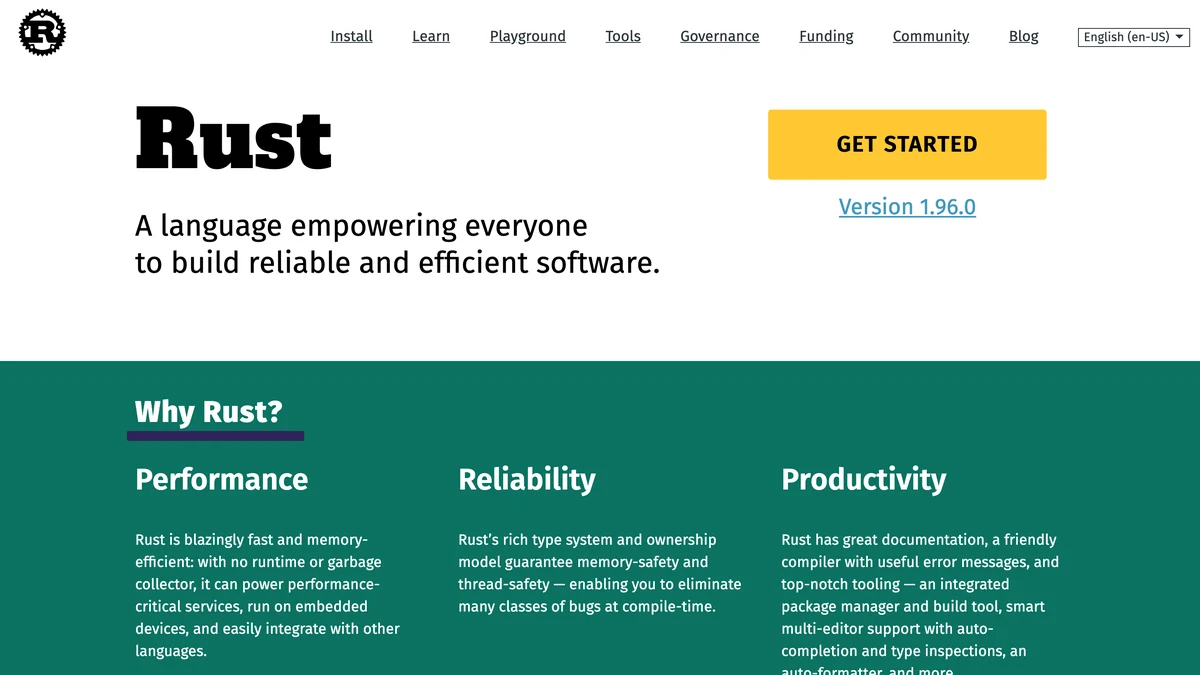
Rust is the dominant blockchain programming language for Solana and for WebAssembly-targeting chains. The ownership and borrow checker eliminate null-pointer dereferences, buffer overflows, and use-after-free bugs at compile time, with no garbage collector and no runtime overhead. The Rust documentation's ownership model chapter explains the mechanism. In a deployed program context, that compile-time memory safety guarantee matters more than in conventional software: bytecode is immutable once deployed, so bugs that reach production cannot be patched without an admin upgrade path.
On Solana, programs compile to BPF (Berkeley Packet Filter) bytecode via the Solana BPF toolchain. The Solana program documentation covers the runtime in full. Compute units are Solana's equivalent of EVM gas; Rust's zero-cost abstractions and lack of garbage collection keep programs within tight compute-unit budgets. On Cosmos and Polkadot, Rust targets WebAssembly via the wasm32-unknown-unknown compiler target. CosmWasm contracts run inside a Wasm interpreter embedded in each Cosmos SDK chain. Polkadot's ink! framework also compiles Rust to Wasm, and Substrate runtime modules (pallets) are upgradeable on-chain as Wasm blobs without a hard fork. That upgrade model is structurally distinct from Solana's program-authority key model, and the difference affects how teams plan on-chain logic changes.
Rust on Solana vs Rust on Substrate
The same Rust codebase compiles to two very different deployment targets depending on the chain. Solana programs become BPF shared objects invoked by the Sealevel parallel runtime; upgrades require a program authority key held by the development team. Substrate runtimes compile to a Wasm blob stored on-chain and upgraded through on-chain governance, removing the need for a hard fork. The table below captures the key operational differences.
| Dimension | Rust on Solana (BPF) | Rust on Substrate (Wasm) |
|---|---|---|
| Compilation target | BPF bytecode (SBF toolchain) | Wasm blob (wasm32-unknown-unknown) |
| Runtime model | Sealevel parallel runtime | Wasmi interpreter inside the node |
| On-chain upgrade path | Program authority key re-deploy | Governance vote, no hard fork needed |
| Compute metering | Compute units per transaction | Weight system (ref-time + proof-size) |
| Memory safety model | Rust borrow checker at compile time | Rust borrow checker at compile time |
| Consensus layer integration | Validator client written in Rust | Substrate node written in Rust |
Go, Python, and C++: Off-Chain Roles in Blockchain Architecture
Go, Python, and C++ do not write on-chain programs for any major public chain, but each is an essential blockchain programming language for a specific infrastructure or application layer. Their roles map to the off-chain side of the architecture: clients, indexers, off-chain orchestration scripts, and node internals.
Go dominates chain client development. The go-ethereum repository (Geth) is the most-used Ethereum execution client and is written entirely in Go. The Tendermint consensus engine, which powers Cosmos, is Go. Hyperledger Fabric chaincode runs in Go (and JavaScript). Go's goroutine concurrency model, fast compile times, and strong standard library make it natural for P2P networking, JSON-RPC servers, and blockchain indexers. For readers examining Go's compile-time performance in build pipeline contexts, see Programming Languages for CI/CD Pipelines.
Python handles off-chain orchestration exclusively. No major chain compiles Python to EVM, BPF, or Wasm bytecode for production execution. Python's role is deployment scripting (Brownie, Ape for Ethereum; Seahorse for Solana), test harnesses, data pipelines that index on-chain events, and academic consensus algorithm prototyping. Python's GIL and weak type safety make it unsuitable for production validator clients.
C++ appears in performance-critical node internals. Bitcoin Core is C++. C++ gives developers direct allocation control and SIMD optimization paths that Go and Python do not. For a detailed look at where C++ and Rust overlap in high-performance compiled code, see C++ vs Rust Speed Comparison.
| Language | On-chain capable | Primary blockchain role | Dominant framework/client | Type safety model |
|---|---|---|---|---|
| Go | No (Fabric chaincode only in permissioned networks) | Execution clients, consensus layer, indexers | Geth, Tendermint | Static, strong |
| Python | No | Off-chain orchestration, test harnesses, data pipelines | Brownie, Ape, Seahorse | Dynamic, weak |
| C++ | No (node internals only) | Performance-critical node binaries | Bitcoin Core | Static, manual |
Comparing Blockchain Programming Languages by Execution Target
Mapping each language to its execution target makes the selection criteria concrete. The IEEE Software analysis of on-chain vulnerability classes identifies reentrancy vulnerability, integer overflow, and timestamp dependence as the three most exploited categories across EVM chains, and notes that the language's type system determines which of these classes can be caught at compile time versus at audit time.
| Language | Execution target | On-chain chains | Memory-safety guarantees model | Primary vulnerability class | Ecosystem maturity |
|---|---|---|---|---|---|
| Solidity | EVM bytecode | Ethereum, Polygon, Arbitrum, Optimism, Avalanche C-Chain, BNB Chain | Manual (storage/memory/calldata) | Reentrancy, unchecked arithmetic | High: Hardhat, Foundry, OpenZeppelin |
| Rust | BPF (Solana), Wasm (NEAR, Cosmos, Polkadot) | Solana, NEAR, Cosmos chains, Polkadot | Borrow checker at compile time | Logic errors, account confusion | High on Solana; growing on Wasm chains |
| Go | Native binary | Off-chain only (Fabric chaincode permissioned) | GC-managed, no manual pointers | Race conditions, nil dereference | High for clients; narrow for on-chain |
| Python | Interpreted (off-chain only) | Off-chain only | Dynamic, runtime-checked | Logic errors, type coercion | Moderate; test tooling only |
| C++ | Native binary | Off-chain only (node internals) | Manual, undefined behavior risks | Buffer overflow, integer overflow | High for Bitcoin Core; narrow otherwise |
Two questions the table cannot capture. First, can projects combine languages? A production decentralized application typically uses Solidity for on-chain logic, TypeScript or Python for the frontend and deployment scripts, and Go or Rust for the event indexer. The language choice is layered across the stack, not singular. Second, does language choice affect audit coverage? Solidity has the deepest on-chain audit tooling: Slither, Mythril, Aderyn, and the Certora Prover each target compiled output and Solidity source. The Solc's IR (Yul) is the basis for formal verification workflows.
Security Audit Coverage by Language
Solidity has the largest pool of smart contract auditors and the widest toolchain coverage. Rust programs on Solana are audited using Soteria and Ackee Blockchain's Trident fuzzer; the audit pool is smaller but growing as Solana's total value locked has increased. CosmWasm contracts are audited using Oak Security's toolchain targeting the Wasm execution environment. Off-chain code written in Go, Python, or C++ is reviewed using conventional software security methods, not smart-contract-specific tooling. The practical implication: teams building on Solidity can find more auditors at more price points. Teams building on Solana or Cosmos should budget additional lead time for audit scheduling. Language choice determines the audit supply chain, not just the development workflow.
Choosing the Right Blockchain language for Your Project
The execution environment determines the language. Developer preference is a secondary consideration. Five decision branches cover the majority of production blockchain projects:
- Building on Ethereum or any EVM-compatible chain: Solidity is the practical choice for on-chain logic. Vyper is a secondary option with Python-like syntax preferred by some auditors for its reduced feature surface. No other language compiles to the Ethereum Virtual Machine's target with production-grade tooling. The Solidity toolchain's gas model and type-safety rules shape contract design from the first line of code.
- Building on Solana or a Wasm-target chain (NEAR, Polkadot, Cosmos): Rust is the standard on-chain language for all on-chain work. No mature C++ or Go toolchain exists for producing BPF or Wasm programs on these chains. The memory-safe runtime guarantees from the borrow checker are an operational requirement given the immutability of deployed programs.
- Building chain clients, indexers, or P2P networking layers: Go is the dominant choice. Fast compile times, first-class goroutine concurrency, and a strong networking standard library make it the default for consensus layer infrastructure. The same codebase can serve JSON-RPC endpoints and block-processing pipelines without architectural fragmentation.
- Building off-chain orchestration, testing harnesses, or data pipelines: Python is acceptable. Use type annotations throughout and enforce
mypyin CI to partially compensate for the dynamic static typing model. For language selection in AI-adjacent pipeline work, see Best Programming Languages for AI Development. - Contributing to a performance-critical node (Bitcoin Core or equivalent): C++ is required. Apply a disciplined subset (MISRA C++ or equivalent) to constrain undefined behavior. The off-chain workflows and build tooling around the node can use Python or Go; the node binary itself requires C++ allocation control and SIMD throughput.
Developers building across multiple layers benefit from a structured language learning path. Learning Path for Full Stack Development covers the broader skill progression for engineers who need to move between on-chain, client, and application layers within the same project.
Standards reference: NIST IR 8202 Blockchain Technology Overview.
Further reading
- Solidity Language Documentation (Ethereum Foundation): full language specification covering the type system, storage layout, and compiled output for EVM-compatible chains.
- Solana Programs Overview (Solana Foundation): BPF toolchain, compute unit model, and Rust program structure for on-chain development.
- The Rust Programming Language: Understanding Ownership (Rust Project): authoritative reference for the safe memory model model underlying all Rust blockchain programs.
- go-ethereum (Geth) (Ethereum Foundation): canonical reference for Go as the implementation language of the primary Ethereum execution client.
- Smart Contract Security Analysis (IEEE Software): peer-reviewed analysis of reentrancy vulnerability, integer overflow, and timestamp dependence across on-chain programs.
- JavaScript Runtime Alternatives To Node.js: Deno, Bun, Compared
- Top API Integration Platforms for Developers: Azure, Apigee, Kong, and More
- VS Code vs Sublime Text: Code Editor Comparison for Developers