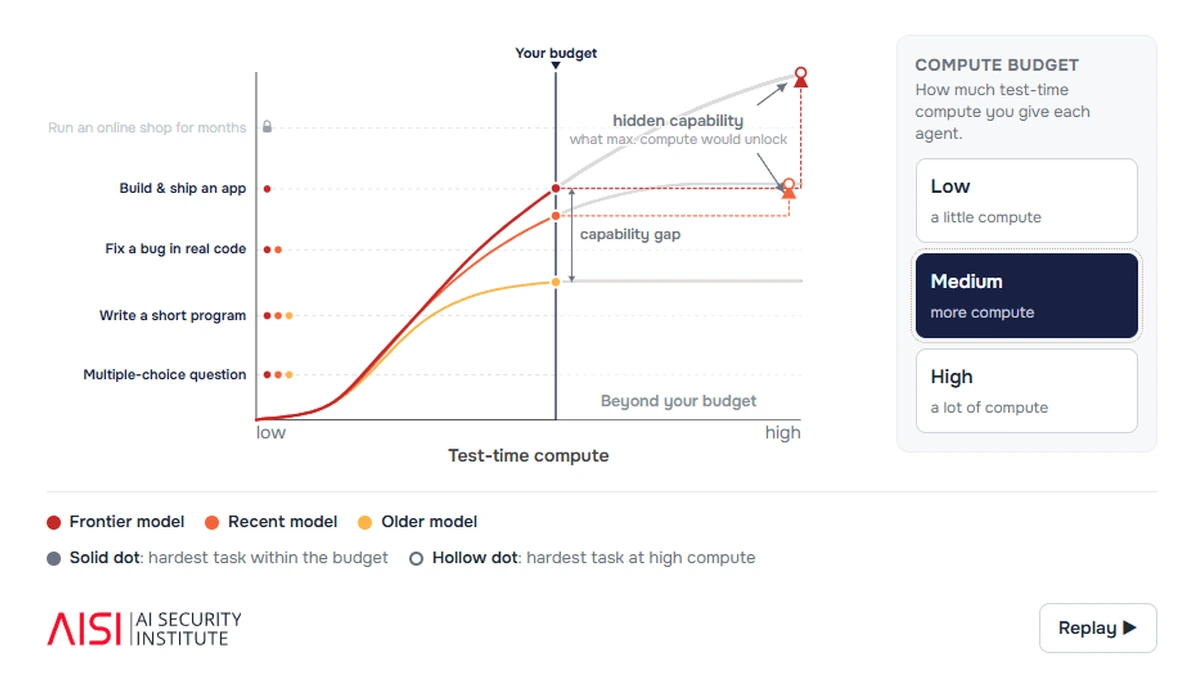
The UK AI Security Institute (AISI) tested frontier AI agents across seven benchmarks at varying compute budgets and found that fixed-budget evaluations systematically miss what these systems can actually do. AISI's research shows agent performance is not a static score but a curve that keeps rising with test-time compute, and cutting a benchmark budget while that curve is still climbing produces a floor measurement, not a ceiling.
The practical gap is significant. On software engineering tasks, success rates jumped roughly 25 percent when the token budget increased from one million to ten million tokens. Math and academic tasks showed about 22 percent gains up to a budget of five million tokens. Cybersecurity showed the starkest results: around 8 percent of tasks were only solved once budgets exceeded 10 million tokens, and some required 50 million. One benchmark task demands roughly 20 hours of a human expert's time and could not be solved by any tested model with fewer than 30 million tokens, a failure attributable to budget, not capability. AISI ran its evaluations using TerminalBench, SWE-Bench Pro, Humanity's Last Exam, HealthBench, and several cyber evaluation suites, drawing on frontier model data from the institute's Science of Evaluations program.
AISI also identified a structural relationship between human expert time and agent token consumption: the two track each other along a power law across 211 software engineering tasks and 78 cyber tasks sourced from METR and AISI's own cyber suite. A one-minute task costs an agent thousands of tokens; a one-hour task, millions; a one-week task, billions. A standard evaluation budget that is uniform across task difficulty therefore cuts off the longest and hardest items in a way that systematically misrepresents the upper end of the capability distribution.
Newer frontier models benefit disproportionately from larger budgets. The capability advantage compounds along three dimensions simultaneously: they reach harder tasks, complete the same tasks more reliably, and require fewer tokens to complete them. At a budget of 2.5 million tokens, the average time horizon for a current frontier model ran roughly 40 minutes; at 50 million tokens, it extended to around four hours. Across the entire tested frontier, the horizon moved from about two hours to 14 hours as the budget rose from 2.5 to 50 million tokens. AISI's evaluation covered GPT-5, GPT-5.5, Claude Opus 4.5, Claude Opus 4.8, and Claude Sonnet 4.5, with full methodology reported by The Decoder.
The implication for capability trend-lines is notable. AISI's prior estimate held that frontier models' time horizon on cyber tasks doubles roughly every 4.7 months at a fixed 2.5 million-token budget. At 50 million tokens, the doubling rate accelerated to every 40 to 50 days. "The estimated doubling rate is partly a product of the evaluation budget you pick, not a fixed property of frontier progress," the institute concluded. Progress is also uneven: on 10 to 30 percent of tasks, newer models scored lower than predecessors, a reminder that capability advances are not monotonic.
The medical task benchmark HealthBench was the notable exception. All models plateaued within the standard budget, regardless of how much compute was added. AISI attributes the difference to feedback loops: extra compute helps most where an agent can verify its own work in real time, such as running code or testing an exploit, and moves little where feedback is absent or delayed. Medicine, unlike software engineering or cybersecurity, offers fewer such intermediate checkpoints within a single session.
AISI's response is a "minimum informative budget" protocol: run each model at several different budget levels and treat a result as meaningful only when the capability curve has visibly plateaued. The institute is also investigating whether high-budget performance can be predicted from cheaper, lower-budget test runs. As token costs fall, compute levels that seem impractical for benchmarking today, such as 50 million or 100 million tokens per task, will become more accessible to developers deploying these systems in production, making compute-aware measurement a matter of practical safety, not just academic rigor.