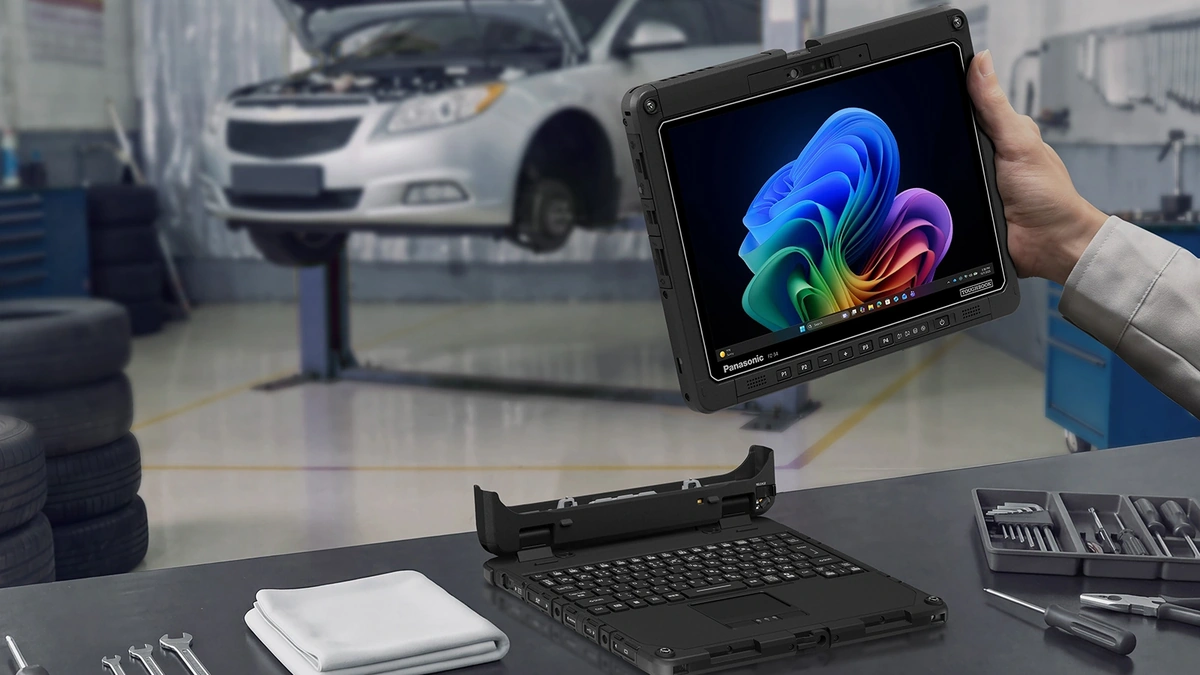
Panasonic Connect will launch the TOUGHBOOK FZ-34 in Japan this October, positioning the rugged 12.4-inch detachable as its entry into Microsoft's Copilot+ PC category, the first time the TOUGHBOOK line has qualified for on-device AI acceleration rather than pitching durability alone. The 2-in-1 replaces the CF-339 and targets hazardous, temperature-swinging job sites, factory floors, construction sites, and disaster-response zones, where standard business laptops tend to fail early.
Powering that AI push is an Intel Core Ultra Series 3 chip, which, according to Panasonic Connect, gives on-site crews enough local processing headroom to crunch inspection or sensor data without shipping it back to a central office first. For now the rollout stays domestic: Panasonic Connect's statement covers only the Japanese market, leaves out any price, and does not say when or whether an international version might follow.
Panasonic Connect is leaning on the same toughness benchmarks that have defined the TOUGHBOOK line for three decades. In tablet mode, the TOUGHBOOK FZ-34 is rated to survive a 180-centimeter drop onto plywood from 26 different angles under the MIL-STD-810H military testing standard, on top of Panasonic's own in-house abuse testing, and its IP65 dust-and-water rating climbs to IP66 once the keyboard is detached. The company also lists an operating range stretching from -10C freezer-aisle cold up to 50C summer-outdoor heat, a spread wide enough to cover both refrigerated warehouses and unshaded job sites.
Keeping crews working through a full shift is the other half of the pitch. Panasonic Connect rates the TOUGHBOOK FZ-34 for roughly 13 hours of video-playback battery life on its standard pack, extending to about 26 hours with an optional second battery that can be swapped in without shutting the machine down, a hot-swap setup meant to avoid downtime during long remote assignments. The device also debuts a pouch-cell battery, a first for the TOUGHBOOK line, which Panasonic Connect says degrades more slowly across repeated charge cycles than the cylindrical cells used in earlier models.
Rather than shipping fixed configurations, Panasonic Connect built the FZ-34 around three swappable bays that can be fitted with an ID-card reader, a barcode scanner, or an HDMI output, letting IT departments customize each unit after purchase instead of ordering separate hardware variants for separate roles. A 5G-connected version rounds out the lineup alongside the standard model, and the touchscreen automatically adjusts between bare-finger, gloved, and wet-screen input, on top of support for a digitizer pen, so crews do not have to fumble with settings mid-task.
The TOUGHBOOK FZ-34 ships under two model numbers, FZ-34CY90XAJ for the standard configuration and FZ-34CY90HAJ for the 5G variant, arriving in Japan on a staggered schedule beginning in October. The launch lands during a milestone year for the brand: TOUGHBOOK turns 30 in 2026, and Panasonic Connect points to VDC Research's first-quarter 2026 Quarterly Tracker as evidence it has held the top global share of the rugged-notebook market for 24 straight years.