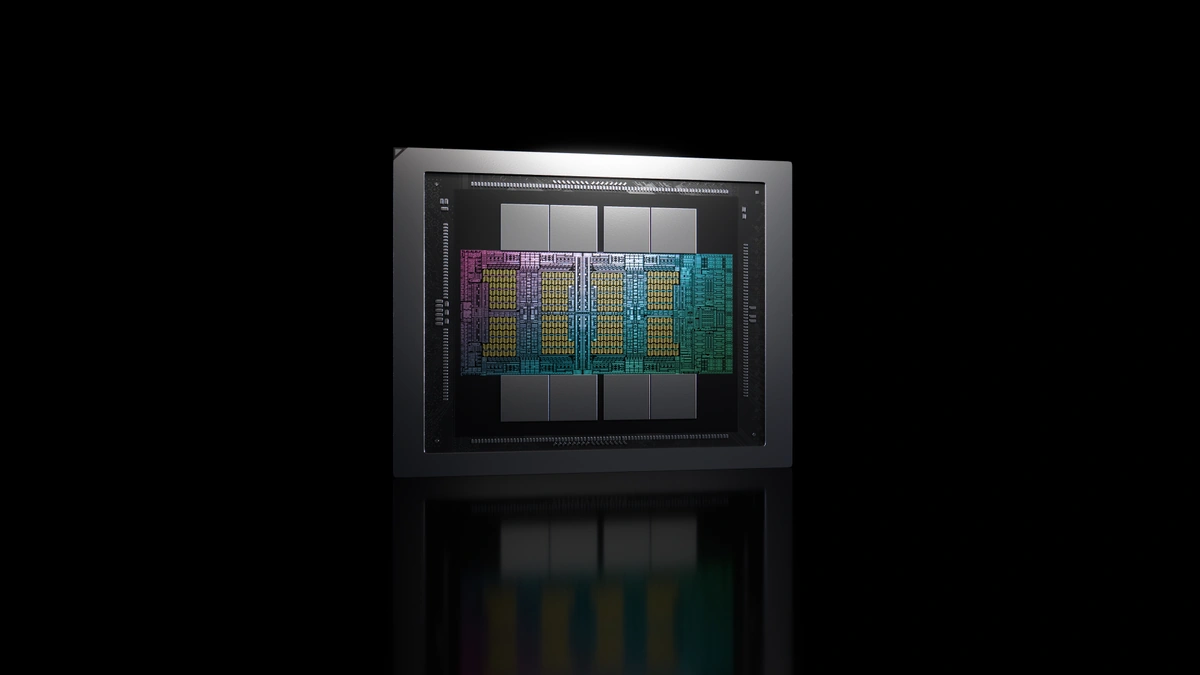
NVIDIA Rubin HPC will carry more than 50,000 CUDA cores, a GPU built for simulation and data processing in science, engineering and analytics. It joins the Vera Rubin platform, and NVIDIA expects it to be available in 2028.
NVIDIA says the design of NVIDIA Rubin HPC scales data movement together with compute instead of piling on compute alone, so the cores spend their time calculating rather than waiting. The chip also adds a sparse data acceleration capability and seventh-generation NVLink for GPU-to-GPU connections.
The target is a familiar workload shape. An application reaches into an immense dataset, gathers a handful of scattered values, computes a result and repeats at enormous scale, in workloads such as climate models, engineering simulations, genomic analysis and financial risk. NVIDIA lists sparse matrix operations, stencil computations, sorting and reductions as the recurring patterns Rubin HPC is meant to speed up.
NVIDIA calls the core count a record for its GPUs. It gives the count and the features, not a performance figure for the chip.
NVIDIA frames the chip around AI agents that propose candidate materials, molecules and designs, then run simulations to test them. Its CUDA-X libraries, which it says agents can use together with Rubin HPC, got their own round of updates on the same day. NVIDIA says cuPotential speeds existing molecular simulation software by up to 3x. Daviator, which is coming to NVIDIA ALCHEMI, is a set of batched GPU kernels for the Vienna Ab initio Simulation Package; NVIDIA says it delivers quantum-mechanical calculations up to 22x faster at up to 75% lower cost. Those figures describe the libraries, not the new GPU.
NVIDIA is working with Schrödinger and the AMBER, NAMD, GROMACS, LAMMPS and Open Molecular Software Foundation communities to bring cuPotential acceleration to their molecular dynamics tools. Cadence, Fathom Therapeutics, Topos Bio, Genesis Molecular AI and Terray Therapeutics are adopting it for drug discovery.