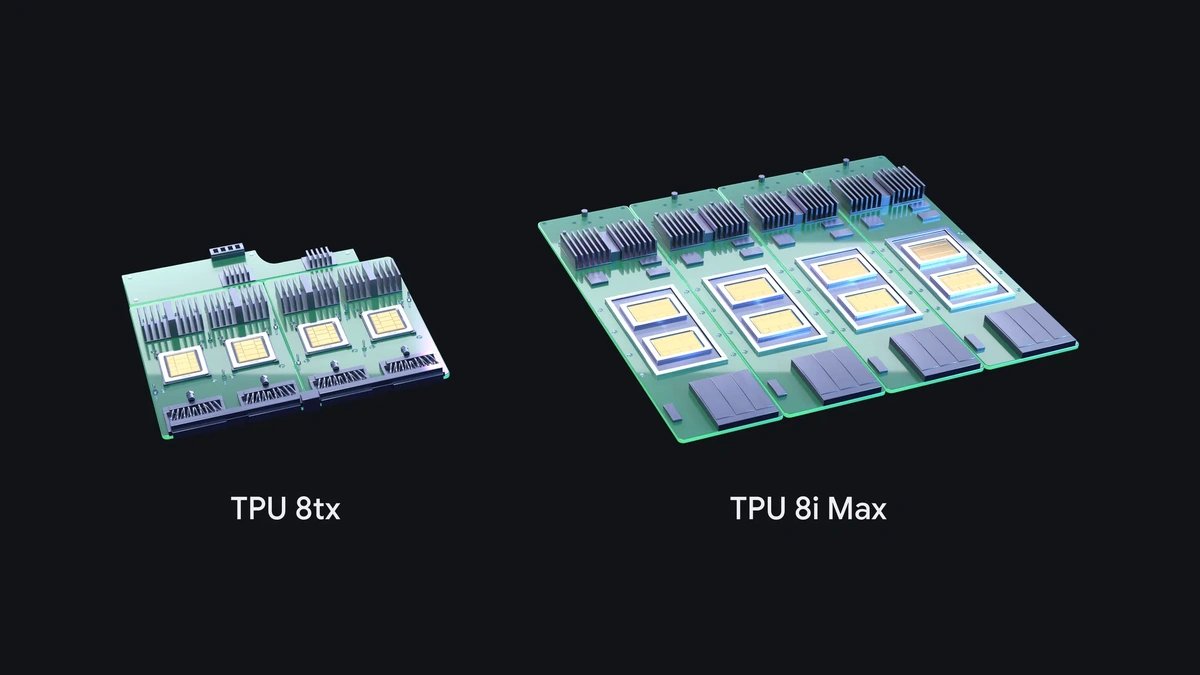
Google added TPU 8tx and TPU 8i Max to its eighth-generation TPU line, which makes four TPU systems in a single year. TPU 8tx is built for confidential inference on regulated data, and TPU 8i Max puts two TPU 8i chips on one package for long-context agent work.
TPU 8tx runs on the same silicon as TPU 8t, the training system, and pairs it with fifth-generation AMD EPYC host CPUs. Google says the hardware shields customer data and model weights during processing, the moment when conventional encryption leaves them readable in memory. It also borrows the Boardfly network from TPU 8i, which Google says gives TPU 8tx up to 2x lower latency than TPU 8t with a near-zero performance penalty. TPU 8tx retains training-class compute, so a single system can fine-tune a model on private records, distill a large model into a smaller one and run reinforcement learning for agents without moving sensitive data between separate clusters. The intended buyers are regulated enterprises and governments.
TPU 8i Max targets the memory bottleneck that stalls agents working across a large codebase or hours of video. Google lists double the compute, double the SRAM and double the HBM bandwidth of TPU 8i, in the same rack footprint, which Google says lets a data center pack in more compute per square foot and per watt. For scale, a single TPU 8i chip, introduced in April, carries 384 MB of on-chip SRAM, three times the previous generation's. Google did not give a price, a region list or a general-availability date for either new system.
| System | Role | Google's stated figure |
|---|---|---|
| TPU 8t | Large-scale training | Up to 2.7x training performance vs. prior generation |
| TPU 8i | Low-latency reasoning | 80% better inference price performance vs. prior generation |
| TPU 8tx | Confidential inference, small-scale training | Up to 2x lower latency than TPU 8t |
| TPU 8i Max | Long context, compute density | 2x compute, SRAM and HBM bandwidth of TPU 8i |
Google reports leading price-performance marks for its vLLM-TorchTPU stack on the InferenceX and AgentX benchmarks, which test agentic coding and long-context work. TPU Sync, which Google is open-sourcing, tiers KV caches off the chip and cuts KV transfer latency and time to first token by more than 90%. GKE dynamic slicing, now generally available, reassembles TPU topologies on demand and cuts job startup times by up to 5x.