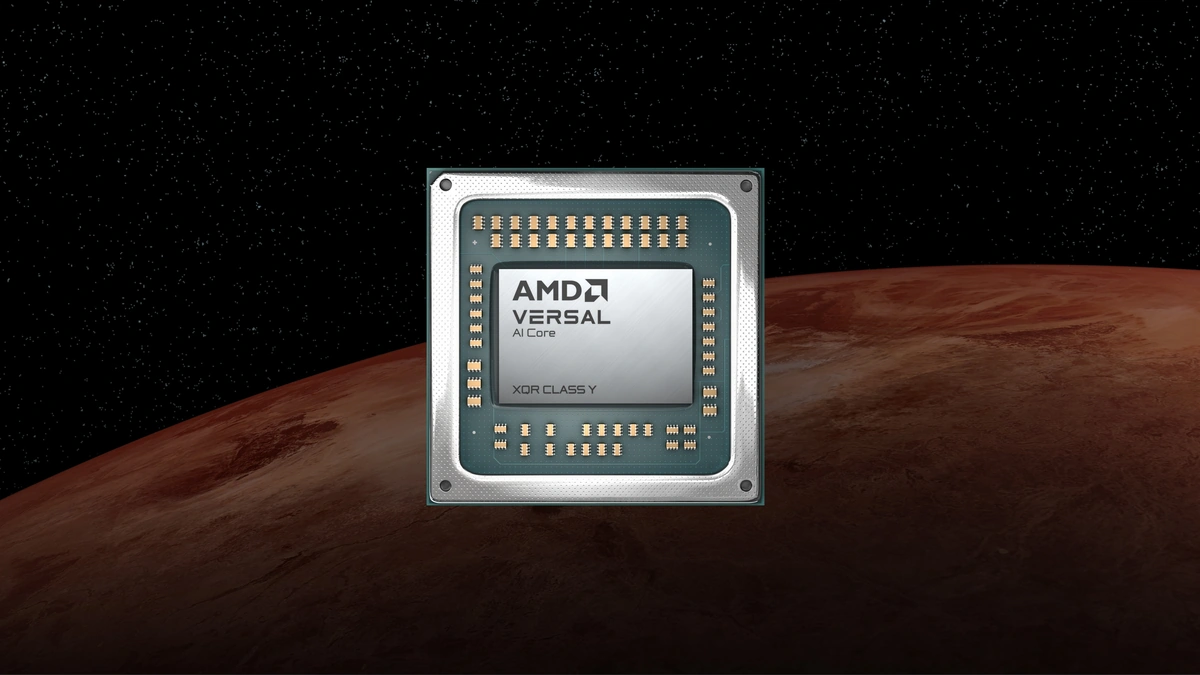
AMD has started sending early-access customers samples of its Versal AI Core adaptive SoC in a new space-grade package, aimed at missions that have to keep working for up to 15 years.
The change AMD is highlighting sits in the packaging. Per AMD, the design is an organic, lidless package that pairs conservative layout rules with an enhanced substrate material, intended to limit thermal and mechanical stress, and it uses space-grade chip capacitors that already have flight heritage. The company says that combination extends the XQRVC1902 version of Versal AI Core to programs that demand the strictest reliability assurance.
Those programs are the ones AMD names: human-rated and long-duration flights, plus missions in geosynchronous, cislunar and heliocentric orbits and in deep space. Reliability is the selling point here, not raw throughput. AMD cites generational gains in vector compute density, logic cells, on-board SRAM and multigigabit transceivers for the chip, but it attaches no figures to any of them.
The new Versal AI Core package is not fully qualified yet. AMD is testing it against the U.S. military specification MIL-PRF-38535 Class Y, which the company calls the highest level of quality and reliability under that standard for spaceflight components. AMD already lists an earlier Class B qualification for the XQRVC1902, so Class Y is a stricter bar the new package still has to clear. AMD expects Class Y flight-qualified units in the second half of 2027.
Until then, the samples are for building engineering models. Ken O'Neill, AMD's Aerospace and Defense lead systems architect, called their availability "an important milestone toward Class Y qualification." AMD describes the device in datasheet DS946.
Pin compatibility is the practical hook. The package matches the existing Versal AI Core VC1902 commercial, defense-grade and space-grade devices in the 2197-ball grid array package, so a board built around any of them should carry over. A team could therefore prototype on today's samples and swap in the Class Y part once it exists.