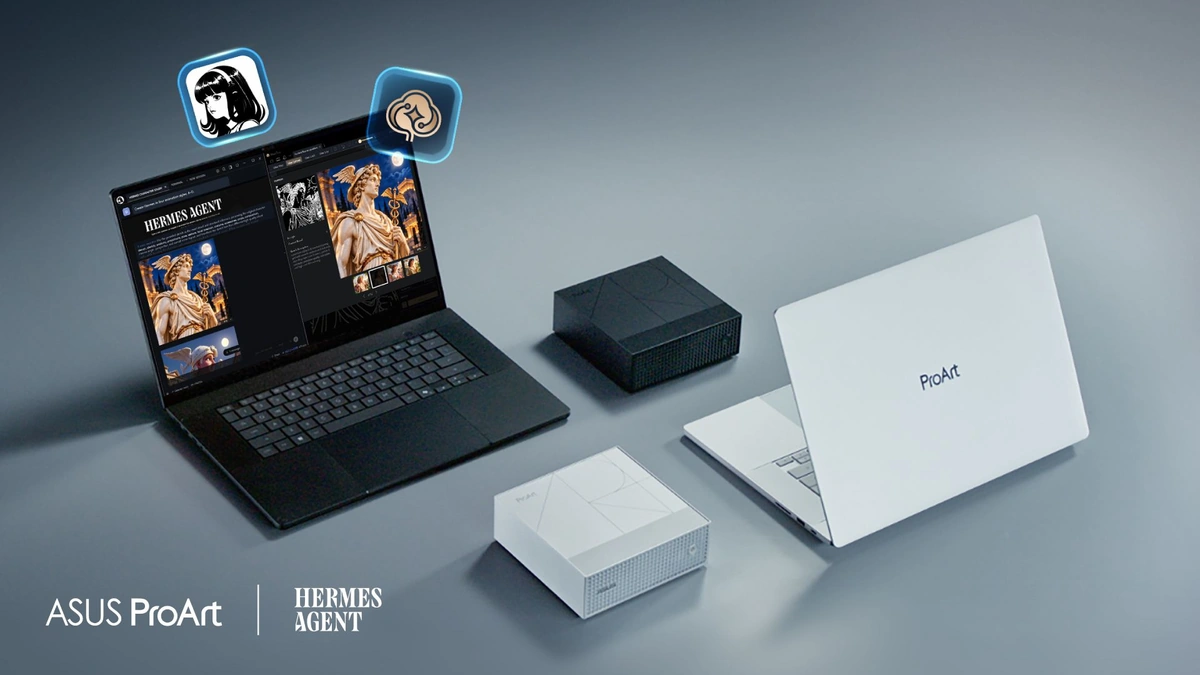
ASUS ProArt P16 and P14 laptops powered by NVIDIA's RTX Spark chip went up for pre-order on October 7, with U.S. prices starting at $2,599.99. A compact ProArt GR1X desktop on the same silicon is due before the end of 2026.
First U.S. deliveries begin October 16, ASUS says. The $2,599.99 entry price applies at BestBuy.com and select Best Buy stores, and ASUS adds that final pricing is set by the retailer and can change. Memory is what separates the configurations. Versions with 24GB, 32GB, 36GB and 48GB go through the ASUS eShop and Best Buy, while the 64GB and 128GB models are sold mainly through those same two channels, with Micro Center also stocking the 128GB one. The release gives no prices for the larger tiers.
The ASUS ProArt P16 and its P14 sibling run on RTX Spark, which pairs a Blackwell RTX GPU with a Grace CPU, and both draw from a single pool of up to 128GB. ASUS quotes up to 1 petaflop of AI performance for the platform. Because the processor and graphics cores share that pool, the memory tier decides which language and image models can be loaded locally, so the 24GB model and the 128GB model are very different machines for AI work.
The two laptops differ mostly in size. The ASUS ProArt P16 measures 12.9mm thick, weighs 1.77kg and carries a battery of up to 99Wh. The P14 is 13.9mm thick at 1.48kg, with up to 90Wh, which ASUS describes as the lightest ProArt laptop on sale. Both use OLED panels rated for up to 1,600 nits peak brightness and a 120Hz variable refresh rate. The P16 can be ordered with a 4K screen and G-SYNC, whereas the P14 tops out at 3K.
On the software side, the ASUS ProArt P16 and P14 come preloaded with MuseTree, which runs the FLUX image and Wan video models locally, and StoryCube, a tool for sorting and tagging media. It also lined up ComfyUI, an open-source visual workflow builder, and Hermes Agent from Nous Research, an autonomous assistant that can operate ComfyUI through plain-language instructions. ASUS argues that running models locally replaces per-token cloud bills with fixed hardware cost and keeps project files on the device. Those are the company's claims for the ASUS ProArt P16 line, and no independent testing has appeared yet. The case holds mainly for work that fits inside the machine's memory; anyone who relies on frontier-scale cloud models will still be paying for them.