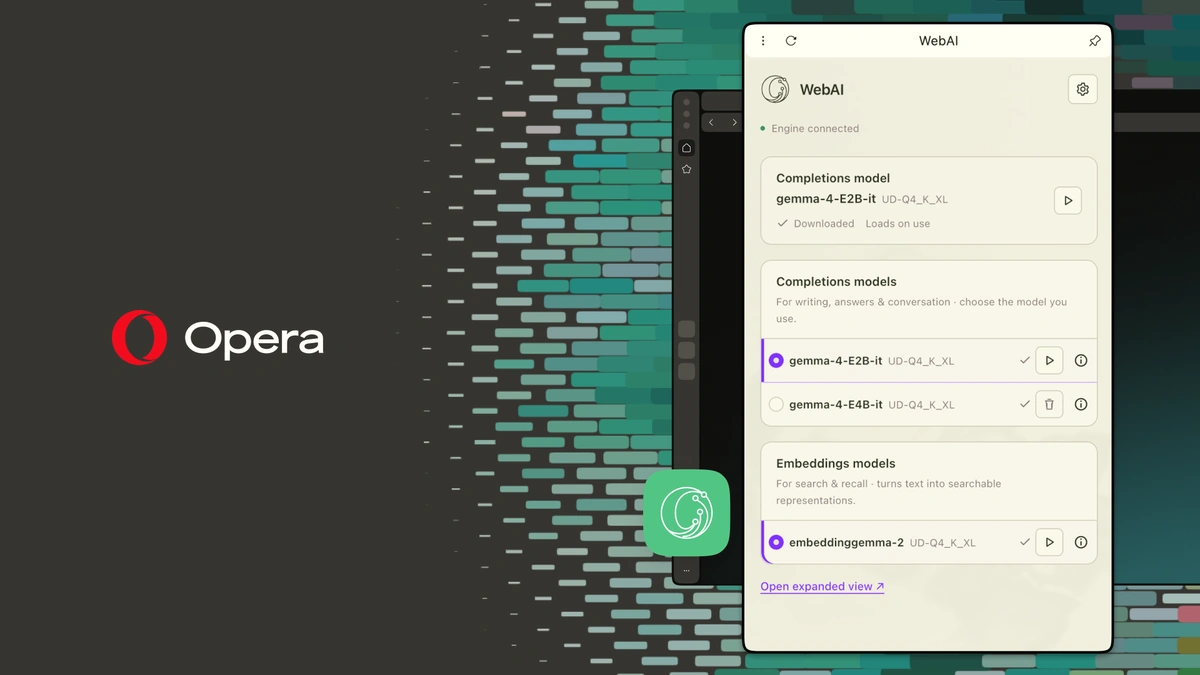
Opera began shipping local AI models in its browsers on October 27 through WebAI, an opt-in early preview that starts in Opera One. Opera GX and Opera Neon are to follow. The models run on the user's own machine: Google's Gemma among them and, on Macs, Apple's on-device foundation model.
WebAI is a proposed web standard backed by companies such as Google and Microsoft, and Opera's implementation lets websites and browser extensions use AI hosted by the browser. Opera says the design is model-agnostic and built around open-weight models, so a developer is not tied to one provider. Nothing downloads until a user turns the feature on, and per-site permissions decide which websites can reach the local models.
For developers, WebAI introduces three new APIs, Opera's developer team says: Prompt for generating text, Decision for classifying information and Semantic Embeddings for finding relationships between pieces of content. Opera's Web AI developer site also has in-browser playgrounds for Summarizer, Writer, Rewriter, Translator and Proofreader APIs. Inference is built into the browser, which means no separate app, no local server and no API key. The team also built six experimental extensions, which it calls examples and not Opera features. Project Lens colors an article by how much each paragraph matters to a project the user describes, and Got It? writes a short quiz on the article just read.
Trying WebAI takes a few steps. A user updates Opera One, opens Settings, then Opera AI (or opera://settings/ai), and switches on Enable Web AI API, which downloads a compatible local model and may take a few minutes. The preview runs on 64-bit Windows PCs with Intel or AMD chips and on Macs with Apple silicon. Intel-based Macs, Linux and Windows on Arm are left out. Speed depends on the machine, because the model uses the computer's own processor. Opera's developer team, though, lists the preview across Opera One, Opera GX and Opera Neon.
The company traces the idea to 2024, when it says it became the first major browser to offer built-in access to local AI models, in an experimental developer build. "A lot of what people want from AI doesn't need a data center," said Krystian Kolondra, Opera's EVP of Browsers and AI. Opera plans to add more open models tuned for different devices, along with more tools for building browser features on local AI.