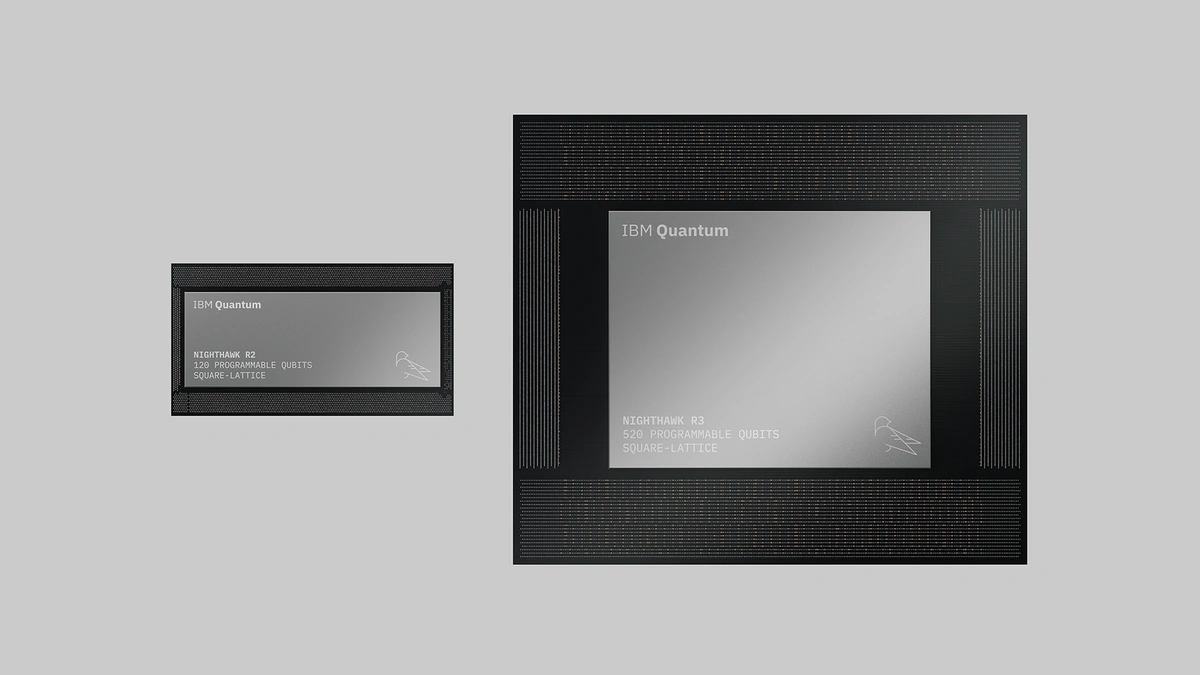
IBM Nighthawk r3 is designed to run circuits of 10,000 quantum operations accurately across 520 programmable qubits, and IBM plans a 2027 machine that joins two of the processors. That system would carry 1,040 qubits.
IBM Nighthawk r3 keeps the square-lattice layout and fast operations of the current Nighthawk r2, adds 10 chip-to-chip links IBM calls l-couplers, and counts 2,034 physical qubits in total, according to IBM. Only 520 are programmable qubits. On r2, the 120 programmable qubits sit alongside 218 couplers and 120 reset elements, per IBM's Nighthawk r2 technical details.
| Spec | Nighthawk r2 | Nighthawk r3 |
|---|---|---|
| Programmable qubits | 120 | 520 |
| Accurate quantum operations per circuit | 7,500+ | 10,000 (design target) |
| Chip-to-chip l-couplers | Not listed | 10 |
| Linked system | None announced | Two chips, 1,040 qubits (2027 plan) |
Speed is the property IBM says Nighthawk r3 will keep. A quantum computer answers in samples, one per circuit run, so useful jobs can need millions or billions of runs. IBM says r2 executes up to 100,000 circuits per second, roughly 25 times the throughput of its Heron processors at about 4,000, because each qubit has a dedicated reset path that shortens the idle time between runs to as little as a microsecond.
The reported speedups come from r2. E.ON reported a 15x speedup on an energy-grid machine learning task, and IBM measured 12x on a materials simulation it ran earlier with Oak Ridge National Laboratory. Both are measured against Heron, not against classical computers, and the "up to 19x" figure IBM gives for partners including Algorithmiq and Q-CTRL is likewise relative to earlier IBM processors. IBM says clients and partners have run more than 34 billion circuits on r2.
The IBM Quantum Platform now also lets users attach classical computing, from a laptop to a supercomputer, to the same managed environment. IBM and the Japanese research institute RIKEN ran their sample-based quantum diagonalization workflow about 5 times faster while doing 100 times more computation than in the original study. Cleveland Clinic and RIKEN processed 608 million samples 33 times faster than without workflow automation.
The 1,040-qubit plan for IBM Nighthawk r3 depends on the links. IBM linked two Nighthawk r1 chips with four l-couplers and reports 99.3 percent quantum state transfer fidelity. The l-coupler results show that 99.3 percent is the best transfer; the average was 99 percent, and entangling gates built across the links averaged 94.75 percent. IBM also joined two cryogenic modules into one system that reached operating temperature in under five days and cooled below 15 millikelvin. Its stated target for state transfer is 99.9 percent.