
AI voice generation is a technology that turns text into natural-sounding speech using neural network models trained on large corpora of human audio. The category spans simple text-to-speech (TTS), high-fidelity voice cloning, dubbing pipelines, and broader audio generation that includes music and sound effects. Production-grade systems from OpenAI, Google Cloud, and ElevenLabs sit behind voiceover for video, accessibility readers, conversational agents, and localized customer support. The boundaries that matter most are not whether a model sounds human. They are which architectures handle prosody and emotion, what consent and licensing the vendor enforces, how SSML and real-time streaming reach the API, and where on-device speech synthesis still loses to cloud inference. Treating AI voice generation as one undifferentiated capability is the most common mistake; treating it as a stack of distinct pipelines is how to choose the right tool.
What AI Voice Generation Is

AI voice generation is the process of converting text or other input signals into spoken audio output using machine-learning models that have learned to replicate the acoustic patterns of human speech. The category is anchored by text-to-speech, the long-running speech synthesis discipline that earlier relied on concatenative or parametric methods and has since moved to neural network architectures. Modern systems learn directly from paired text and audio, producing a waveform that can be streamed or saved as a file. OpenAI documents its audio APIs as generating speech from text inputs, with a fixed catalog of voices and quality tiers selectable per request (OpenAI Developer Platform, Audio guide). Google Cloud frames its Text-to-Speech product as turning text into natural-sounding speech in more than 50 languages with a selection of neural voices (Google Cloud, Text-to-Speech). For the wider family of systems this sits inside, see how modern generative AI systems work, and for the audio layer specifically, the broader survey of generative AI tools across text, image, video, and audio.
- Text-to-speech (TTS): the core function, mapping a written input string to a synthesized speech waveform.
- Voice model: the trained weights that define a specific voice identity, accent, and timbre.
- Voice cloning: training a new voice model that imitates a target speaker from a short reference recording.
- Audio generation: the umbrella term that also includes non-speech output such as music, ambience, and sound effects.
- Speech synthesis: the academic term for the same engineering problem, predating neural approaches by decades.
How Neural TTS Models Work
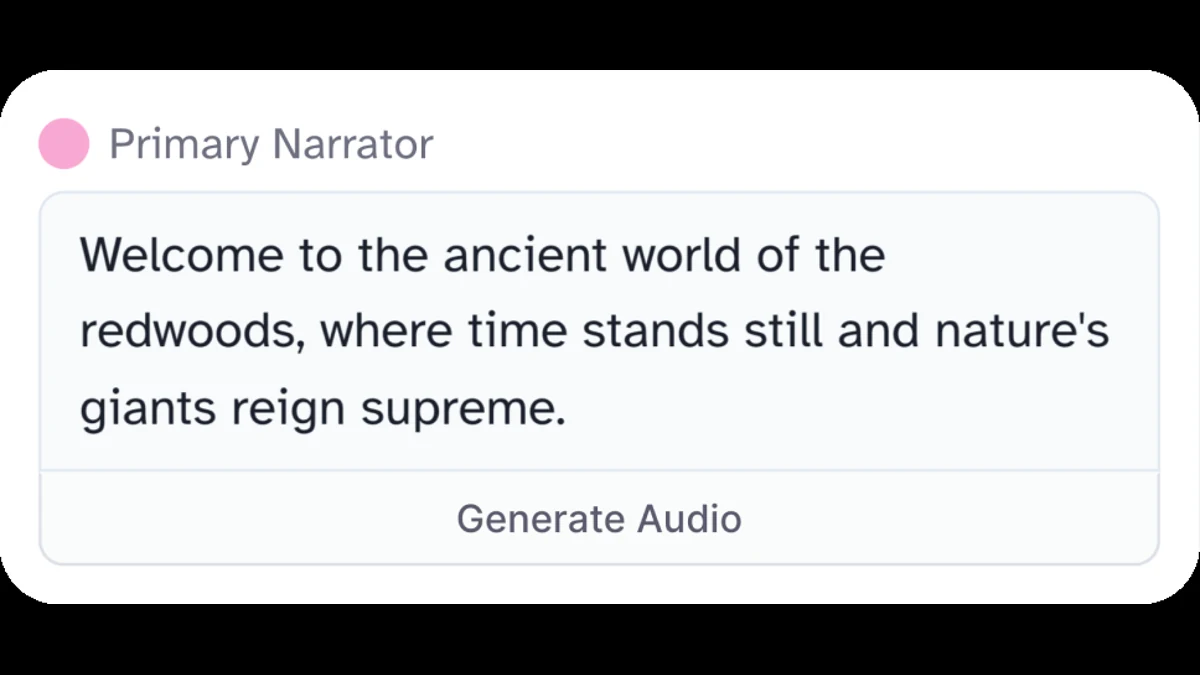
AI voice generation systems process input text through a pipeline of neural network components that jointly produce a waveform, the raw audio signal a speaker or encoder converts to audible sound. The classical neural stack splits the work in two. An acoustic model predicts an intermediate spectrogram representation from input tokens, and a vocoder converts that spectrogram into the final waveform. WaveNet pioneered the deep-learning vocoder approach, and Tacotron-style sequence-to-sequence models established the acoustic side; production systems today fold both stages into end-to-end architectures that learn the mapping in a single training run. Google Cloud documents its current speech synthesis stack as supporting both standard and neural voices, with the Gemini-based generation introducing controllable style and emotion alongside the established WaveNet voice family (Google Cloud Blog, Gemini 3.1 Flash TTS on Google Cloud). The dependence on multimodal training data is direct: aligning text and audio at scale is how the model learns prosody, and combined text-audio training is the same pattern explored in how multimodal AI models combine text, image, and audio.
- Tokenize: input text is normalized (numbers, abbreviations, punctuation) and converted into phonemes or sub-word tokens.
- Encode: a neural network encoder builds a contextual representation that captures prosody-relevant cues such as sentence structure and stress.
- Predict acoustics: an acoustic model generates a mel-spectrogram or equivalent intermediate feature sequence frame by frame.
- Vocode: a neural vocoder transforms the spectrogram into a raw audio waveform at the target sample rate.
- Stream or render: the waveform is either delivered as a complete audio file or pushed to the client in chunks for real-time streaming playback.
Types of AI Voice and Audio Generation
AI voice generation spans several distinct categories that differ in input, output fidelity, and the underlying model architecture. Standard TTS reads arbitrary text in a pre-built voice and is the workhorse for narration, screen readers, and IVR. Voice cloning trains a new voice model from a sample of a target speaker and is the path for branded narrators, personalized assistants, and accessibility tools that restore a lost voice. Speech-to-speech models translate or restyle an input recording, useful for dubbing and accent neutralization. Broader audio generation extends the same neural network principles to music, sound effects, and ambient beds, which the underlying TTS engine cannot produce. OpenAI exposes a single audio surface that covers text-to-speech, speech-to-text, and speech-to-speech in one API family, with selectable voices and quality tiers per call (OpenAI Developer Platform, Audio guide). Confusing these categories is the editorial trap behind most poor tool choices: a voice-cloning vendor solves a different problem from a cloud TTS vendor, even when both ship an API that accepts text and returns audio.
| Category | Input | Output | Typical use |
|---|---|---|---|
| Standard TTS | Text plus voice selector | Speech waveform in a pre-built voice | Narration, accessibility, IVR, voiceover |
| Voice cloning | Reference audio sample plus text | Speech in a custom voice model that mimics the speaker | Branded narrators, restored voices, personalization |
| Speech-to-speech | Source audio recording | Restyled or translated speech | Dubbing, accent shifting, real-time translation |
| Broader audio generation | Text prompt or musical seed | Music, sound effects, ambience | Game audio, podcasts, video production |
Leading Tools: ElevenLabs, OpenAI TTS, and Google Cloud
AI voice generation tools differ substantially in voice catalog size, cloning depth, SSML support, real-time streaming capability, and pricing model. ElevenLabs positions itself around high-fidelity voice cloning and a large multilingual voice catalog, with plan tiers that gate cloning depth and commercial rights (ElevenLabs, Pricing and plans). OpenAI exposes a smaller curated voice catalog through its audio API alongside speech-to-text and speech-to-speech, with streaming support for low-latency voiceover and conversational use (OpenAI Developer Platform, Audio guide). Google Cloud Text-to-Speech ships the broadest language coverage, deep SSML support, and the WaveNet voice lineage, with the Gemini-based generation adding controllable style and prosody (Google Cloud Blog, Gemini 3.1 Flash TTS on Google Cloud). The comparison below maps vendor-documented capabilities side by side; treat any feature list as a snapshot, because voice rosters and quotas change frequently and the live vendor pricing page is the authoritative source.
| Vendor | Voice catalog | Voice cloning | SSML | Streaming |
|---|---|---|---|---|
| ElevenLabs | Large multilingual library | Instant and professional clones, gated by plan tier | Subset supported | Streaming TTS endpoint |
| OpenAI TTS | Curated preset voices in the audio API | Not exposed as a public capability | Limited; format-driven controls | Streaming supported for low-latency use |
| Google Cloud Text-to-Speech | Hundreds of voices across 50-plus languages | Custom Voice via separate program with consent | Full SSML support | Streaming TTS available |
Core Use Cases for AI Voice Generation
AI voice generation is deployed across narration, customer support, accessibility, localization, and game development, each with distinct requirements for fidelity and latency. Long-form voiceover for documentary, training video, and audiobook production tolerates batch generation and rewards the highest neural fidelity. Customer support and conversational agents prioritize real-time streaming, low time-to-first-audio, and acceptable-quality voices that hold up across thousands of turns. Accessibility tools, including screen readers and reading assistants, value clarity and SSML control over pronunciation more than expressive emotion. Localization and dubbing combine speech-to-speech with voice cloning to carry a speaker identity across languages, a workflow Google Cloud has illustrated in published podcast-build tutorials that pair Gemini-generated narration with structured prompts (Google Cloud Blog, Build a podcast with Gemini 1.5 Pro). Game development blends standard TTS for non-player dialog with cloned voices for hero characters, where the licensing layer is as important as audio quality. A broader map of these deployment patterns sits in the survey of how AI is applied across industries.
- Narration and voiceover: long-form video, e-learning, and audiobook reads where batch generation and maximum fidelity matter most.
- Conversational support: IVR, voice bots, and AI agents that depend on real-time streaming and sub-second first-audio latency.
- Accessibility: screen readers, reading assistants, and AAC devices that prize SSML pronunciation control and clarity.
- Localization and dubbing: cross-language voiceover that pairs speech-to-speech translation with voice cloning to preserve speaker identity.
- Game development: non-player character dialog at scale, plus targeted voice cloning for named characters under licensed performance agreements.
- Media production: podcast intros, ad reads, and synthetic anchors that complement human-recorded segments.
SSML, Streaming, and Integration Patterns
AI voice generation integrates into production systems via REST APIs and streaming endpoints, with SSML giving developers fine control over prosody, pauses, and emphasis. Speech Synthesis Markup Language (SSML) is an XML-based standard that wraps the input text with tags governing rate, pitch, pronunciation, and structured breaks, letting engineers tune output for acronyms, brand names, and domain-specific terminology. Google Cloud Text-to-Speech documents full SSML support across its voice catalog, including phoneme-level pronunciation overrides and structured prosody (Google Cloud, Text-to-Speech). Real-time streaming sends audio chunks back as each segment of the waveform is synthesized, rather than waiting for the full file, which is the architectural difference that makes conversational AI feel responsive. OpenAI exposes streaming through its audio API and pairs it with selectable quality tiers, letting teams trade latency against neural fidelity (OpenAI Developer Platform, Audio guide). Integration follows a small set of repeatable patterns, and the broader operational picture for serving these models sits in how AI models are served at scale.
- Batch synthesis: POST text and voice parameters, receive a complete audio file, store or play. Right for narration and prerendered assets.
- Streaming synthesis: open a streaming endpoint, send the text, receive audio chunks for near-immediate playback. Right for conversational agents.
- SSML-wrapped requests: mark up the input with explicit prosody, breaks, and phoneme overrides for brand names and technical vocabulary.
- Voice catalog selection: resolve a voice identifier at request time so the same code path can serve multiple languages or speaker styles.
- Caching layer: hash the input text plus voice identifier and store the resulting waveform; repeated phrases avoid a second synthesis call.
Consent, Licensing, and Impersonation Risks
AI voice generation carries ethical and legal obligations that differ sharply between basic TTS and voice cloning, where vendors set policy at the plan level and enterprise deployments require explicit consent frameworks. Standard TTS draws from licensed voice talent recorded by the vendor under contract, so the commercial-use right travels with the API plan; ElevenLabs documents commercial rights as gated by subscription tier, with the free tier limited to personal use (ElevenLabs, Pricing and plans). Voice cloning adds a separate consent layer: the target speaker must authorize a voice model of their own voice, and reputable platforms require attestations before training. Disputes are already in litigation, with active lawsuits over voiceprint collection in communications tools illustrating how broad the legal surface has become (AI CERTs News, Voiceprints lawsuit targets Microsoft Teams audio). Impersonating a public figure without permission violates most vendor acceptable-use policies and exposes deployers to civil and, in some jurisdictions, criminal liability. The platform-side controls and policy enforcement that backstop these rules are covered in how AI safety and alignment policies are enforced.
- Standard TTS rights: commercial use is typically granted at the paid-plan level under the vendor's standard API terms.
- Voice cloning consent: reputable platforms require explicit, often written, attestation from the speaker whose voice is cloned.
- Impersonation policy: mimicking a real person without permission violates acceptable-use terms and exposes deployers to legal risk.
- Disclosure expectations: regulated sectors (political advertising, financial services) increasingly require disclosure that audio is synthetic.
- Provenance metadata: embedding watermark or provenance signals in generated audio is a maturing practice and a likely compliance baseline.
References
- OpenAI Developer Platform, Audio guide
- Google Cloud, Text-to-Speech
- Google Cloud Blog, Gemini 3.1 Flash TTS on Google Cloud
- Google Cloud Blog, Build a podcast with Gemini 1.5 Pro
- ElevenLabs, Pricing and plans
- AI CERTs News, Voiceprints lawsuit targets Microsoft Teams audio
Further reading
Frequently Asked Questions
What is the difference between AI voice generation and voice cloning?
AI voice generation produces spoken audio from text using a pre-built voice model. Voice cloning creates a new model that replicates a specific person's vocal characteristics from a short audio sample. Standard TTS uses shared voice catalogs; cloning requires additional consent, often explicit written permission, and is subject to vendor-specific policy restrictions that vary by plan tier.
Does AI voice generation require an internet connection to run?
Most production-grade AI voice generation runs via cloud APIs and requires an active connection. On-device TTS engines exist for mobile and embedded scenarios but produce lower fidelity than cloud neural models; vendors such as Google and OpenAI offer only cloud-hosted inference for their highest-quality neural voices.
What is SSML and why does it matter for voice generation?
SSML (Speech Synthesis Markup Language) is an XML-based standard that lets developers control pronunciation, pitch, rate, pauses, and emphasis in a TTS request. Without SSML, the neural model applies default prosody; with it, engineers can tune the output for specific cadences, acronym pronunciation, and domain-specific terms, which is essential for professional voiceover and accessibility applications.
Can AI-generated voices be used commercially?
Commercial rights depend on the vendor and plan tier. Google Cloud TTS and OpenAI TTS grant commercial-use rights under their standard API terms; ElevenLabs distinguishes commercial rights by subscription level, with the free tier limited to personal use. Voice cloning adds a separate licensing layer, and impersonating a real person's voice without consent violates most vendors' acceptable-use policies.
How does real-time streaming work in AI voice generation?
Real-time streaming sends audio chunks to the client as each is synthesized rather than waiting for the full waveform to complete. Both OpenAI and ElevenLabs support streaming TTS endpoints that reduce time-to-first-audio significantly, which matters for conversational AI agents and interactive customer-support systems where latency directly affects perceived responsiveness.