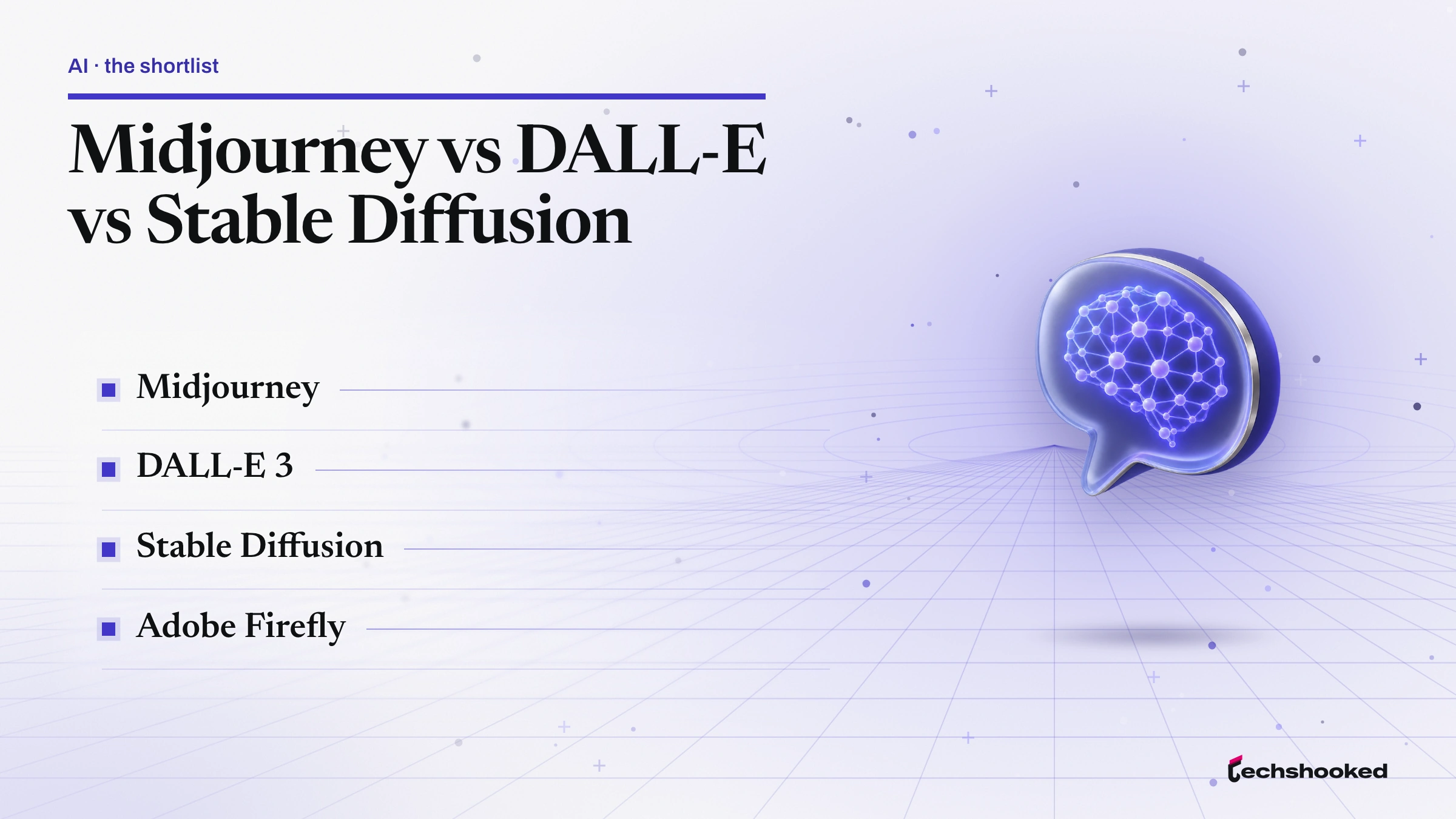
An AI image generator is a model that converts a text prompt into a finished image by running a diffusion process over latent noise. Midjourney, DALL-E, and Stable Diffusion sit at the top of that category, and each one resolves the same task in a materially different way. Midjourney pushes aesthetic polish through a subscription-only Discord and web interface. DALL-E 3 lives inside ChatGPT and the OpenAI API, with the model card published on the OpenAI developer platform (OpenAI Developer Platform, DALL-E 3 model reference). Stable Diffusion ships open weights from Stability AI, which means anyone can pull the model down and run image generation on local hardware. The choice between these tools is rarely about which output looks best in isolation; it is about access model, commercial-use rights, and how much control over the diffusion model the team needs. The sections below walk through how each generator works, what its subscription tier or API channel costs in friction, and where Adobe Firefly fits as a fourth option in agencies with strict training data policies.
How AI Image Generators Work
An AI image generator works by sampling a latent diffusion model that progressively removes noise from a random seed until the decoded output matches the text prompt. The underlying architecture descends from denoising diffusion probabilistic models, a class of generative network that learns to reverse a fixed forward noising process. A text encoder, typically CLIP or a successor, maps the prompt into a vector that conditions the denoising network at each step. A U-Net or transformer backbone predicts the noise component to subtract, and a variational autoencoder decodes the cleaned latent into RGB pixels. The same loop repeats across roughly 20 to 50 sampling steps, and every step is a function of the prompt embedding, so a longer or more specific prompt steers the trajectory through latent space differently. For broader context on the category, the explainer on generative AI tools covers how text, image, video, and audio models share this scaffolding while differing in modality. The mechanics matter for the comparison ahead, because Midjourney, DALL-E 3, and Stable Diffusion all use diffusion architectures but expose very different levers to the user.
- Encode the prompt: a text encoder such as CLIP turns the prompt into a conditioning vector the diffusion model can read.
- Initialize noise: the generator samples a random tensor in latent space, the starting point for the reverse diffusion process.
- Denoise iteratively: a U-Net or transformer predicts the noise to remove at each step, guided by the prompt embedding.
- Decode the latent: a variational autoencoder maps the cleaned latent tensor back into a pixel-space image at the requested resolution.
- Upscale or refine: an optional pass increases output resolution or applies a refiner network for sharper detail.
Midjourney: Aesthetic Quality and Subscription Access
An AI image generator like Midjourney delivers polished, aesthetically refined results from short prompts, with version 7 producing upscaled images at 2048 x 2048 pixels at the default 1:1 aspect ratio, per Midjourney documentation (Midjourney Docs, Image Size and Resolution). Access is gated behind a paid subscription tier, and Midjourney lists four plans on its comparison page: Basic, Standard, Pro, and Mega, all of which auto-renew monthly or yearly unless the subscriber cancels (Midjourney Docs, Comparing Midjourney Plans). Higher tiers add relaxed-mode GPU minutes and unlock private generation mode on Pro and Mega, which hides outputs from other subscribers. The Personalization feature, which Midjourney describes as a style assistant compatible with V6 and V7, lets the model learn an account's stylistic preferences and apply them to subsequent prompts. Each model version maintains its own Global Profile, so personalization tuned on V6 does not automatically transfer to V7. For readers approaching this from the broader generative landscape, the pillar on how modern generative AI systems work covers where diffusion fits next to large language models and multimodal architectures.
- Default output resolution
- Midjourney v7 upscaled images render at 2048 x 2048 pixels in the default 1:1 aspect ratio, per Midjourney documentation.
- Subscription tiers
- Four tiers (Basic, Standard, Pro, Mega) with monthly or yearly auto-renewal until canceled, scaling fast-mode GPU minutes upward at each level.
- Personalization
- A style assistant that adapts output to account preferences, compatible with V6 and V7, with a separate Global Profile per model version.
- Access channel
- Web app and Discord; no public API for image generation, which limits programmatic workflows compared with DALL-E 3.
DALL-E 3: ChatGPT Integration and API Access
An AI image generator like DALL-E 3 is built into ChatGPT and the OpenAI API, making it the lowest-friction entry point for teams already on the OpenAI platform. OpenAI's DALL-E 3 research page describes the model as designed to translate nuanced text prompts into accurate images, with safety mitigations that prevent generation of public figures by name and bias-reduction work on demographic representation (OpenAI, DALL-E 3). The developer reference lists DALL-E 3 alongside the rest of the OpenAI image generation models, accessible through the same OpenAI API used for its text endpoints (OpenAI Developer Platform, DALL-E 3 model reference). Rate limits are not a single universal cap; OpenAI's help center states that the default rate limit for image generation APIs depends on the model and on the user's usage tier, and points to the per-model page for the current numbers (OpenAI Help, Rate Limits for Image Generation). For teams comparing the wider model landscape, the explainer on OpenAI alternatives for language models sketches where DALL-E sits inside the broader OpenAI product surface.
- ChatGPT integration: DALL-E 3 generates images directly inside ChatGPT conversations, with the assistant rewriting short prompts into longer, more specific text prompts before image generation.
- OpenAI API access: the developer platform exposes DALL-E 3 as a standard image endpoint, suitable for embedding image generation into a product backend.
- Rate-limit model: per-model and per-usage-tier, so quotas scale as account spend rises rather than at a single flat ceiling.
- Microsoft Designer and Copilot: DALL-E powers image generation in Microsoft Designer and the image features inside Microsoft Copilot, broadening reach beyond the OpenAI surface.
- Safety filters: the model declines public-figure and trademark requests by default, which reduces risk for ad-adjacent use cases.
Stable Diffusion: Open Weights and Local Deployment
An AI image generator like Stable Diffusion differs from the others by releasing open weights, meaning anyone can download and run the model locally without a subscription. Stability AI's announcement of Stable Diffusion 3.5 frames the release as a family of open models that includes Large, Large Turbo, and Medium variants, with the weights free for non-commercial use and for commercial use by organizations under 1 million dollars in annual revenue under the Stability AI Community License, above which a paid Enterprise License applies (Stability AI, Introducing Stable Diffusion 3.5). The open release reshapes the workflow around the diffusion model. Practitioners can fine-tune the base checkpoint on a custom dataset using LoRA (Low-Rank Adaptation), swap samplers, run inference on a consumer GPU through tooling such as ComfyUI or AUTOMATIC1111, and deploy the model behind a private API without sending prompts to a vendor. The trade-off is direct: the operator owns content moderation, the prompt-safety layer, and the legal exposure tied to training data and downstream outputs. The explainer on AI risks including bias, hallucination, and training-data concerns covers the governance surface that lands on the deploying team rather than on a hosted vendor.
- Open weights
- Model parameters are publicly downloadable from Stability AI and Hugging Face, enabling offline image generation without a subscription.
- Local deployment
- Stable Diffusion runs on a workstation GPU through ComfyUI, AUTOMATIC1111, or a custom inference stack, keeping prompts and outputs on the operator's hardware.
- Fine-tuning with LoRA
- Low-Rank Adaptation allows specialization on a small custom training data set without retraining the base diffusion model from scratch.
- Licensing
- The Stability AI Community License covers Stable Diffusion 3.5 weights for non-commercial use and for commercial use below a revenue threshold, with terms the operator must verify against the use case.
Side-by-Side Comparison: Output, Access, and Cost
Choosing an AI image generator depends on whether you prioritize output style, access model, commercial licensing, or the ability to run locally. Midjourney leads on aesthetic polish for marketing and concept work, DALL-E 3 leads on prompt adherence and integration with text-first workflows through ChatGPT and the OpenAI API, and Stable Diffusion leads on flexibility for teams that need to fine-tune the diffusion model on proprietary training data. Adobe Firefly enters the comparison as a fourth option positioned around licensing safety: Adobe trains Firefly on licensed and public-domain content and ships it inside Photoshop, Illustrator, and Express. The table below maps these tools across the dimensions that matter when picking one for production work. For the broader analytical frame on model selection, the explainer on machine learning explained for broader AI context covers how supervised, unsupervised, and self-supervised training shape what a model can and cannot do.
| Tool | Access model | Default resolution | Commercial use | Open weights | Standout strength |
|---|---|---|---|---|---|
| Midjourney v7 | Web app and Discord, subscription tier required | 2048 x 2048 px upscaled at 1:1, per Midjourney documentation | Granted to paid subscribers under the Midjourney terms | No | Aesthetic polish from short prompts and Personalization style assistant |
| DALL-E 3 | ChatGPT, OpenAI API, Microsoft Designer, Copilot | Configurable, square plus portrait and landscape options | OpenAI usage policy assigns output rights to the user | No | Prompt adherence and integration with text-first workflows |
| Stable Diffusion 3.5 | Open download, local inference, optional hosted API | Configurable, model-dependent | Free under the Community License below a revenue cap, Enterprise License above | Yes | Fine-tuning with LoRA and offline image generation on local hardware |
| Adobe Firefly | Adobe Creative Cloud apps and Firefly web | Configurable inside the Adobe surface | Designed for commercial use with indemnification for enterprise plans | No | Training data limited to licensed and public-domain content |
Commercial Use Rights Across Platforms
Each AI image generator has a different approach to commercial use rights, and matching that policy to your workflow avoids downstream licensing friction. Midjourney grants commercial use to paying subscribers, with the practical implication that an expired subscription tier does not retroactively void output already produced under an active plan, though new outputs require an active plan. The OpenAI usage policy assigns ownership of DALL-E 3 outputs to the user, with the standard caveat that the user is responsible for ensuring prompts and outputs comply with applicable law and OpenAI's content policy. Stable Diffusion sits in a third regime: the Stability AI Community License covers non-commercial use and commercial use below a 1 million dollar annual-revenue threshold, with an Enterprise License required above it, and downstream forks, fine-tuned checkpoints distributed on Hugging Face, and third-party hosted APIs can carry their own licenses on top, so the deploying team checks the license file in the specific checkpoint it runs (Stability AI, Introducing Stable Diffusion 3.5). Adobe Firefly takes the most conservative stance: Adobe trains the model exclusively on licensed and public-domain content and offers enterprise customers indemnification for outputs, a posture aimed squarely at agencies that need a clean training data provenance story. The pragmatic takeaway is that commercial use is rarely a single yes or no across these tools; it is a per-vendor policy that interacts with subscription tier, channel of access, and the specific checkpoint or model variant in play.
- Midjourney: commercial rights for paid subscribers; verify the current Midjourney terms before client delivery.
- DALL-E 3: OpenAI assigns output ownership to the user under the usage policy, with content-policy compliance on the user.
- Stable Diffusion: Stability AI Community License governs the base weights; downstream checkpoints can carry additional terms.
- Adobe Firefly: trained on licensed and public-domain content, with enterprise indemnification available for Creative Cloud customers.
References
- OpenAI, DALL-E 3 Research Index
- OpenAI Developer Platform, DALL-E 3 Model Reference
- OpenAI Help, Rate Limits for Image Generation
- Midjourney Docs, Comparing Midjourney Plans
- Midjourney Docs, Image Size and Resolution
- Stability AI, Introducing Stable Diffusion 3.5
Which AI Image Generator Should You Use?
Selecting an AI image generator for real client work requires weighing output quality, pricing structure, and commercial-use terms against your delivery timeline. The honest answer is that none of the three flagship tools dominates on every axis, and the right pick maps to the workflow constraint that bites hardest. Marketing and concept teams chasing aesthetic polish from short prompts default to Midjourney on a paid subscription tier. Product and engineering teams that already pay for OpenAI infrastructure and want image generation alongside text reach for DALL-E 3 through ChatGPT or the OpenAI API. Teams that need on-prem inference, custom fine-tuning on proprietary training data, or strict prompt confidentiality run Stable Diffusion locally. Agencies with strict IP policies, or those delivering to brand-sensitive enterprise clients, lean toward Adobe Firefly inside Creative Cloud. The deeper architectural background for these choices lives in the how modern generative AI systems work pillar.
- Pick Midjourney when output aesthetic is the lead requirement and a paid subscription tier on Basic, Standard, Pro, or Mega is acceptable.
- Pick DALL-E 3 when the workflow already runs through ChatGPT or the OpenAI API and prompt adherence matters more than stylistic flourish.
- Pick Stable Diffusion when open weights, local deployment, LoRA fine-tuning, or offline operation are non-negotiable.
- Pick Adobe Firefly when training data provenance and enterprise indemnification take precedence over peak aesthetic output.
- Run a side-by-side trial on three representative prompts before committing, since each AI image generator handles resolution, composition, and text rendering differently.
Further reading
Frequently Asked Questions
What is the difference between a diffusion model and a GAN in AI image generation?
A diffusion model gradually removes noise from a random seed to produce an image, while a GAN pits a generator against a discriminator. Most leading AI image generators, including Midjourney, DALL-E, and Stable Diffusion, now use diffusion-based architectures rather than GANs because they produce more diverse and controllable outputs at higher resolution.
How do Midjourney subscription tiers affect image generation volume?
Midjourney offers four subscription tiers, with monthly GPU-minute allocations that scale from Basic through Mega, per Midjourney documentation. All tiers auto-renew monthly or yearly unless you cancel. Higher tiers add relaxed-mode GPU time and, on Pro and Mega, private generation mode that hides outputs from other subscribers.
Can you use AI image generators commercially?
Commercial-use rights differ by tool and subscription tier. Midjourney grants commercial rights to paid subscribers; OpenAI's usage policy assigns DALL-E 3 outputs to the user for commercial use; Stable Diffusion open-weight licenses vary by version and distribution. Always check the vendor's current terms before using AI-generated images in client deliverables.
What does open weights mean for Stable Diffusion users?
Open weights means the trained model parameters are publicly downloadable, so you can run Stable Diffusion locally on your own hardware without a subscription. This enables fine-tuning on custom datasets, offline operation, and integration into private workflows, but also places the responsibility for content filtering and licensing compliance on the operator.
Is Adobe Firefly a direct competitor to Midjourney and DALL-E?
Adobe Firefly trains exclusively on licensed and public-domain content, making it a lower-risk choice for agencies with strict IP policies. It is integrated into the Adobe Creative Cloud suite rather than operating as a standalone AI image generator, which positions it as a workflow complement rather than a direct like-for-like replacement for Midjourney or DALL-E 3.