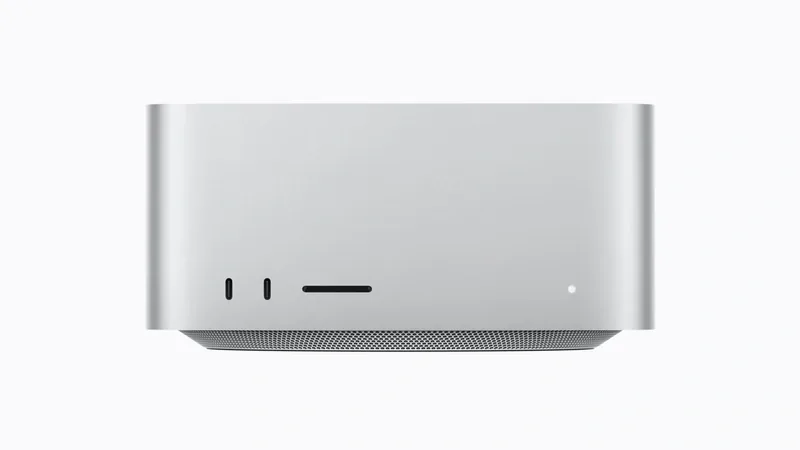
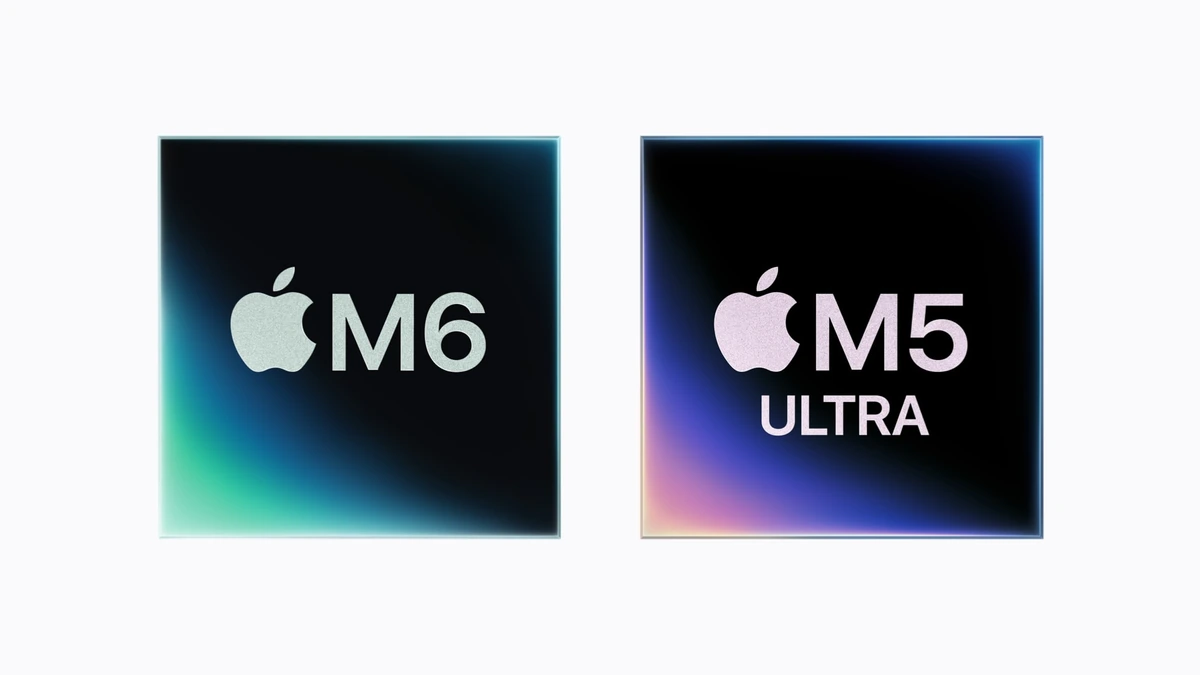
Apple's M6 and M5 Ultra chips land in the Mac mini and Mac Studio, giving the company its first 2-nanometer processor and its first quad-die chip design in a single release.
Per Apple, the M6 pairs a 12-core CPU with a 12-core GPU, a Dual 16-core Neural Engine, up to 32GB of memory, and 170GB/s of bandwidth. The M5 Ultra, Apple's first quad-die chip, uses UltraFusion to join two dual-die M5 Max chips for up to a 36-core CPU, an 80-core GPU, a 32-core Neural Engine, and a 512GB unified memory pool fed at 1.2TB/s.
The two designs answer different workloads. Apple packed Neural Accelerators into the GPU cores of both chips and rates the M6's dual Neural Engine at up to twice the peak compute of the prior generation, a combination aimed at keeping agentic tasks on the device. The 2-nanometer process lets Apple add cores without the power budget climbing, which is what makes that class of compute practical in a compact desktop like the Mac mini. The quad-die M5 Ultra targets teams that rent GPU capacity for heavy work: four dies sharing one memory pool is what lets the Mac Studio keep a very large model and its dataset entirely on the machine.
The release is Apple's clearest statement yet that the next round of AI workloads belongs on the desk rather than in the cloud, with the M5 Ultra's 512GB memory ceiling as the headline argument. Per Apple, Mac mini with M6 starts at $899 and Mac Studio with M5 Ultra at $5,499, both arriving September 22, though the 512GB Mac Studio configuration slips to late October. The performance figures come from Apple's own testing, so independent benchmarks will decide how the generational claims hold up.