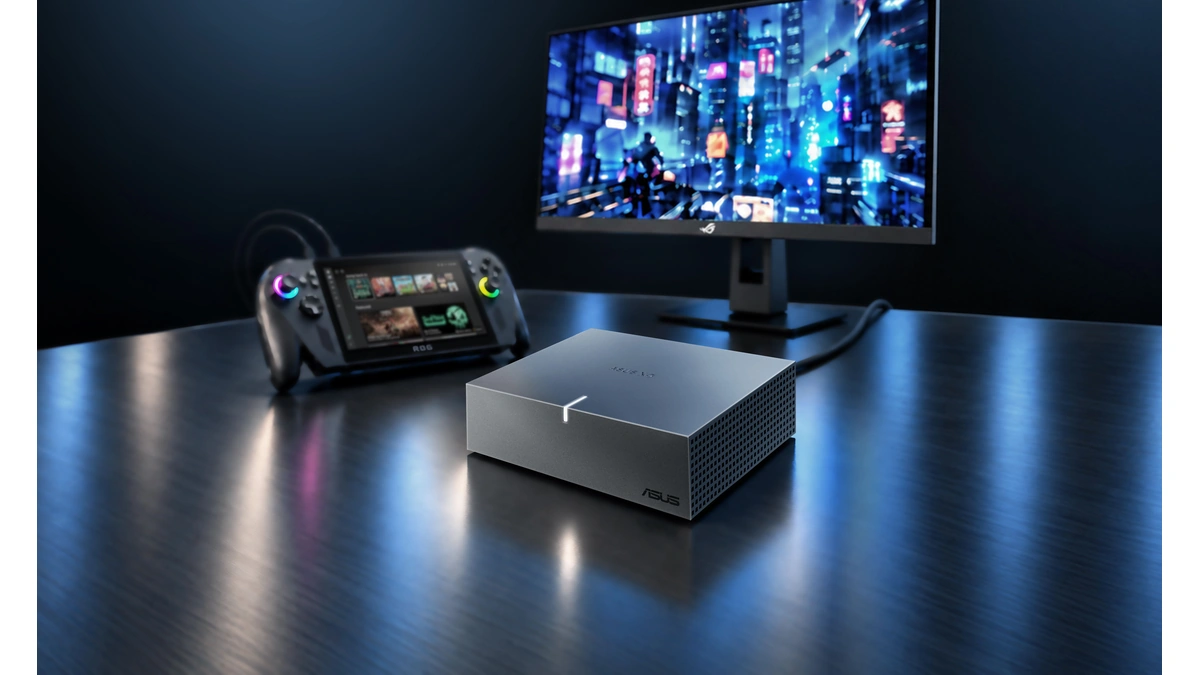
ASUS introduced the Ascent QN10, a compact desktop the company is billing as the first of its kind to squeeze an 80 TOPS neural processing unit into a case smaller than 0.7 liters. ASUS says buyers no longer have to choose between a full-size tower and serious on-device AI horsepower. Its Ascent QN10 runs Qualcomm's Snapdragon X2 Elite platform, built around an 18-core Oryon CPU, and clears Microsoft's Copilot+ PC bar without any extra configuration. It lands as PC makers keep pushing Arm-based Snapdragon silicon out of laptops and into desk-side hardware, betting that on-device inference, not raw clock speed, becomes the thing buyers shop on next.
ASUS puts the machine at about 86% smaller than a conventional 5-liter desktop tower, a shrink that mirrors the same architectural bet Apple made with the Mac mini years earlier: swap x86 for a tightly integrated system-on-chip and the case can shrink dramatically without giving up much compute. Graphics come from a Qualcomm Adreno GPU that ASUS claims outruns the integrated graphics in its earlier Snapdragon mini PCs by a factor of 2.3, enough headroom for casual creative work and light gaming on a machine this small. ASUS is framing the box for creators, developers, and IT buyers who want desk-side AI compute without a workstation's footprint or fan noise.
The 80 TOPS figure comes from the chip's Hexagon NPU, and the practical argument is latency and privacy rather than raw benchmark bragging rights: translation, video processing, and assistant queries that never leave the box avoid both the round-trip delay and the data-handling questions that come with cloud inference. Developers also get Qualcomm's AI Hub, a catalog ASUS says holds more than 175 pre-optimized models, plus support for loading custom models and training data so teams can tune inference on hardware they already own instead of renting cloud GPU time for every experiment.
ASUS paired an fTPM 2.0 module for credential and encryption handling with Microsoft's Pluton processor, which manages device identity and keys on machines administered remotely, a combination aimed at IT departments rolling out AI hardware fleet-wide rather than at a single buyer setting up one desk.
The more unusual claim is hybrid agentic support: the Ascent QN10 can split a task between its own NPU and cloud-hosted large language models depending on the job, using agent frameworks such as OpenClaw and Hermes Agent, with WhatsApp and LINE named as the chat interfaces for triggering those automations. That is a consumer-messaging habit bleeding into enterprise tooling, and it suggests ASUS expects agentic workflows to be operated the way people already run chatbots, not through a dedicated console. Per ASUS's specifications, wireless connectivity on the Ascent QN10 covers Wi-Fi 7 and Bluetooth 6.0, and the company has not said what the machine will cost or when it ships.