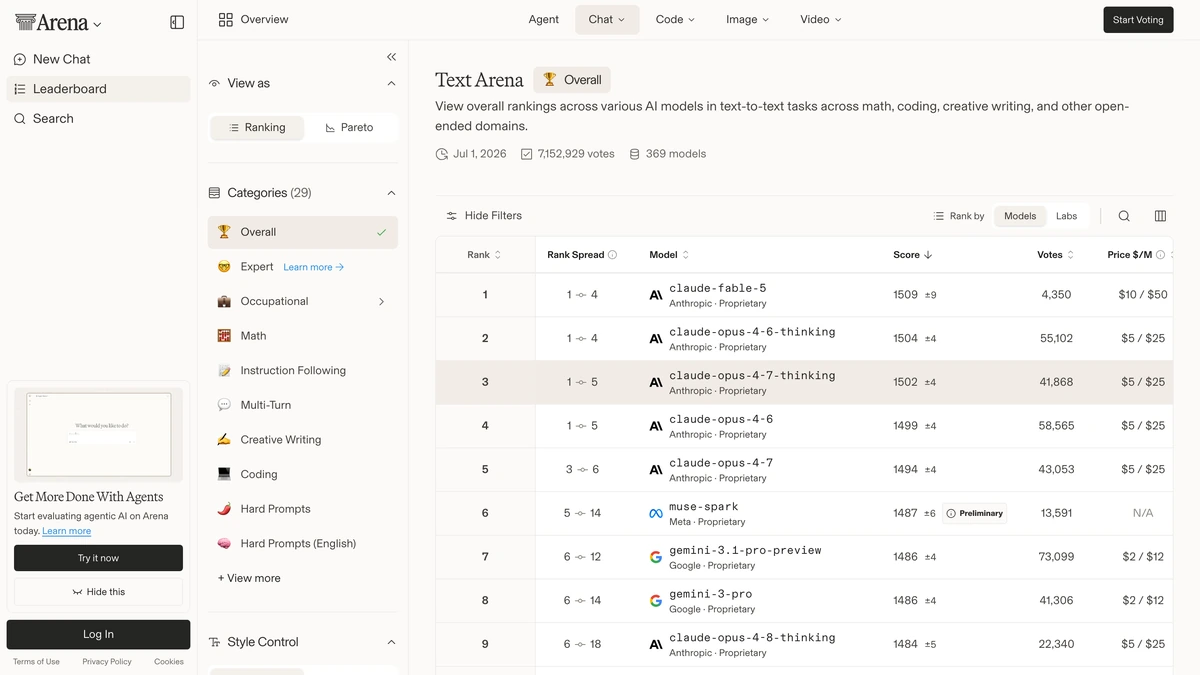
Chatbot Arena, rebranded as LMArena after its 2024 move to a dedicated site, is a free, open platform where a user submits a prompt, receives answers from two anonymous large language models, and votes for the response they prefer. The two models' identities stay hidden until after the vote is cast, so the reader is judging the text on its own merits rather than a brand name. That pairwise comparison, repeated across thousands of users, is what LMArena turns into a public leaderboard.
The project began as an open-source effort from LMSYS and UC Berkeley SkyLab, launched in May 2023 and originally hosted with FastChat, the group's multi-model serving system, at www.lmsys.org/blog/2023-05-03-arena. Researchers Ion Stoica, Wei-Lin Chiang, and Joseph E. Gonzalez are associated with the project's origin at UC Berkeley. Crowdsourced voting at that scale is what separates the Arena from a lab's internal test set: any visitor can cast a vote, and the leaderboard reflects the accumulated result. The core distinction that runs through everything below: LMArena measures which answer people prefer in a blind read, not which answer is objectively correct. That is a different question than a static benchmark or an AI-judged score asks, and the rest of this article builds on that difference.
From Votes to Rankings: The Elo and Bradley-Terry Math
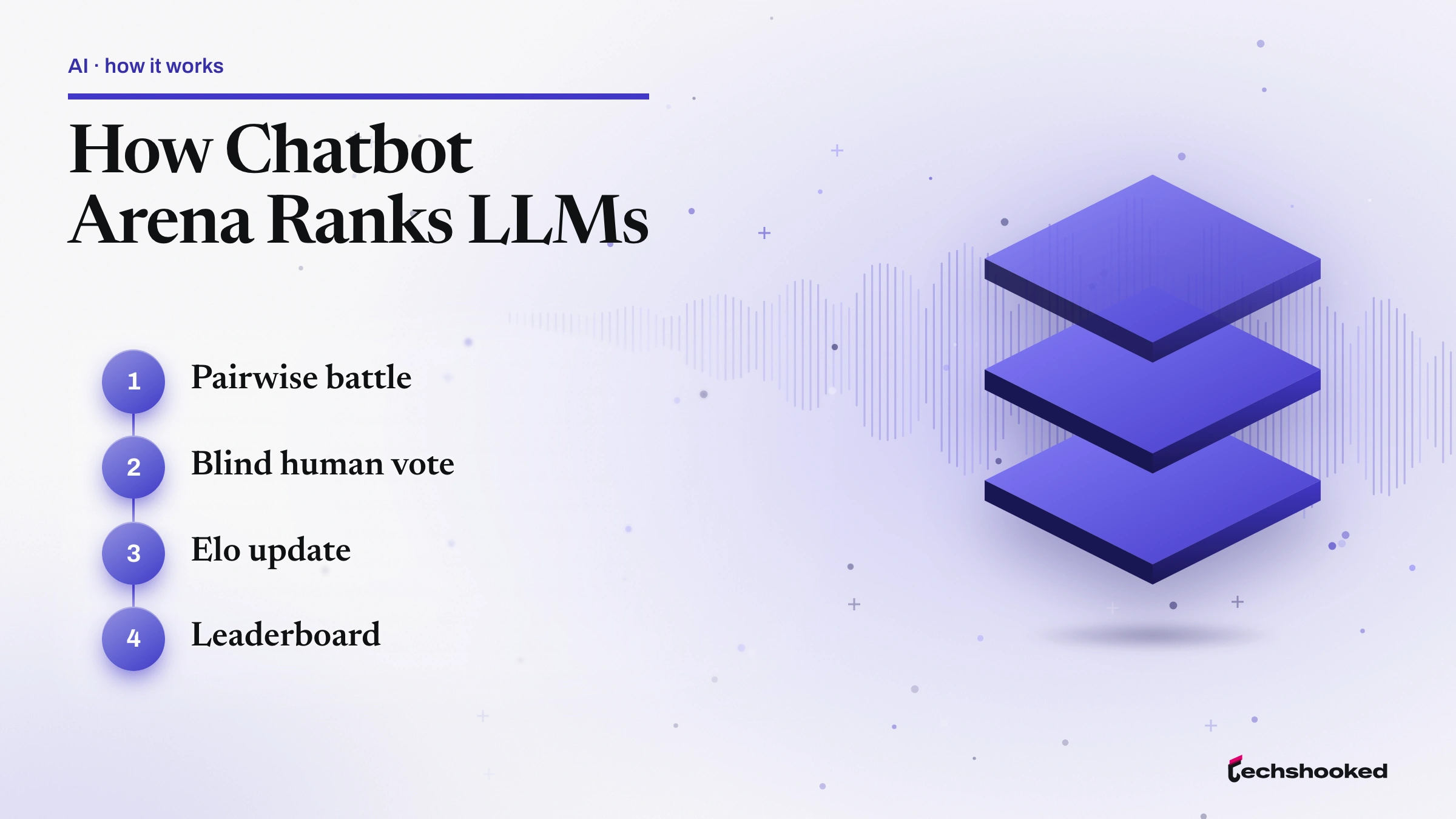
LMArena turns each blind battle's outcome into a rank using the Elo rating system, the same method chess federations use to rate players, before transitioning to the closely related Bradley-Terry model for more stable estimates. The mechanism runs in five steps, from a single pairwise comparison to a public leaderboard entry.
- Two models are sampled at random for a blind battle and shown to a user with their identities hidden, so the response text is the only thing being judged, per news.lmarena.ai/arena.
- The user reads both responses and casts one vote for the preferred answer, or marks a tie if neither stands out, contributing to the platform's crowdsourced voting pool.
- Each pairwise comparison nudges both models' Elo ratings up or down based on how surprising the outcome was, the same update logic chess ratings use, documented at news.lmarena.ai/arena.
- LMSYS later moved from an online Elo rating update rule to the Bradley-Terry model for a more stable, order-independent ranking, a transition detailed at www.lmsys.org/blog/2023-12-07-leaderboard.
- A model's rating only becomes trustworthy after enough votes accumulate; LMArena's own policy states ratings stabilize after at least 1,000 votes, typically more, per news.lmarena.ai/policy.
Concrete numbers help ground the mechanism. LMSYS's December 2023 leaderboard update reported GPT-4-0613 at an Elo rating of 1153 and GPT-4-Turbo at 1217, drawn from more than 130,000 valid votes across over 45 deployed models, per www.lmsys.org/blog/2023-12-07-leaderboard. Those are historical snapshots from a specific dated post, not today's live leaderboard. The project's own methodology paper reported the platform running since April 2023 and having collected over 240,000 crowdsourced votes from about 90,000 users across more than 100 languages as of January 2024, per arxiv.org/abs/2403.04132. That scale of crowdsourced voting is the source of the human preference signal the whole rating pipeline runs on. Vote totals kept climbing after that, and the March 2024 policy page put the count at over 800,000, per www.lmsys.org/blog/2024-03-01-policy. Current standings shift constantly as new models enter and old ones age out, so the exact number worth trusting is the one on the live leaderboard, not a figure quoted from a past post.
Chatbot Arena, MT-Bench, and Other Human-Aligned Evaluation
Chatbot Arena is the best-known human-preference leaderboard, but it sits alongside MT-Bench, a multi-turn question set that also grades responses against human-style judgment rather than a fixed answer key. The research preprint that introduced MT-Bench paired it directly with Chatbot Arena as two complementary ways to approximate human preference at scale, at arxiv.org/abs/2306.05685. The table below lines up Chatbot Arena, MT-Bench, and a static benchmark like MMLU on how each collects a verdict.
| Method | How it collects a verdict | Strength | Limitation |
|---|---|---|---|
| Chatbot Arena / LMArena | Live, crowdsourced pairwise votes from real users on open-ended prompts | Massive scale, organic preference signal, broad language coverage | Reflects whatever prompts users happen to submit, not a fixed representative task set |
| MT-Bench | A curated set of multi-turn questions scored for quality | Controlled, repeatable, tests multi-turn conversation specifically | Smaller and less representative of open-ended real-world traffic than the Arena's live votes |
| Static benchmark (e.g. MMLU) | A fixed multiple-choice or exact-match answer key | One objective, reproducible score per item | Cannot capture writing quality, tone, or formatting a human voter cares about |
A methodological note matters here: some MT-Bench-style pipelines score responses with an AI model acting as the grader rather than a human rater, a technique known as LLM-as-a-Judge. That is a distinct method from what Chatbot Arena runs. Chatbot Arena's verdicts come from human voters clicking a preference button, not from a language model rendering its own judgment on a rubric. The two approaches can complement each other, but conflating them obscures which one a specific leaderboard number is actually measuring.
Why Human Preference Complements Static Benchmarks
A static benchmark such as MMLU can only score what it was built to test, while human preference voting captures qualities no answer key encodes: tone, formatting, helpfulness on an open-ended request, and how a response actually reads to a person. Several properties make that difference useful rather than incidental.
- Open-ended prompt coverage. Arena users submit real, unscripted questions rather than selecting from a fixed multiple-choice item bank, so the leaderboard reflects a wider slice of how people actually use a chatbot.
- Subjective quality signals. Tone, clarity, and formatting have no single correct answer, and a fixed answer key cannot score them at all; a human vote can.
- Resistance to answer-key memorization. A model cannot simply train on a published answer key when the prompts voters submit are live and constantly varied.
- Sample breadth. The LMSYS policy page reported over 800,000 votes by March 2024, and the arXiv methodology paper reported coverage across more than 100 languages as of January 2024, at www.lmsys.org/blog/2024-03-01-policy and arxiv.org/html/2403.04132v1.
Human preference and static benchmarks measure different things, and the useful move is reading them together rather than treating one as a replacement for the other. A model can score well on a fixed answer key and still leave a human preference vote unimpressed, or the reverse, and both readings are informative.
The Limits of Human-Preference Rankings
Human-preference leaderboards carry their own documented limitations, and four show up most often in discussions of Chatbot Arena: style bias, length bias, gameability, and sensitivity to prompt distribution.
- Style bias. Voters can reward confident tone, bullet points, or bold formatting over the accuracy of the underlying content, especially when a reader is skimming two answers quickly.
- Length bias. A longer response can look more thorough to a quick reader even when the extra length adds no real information, a documented tendency across preference-based evaluation broadly.
- Gameability. A lab can tune a model's conversational style specifically toward whatever Arena voters tend to reward, a shift that would not necessarily show up on a static benchmark score at all.
- Prompt distribution. The leaderboard reflects whichever prompts the self-selected pool of Arena visitors happens to submit, not a controlled, representative sample of every possible task; LMArena's own policy acknowledges that only generally available public models are listed and that methodology changes are tracked in a public changelog, per news.lmarena.ai/policy.
The core distinction this article has been building toward follows directly from those limits: preference is not the same thing as correctness. A voter can prefer a fluent but factually wrong answer over a correct one that reads awkwardly, so a high Arena rank does not certify accuracy the way a static benchmark's pass-or-fail score does. A confident, well-formatted answer that quietly contains a fabricated detail can still win the vote, which is one reason a leaderboard rank should never stand in for a dedicated accuracy check.
How Chatbot Arena Fits Into a Broader Evaluation Strategy
Reading a Chatbot Arena rank in isolation misses the point. The leaderboard is one input among several that a team evaluating a model should weigh together, and four concepts frame how to use it responsibly.
- Directional signal. A rising or falling Arena rank is a useful early indicator of how a broad user base perceives a model's conversational quality, not a certified accuracy score.
- Complementary static testing. Pairing an Arena rank with fixed-answer benchmark suites like MMLU and HumanEval catches the objective correctness gaps that voting alone cannot.
- Governance transparency. LMArena's own policy page documents that listed models must be generally available and that ranking-pipeline changes are logged in a public changelog, per news.lmarena.ai/policy, a factor worth weighing when interpreting any sudden rank shift.
- Domain-specific gap. A model can rank well on Chatbot Arena's broad, casual-use prompt mix while still underperforming on a narrow professional or technical task the Arena rarely samples.
LMSYS announced in September 2024 that Chatbot Arena had moved to its own dedicated site and blog at lmarena.ai while remaining a close partner with the original research group, per www.lmsys.org/blog/2024-09-20-arena-new-site. That rebrand did not change the underlying method. A team choosing between models should still treat the Arena leaderboard as one data point, read alongside the broader landscape of AI model evaluation and its limits and, where correctness matters more than style, alongside a check for why models produce confident but incorrect answers in the first place.
References
- LMArena: initial Elo-based Arena results and leaderboard
- LMArena: leaderboard policy
- LMSYS: launching the Arena
- LMSYS: Chatbot Arena leaderboard update
- LMSYS: policy page
- LMSYS: Chatbot Arena moves to its own site
- LMSYS/UC Berkeley: Chatbot Arena arXiv paper
- Judging LLM-as-a-Judge with MT-Bench and Chatbot Arena (arXiv preprint)
Further reading
Frequently Asked Questions
Is Chatbot Arena the same thing as LMArena?
Yes. Chatbot Arena is the original name of the project; LMArena is the current branding after the platform moved to its own dedicated site and blog. LMSYS announced the dedicated lmarena.ai site and blog in September 2024 while remaining a close partner with the original LMSYS research group, so older references to Chatbot Arena and newer references to LMArena describe the same leaderboard.
Does a high Chatbot Arena rank mean a model is more accurate?
Not necessarily. Chatbot Arena measures which response voters preferred in a blind, head-to-head comparison, not whether the response was factually correct. A fluent, well-formatted answer can outscore a correct but plainly worded one, so a strong Arena rank should be read alongside a static, answer-key benchmark rather than treated as proof of accuracy on its own.
How is a model's Chatbot Arena rating actually calculated?
Each blind vote nudges both models' ratings using a rule descended from chess Elo scoring, later refined into the Bradley-Terry model. LMSYS has documented that transition, and LMArena's own policy states a rating only becomes reliable after at least 1,000 votes, typically more, before the number should be trusted.
What is the difference between Chatbot Arena and MT-Bench?
Chatbot Arena collects live, crowdsourced votes on open-ended prompts users choose themselves, while MT-Bench is a smaller, curated set of multi-turn questions. Both incorporate human-style judgment rather than a single fixed answer key, but the Arena's scale and organic prompt mix make it a broader, less controlled signal than MT-Bench's fixed question set.