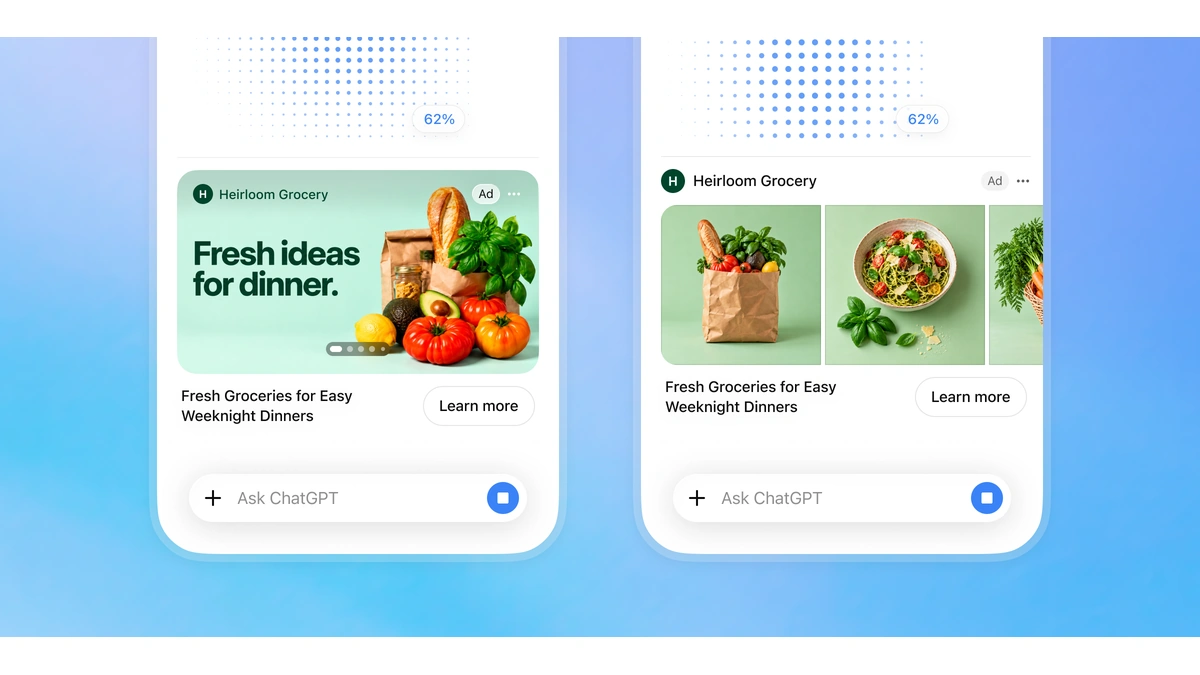
ChatGPT will soon carry visual ads that appear while a user waits for an image to be generated. OpenAI plans to test the format in the US later in October with a first group of advertisers, and it presents the change as a way for people to see how a product or service might fit into their lives.
The ads are built around pictures of a product, of it in use, or of the experience it makes possible. OpenAI says every ad will be labeled and kept apart from the image the user asked for, and that advertising does not shape what ChatGPT answers. The company also puts ChatGPT's weekly reach at 1.2 billion people, a figure it uses to argue that ads let it serve a far larger market than subscriptions alone.
Most of the announcement concerns measurement rather than creative. OpenAI lists integrations with Hightouch, Tealium and LiveRamp for sending conversion data into ChatGPT Ads, plus attribution support from partners such as AppsFlyer, Adjust, Branch, Kochava, Singular and Triple Whale. For incrementality testing, which tries to isolate the sales an ad actually caused, it is working with Haus, Measured and WorkMagic on geo-based experiments, and it describes that effort as early.
OpenAI cites three early partner findings. DV Rockerbox reported that WeightWatchers' attributed cost per acquisition on ChatGPT Ads ran 15.3% below its blended paid-search benchmark. WorkMagic saw 67% of incremental purchases for the wellness brand Dose come from net-new customers, and Triple Whale said 93% of Portland Leather's visitors from the ads were new. Each is a single-brand result relayed by a company that sells measurement, so none says much about typical campaign performance.
On brand safety, OpenAI says its placement guardrails keep ads out of emotionally vulnerable or sensitive conversations, and qualifying advertisers can now use Negative Phrases to rule out contexts specific to their own policies. It is also developing pilots with DoubleVerify and Integral Ad Science in which the two firms assess how those standards are applied in a controlled test setting, without access to private user conversations. If the pilots go ahead as described, outside verifiers would stand behind the claim that sensitive chats stay ad-free, instead of OpenAI alone.