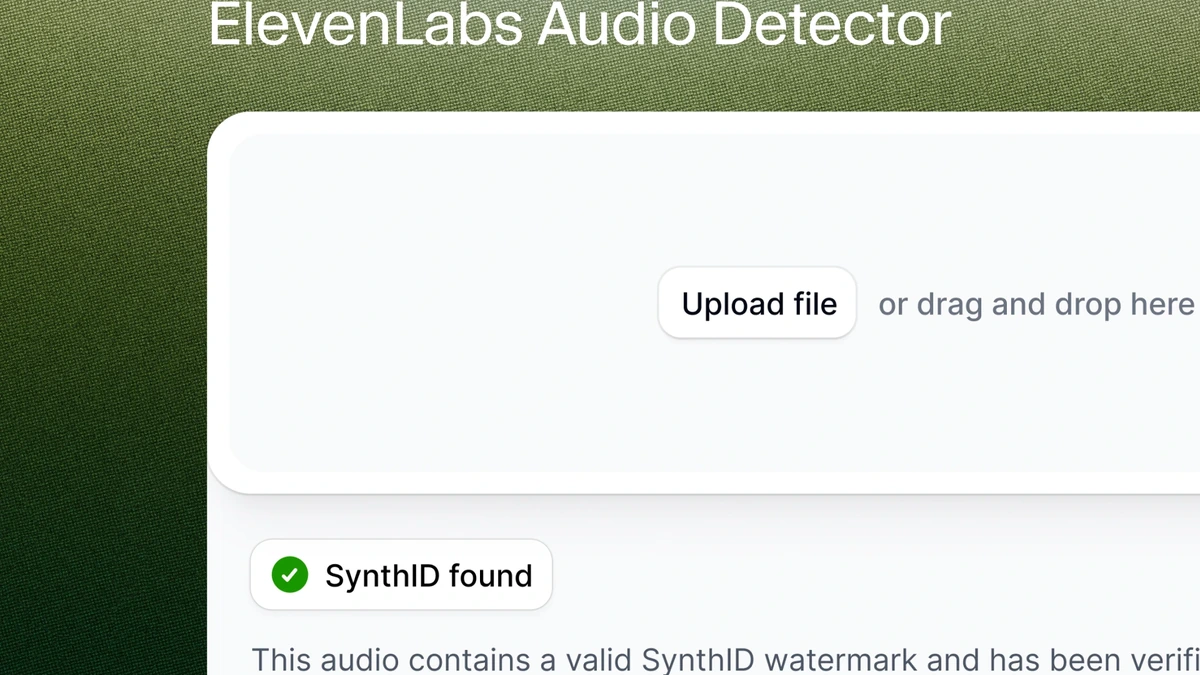
ElevenLabs SynthID is a bet that the way to catch a synthetic voice is a mark you cannot hear. ElevenLabs said on June 25, 2026 that it is embedding the Google DeepMind SynthID watermark into the audio its models generate, and pairing it with a free ElevenLabs Audio Detector, a webpage anyone can use to check whether a clip came out of ElevenLabs. The ElevenLabs SynthID mark goes in at generation time; the ElevenLabs Audio Detector reads it back.
SynthID hides a pattern of sound that sits below what the human ear can detect, with a unique pattern per file, according to ElevenLabs. The mark survives the edits that usually strip provenance, ElevenLabs says, including trimming, speed changes, metadata removal, and format conversion, so a clip stays traceable after the kind of re-encoding it picks up moving around the internet. ElevenLabs also claims the watermark adds no time-to-first-byte latency and does not audibly degrade quality, with a high detection rate and a low false-positive rate. Those figures are ElevenLabs's own and it did not publish the underlying numbers, so the detector's real-world accuracy is not yet independently established.
The honest limit is built into the design. The mark cannot be transferred onto audio that ElevenLabs did not produce, which prevents framing someone by faking their watermark, but it also means the detector answers only one narrow question: did this come from ElevenLabs? It says nothing about voices generated by any other tool, and a bad actor's obvious move is to use a model that does not watermark at all. ElevenLabs is rolling the mark out first on Text to Speech for free users and expanding to all of its audio generation over the coming weeks, and it points to C2PA Content Credentials, including a possible spot on the C2PA soft bindings list, as a way to reattach provenance data that gets stripped.
Watermarking is only as useful as it is universal, and that is the part no single vendor can ship. A detector that covers one company's output raises the cost of a casual fake and gives platforms a signal to check, which is a real gain over nothing. It does not close the gap left by every unwatermarked model, and it leaves open whether audio provenance becomes an interoperable standard the way C2PA is trying to be for images, or stays a patchwork of vendor-specific marks that only catch the honest.