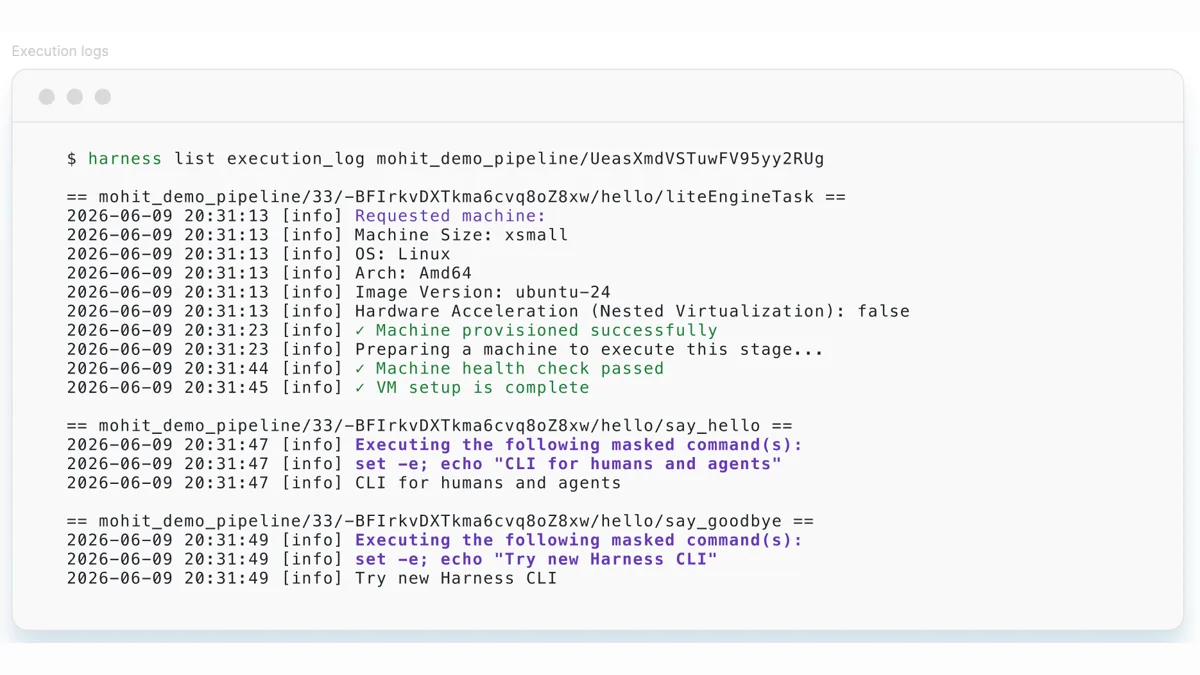
Harness shipped the public beta of Harness CLI on Tuesday, replacing a fragmented set of per-module binaries with a single command-line tool that spans the company's 15-product DevOps platform and was redesigned from the ground up to serve AI coding agents as readily as human engineers.
The Harness CLI binary, version 3.0, follows one grammar across every Harness module: harness <verb> <noun> [identifier] [flags], with six core verbs (list, get, create, update, delete, execute) covering pipelines, continuous delivery, code repositories, artifact registries, infrastructure-as-code workspaces, feature flags, governance policies, and the full audit trail, according to Harness's announcement.
The focus on AI agent support is the more substantive engineering decision. Harness says roughly half the shell commands reaching its platform APIs in an average customer account are now emitted by coding agents (Claude Code, Cursor, and Copilot CLI, among others) rather than typed by engineers. Those agents break when output formats shift or when multiple tools return inconsistent shapes. The Harness CLI addresses this with stable output contracts on every list command (--format json|jsonl|csv|tsv|markdown), deterministic exit codes, and a self-describing harness list noun --format json surface that returns the full action graph as structured data, letting an agent enumerate capabilities before chaining commands into a workflow.
The human developer experience also improves. The Harness CLI's harness list noun command prints every resource type, its module, and the full verb matrix in one screen. Tab-completion resolves live execution IDs and pipeline names from the real API rather than static lists, and a --ui flag on any paged list drops into an interactive terminal browser without leaving the shell. Every mistyped command returns a Levenshtein-based suggestion rather than a blank error.
Harness CLI is fully open source under Apache 2.0 at github.com/harness/cli, with reproducible builds, Software Bill of Materials (SBOMs), and Cosign signatures shipping with each release. macOS (Intel and Apple Silicon) and Linux (amd64 and arm64) are supported today; Homebrew, yum, and a Windows Installer are on the roadmap. Harness says a general availability release will follow the current beta period after the team collects community feedback.
The single-binary approach resolves an accumulation problem common to platforms that grew through module expansion: each new product had added its own binary, its own authentication pattern, and its own flag conventions. Whether the unified grammar holds as Harness continues shipping products will determine whether this is a durable developer-experience improvement or a consolidation that drifts back toward fragmentation over time.