Google DeepMind released Mass Spec Skills, a plugin that teaches its Antigravity agent platform to work out which molecule produced a tandem mass spectrum and to hand a chemist the evidence behind its answer. Mass Spec Skills is available in the Antigravity app now.
DeepMind says the bottleneck is identification. One drop of plant or blood extract can produce tens of thousands of signals, yet comparing them with stored reference spectra labels only about 5% on average, or 10% for human samples. Everything else calls for hand work: infer a formula, pull possible structures from public databases, then check each against the fragment peaks. DeepMind says each stage already has an openly available tool, but an expert needs real time per spectrum while one study can yield thousands.
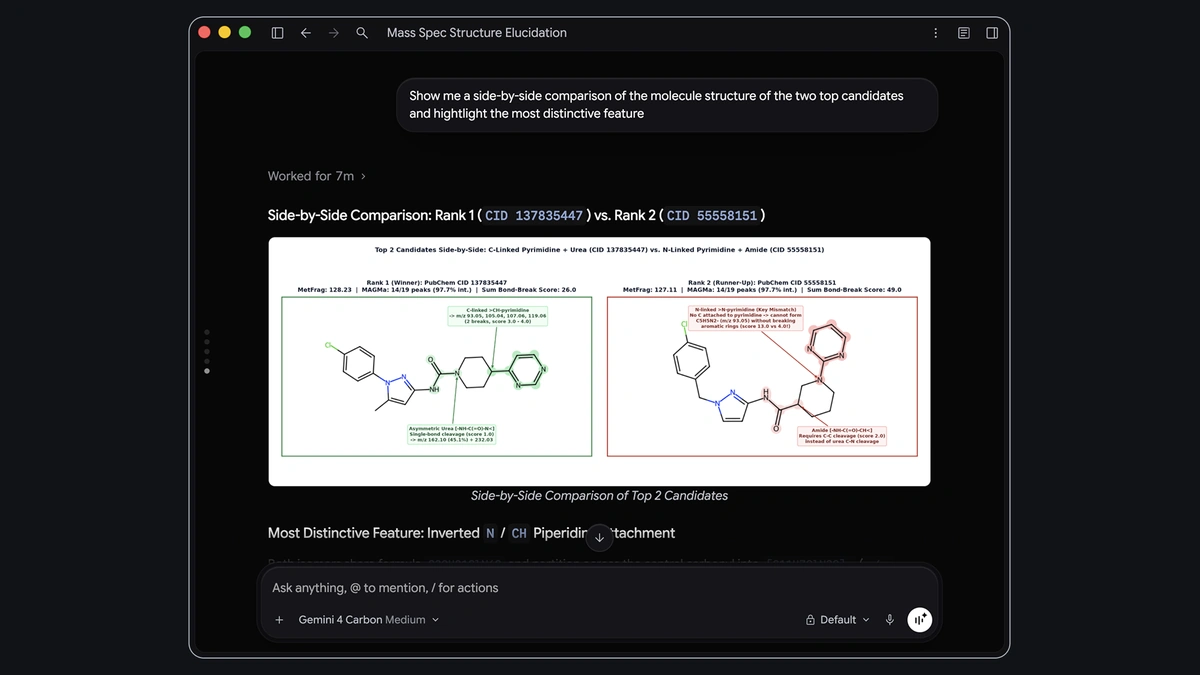
The plugin wraps those open tools, including the SIRIUS formula predictor and the RDKit chemistry library, so that Antigravity can chain them from a request written in everyday words. In DeepMind's worked example, the agent cleaned a recording down from 1,761 peaks to 19, settled on the formula C20H21ClN6O, and scored 845 isomers of that formula from PubChem. Several tied on fragment coverage. Losses of hydrogen chloride and isocyanic acid pointed to a urea group, filtering for a urea bond that splits into the two measured halves left five isomers, and two small fragments then singled out one.
Google DeepMind measured the effect on 100 compounds from the Enamine REAL MS/MS collection in the public MoNA library, testing the lightweight Gemini 3.8 Flash alongside the frontier Gemini 4 Argon and Gemini 4 Carbon, with three tries per spectrum and any run past an hour counted as a miss. With no web access and no skills, each model stayed under 4% exact-match accuracy. With web access but no skills, frontier models still missed a quarter to a third of spectra, and Flash missed more than three-quarters, which DeepMind puts down to search scripts written on the fly that were brittle around precursor windows, adducts and noisy peaks. Add Mass Spec Skills and all three landed the exact molecule in about 97% of tries. Skills also cut the tokens each try generated: by nearly four times for Flash, by half for Argon and by nearly a fifth for Carbon.
Those figures cover compounds whose spectra already sit in public libraries. For a genuinely new molecule, such as many natural products, Mass Spec Skills cannot retrieve or confirm a structure on its own; DeepMind says it supplies a predicted formula, peak assignments and an annotation table as a starting point. Mirror-image molecules and some close isomers need extra data such as retention time, ion mobility or NMR to tell apart, since they fragment almost identically.
Enterprise customers log in with Google Cloud credentials through the Use Business Account option. Separately, DeepMind will give 10,000 scientists its highest Antigravity usage tier at no cost for six months, subject to eligibility, capacity and selection, with onboarding on a rolling basis. Applications are open.