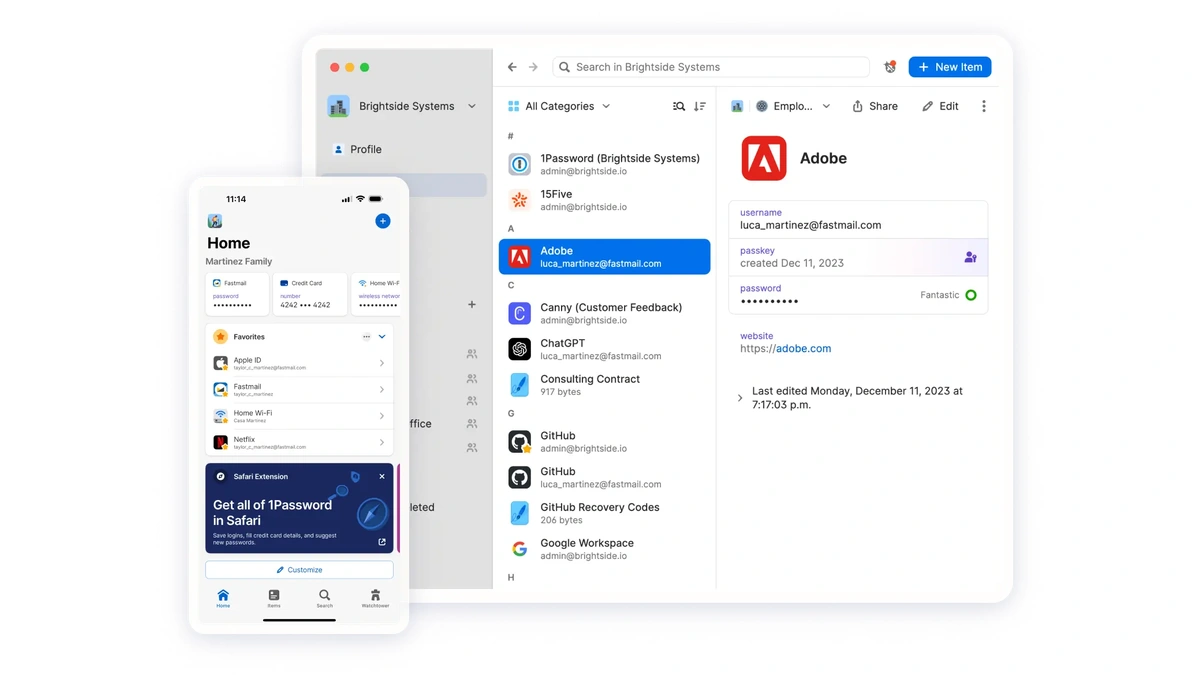
Password manager 1Password said an attacker took over an employee's corporate GitHub account, pushed malicious code to backend services through it, and pulled account records for a subset of customers. The records include names and the email addresses people use to sign in. Vault contents were never accessed, according to the company, which stores neither account passwords nor Secret Keys.
1Password began investigating on November 19, 2026, after indications that the GitHub account had been compromised. The attacker also copied source code from private repositories and reached the CI/CD system, which holds infrastructure secrets the product needs to run. Its response was to shut the account down, cancel the stolen token, strip out the access the attacker had set up, and rotate or revoke each credential that could have leaked. It says its services, availability and product security were not affected.
Per 1Password, the split between what was taken and what was not looks like this:
| Data | Status |
|---|---|
| Names and email addresses | Downloaded |
| Account and user identifiers, account creation and last sign-in times | Downloaded |
| Public keys and Secure Remote Password parameters | Downloaded; the company says the SRP parameters cannot be used to access an account and the public keys have no impact on user security |
| Tokens in certain emailed invitation, provisioning and recovery links | Downloaded |
| Vault items, vault keys, recovery keys, apps and browser extensions | Not affected |
Invitation, provisioning and account-recovery emails each carry a token. A token completes the process only alongside an SSO sign-in or a six-digit code sent to the user's registered email address, and it cannot open an account by itself. The code is now ten alphanumeric characters. If each character can be any of 36 letters and digits, ten characters allow about 3.7 quadrillion combinations, against 1 million for six digits, and the company calls brute-force guessing practically impossible.
A small number of users had invitations or account recoveries in progress, and 1Password has notified them directly. The company says it found no internal evidence of account takeovers using exposed provisioning tokens, and it has brought in independent cybersecurity experts to check its containment and remediation. It has also tightened internal GitHub, CI/CD and endpoint controls and added detections for this kind of attack.
Customers need not change anything in their accounts. 1Password advises caution with unexpected emails, texts or calls about invitations or account recovery that the recipient did not start, and says it will never ask for an account password or Secret Key. It says it will share an update if anything changes what it has stated.