An enterprise password manager is a credential-security platform that centrally generates, encrypts, stores, and audits workforce passwords under administrator control, replacing the ad-hoc credential practices that make organizations vulnerable to credential-stuffing and phishing attacks.
The buyer's framework that follows is the one a security team actually applies before signing a contract, not the consumer-review rubric that dominates most comparison content. The five vendors weighed below (1Password Business, Bitwarden Enterprise, Keeper Business, Dashlane Business, and NordPass Business) qualify on the gating criteria that decide whether a password vault can hold privileged credentials at all: zero-knowledge architecture verified by published audit, SCIM provisioning with direct identity provider integration, an immutable audit trail exportable to a SIEM, a documented emergency access workflow, and regional data residency options. CISA's Cross-Sector Cybersecurity Performance Goals name password manager adoption as a baseline control under IAM goal 2.B, and NIST SP 800-63B grounds the underlying authentication-assurance requirements.
What Makes an Enterprise Password Manager Different From a Consumer Tool
An enterprise password manager differs from a consumer password manager along five operational axes that decide whether the platform can actually live inside a corporate security program: a centralized administration console, identity-provider-brokered authentication, lifecycle provisioning, role-based access control, and immutable audit logging. A consumer vault is a single-user secret store. An enterprise-grade credential vault is a multi-tenant platform with directory sync, policy enforcement, and forensic logging built around the assumption that the operator (a security or IT team) is not the same person as the user.
That distinction matters before vendor selection because it sets the floor. A consumer tool retrofitted with shared folders does not deprovision a departing employee's access automatically, does not emit a SIEM-ingestible audit trail, and does not satisfy a SOC 2 Type II auditor evaluating credential-management controls. The boundary on the other side, where privileged access management (PAM) platforms take over, is also worth fixing: a credential vault stores user and shared-team passwords with SSO-style retrieval, while a PAM system (CyberArk, BeyondTrust, Delinea) brokers session-level access to root and service accounts, rotates secrets after each use, and records the session itself. Workforce credential vaults and PAM platforms coexist; they do not substitute for each other.
Core Admin Capabilities Security Teams Require
Five capabilities are the baseline for any enterprise password manager evaluation: centralized vault-policy enforcement (length, complexity, MFA-required tiers); automated user provisioning and deprovisioning over SCIM 2.0; directory sync with Microsoft Entra ID (formerly Azure AD), Okta, Google Workspace, or Duo; granular role-based permissions across user, manager, admin, and owner tiers; and read-only audit-log access for compliance teams. These five capabilities feed directly into the comparison table further down. Encryption architecture, which determines how vault contents are protected against the vendor itself, is covered in the next section alongside the Difference Between Encryption And Tokenization reference for the underlying cryptographic model, and the MFA vs SSO: A Comprehensive Comparison guide covers the single sign-on integration patterns these platforms layer on top of.
How to Evaluate a Password Manager: The Security Criteria That Matter
Evaluating a password manager for enterprise use properly means weighing six operator-grade axes that vendor marketing pages tend to compress or obscure. The list below is the scoring rubric applied to the comparison table in the next section; it is not a vendor walkthrough.
- Encryption architecture. Distinguish a true zero-knowledge architecture (vault contents are encrypted client-side, the server never sees plaintext or derived keys) from architectures that advertise zero-knowledge but rely on server-assisted recovery paths that weaken the guarantee. Inspect cipher choice (AES-256-GCM, AES-256-CBC, XChaCha20) and key derivation (PBKDF2-SHA256, Argon2id) on the vendor's public security paper.
- SCIM provisioning and single sign-on integration depth. Note which identity provider integrations are native (SCIM 2.0 endpoints with direct directory sync) versus indirect (SAML-only with manual user import). Native lifecycle sync is what turns offboarding from a multi-step ticket into an automated event.
- Master password recovery and emergency access workflow. Document the recovery paths the vendor offers before any employee is enrollled: account-recovery kits, admin-initiated recovery, designated emergency-access contacts, or full SSO-only mode that eliminates the master password recovery problem entirely.
- Audit-trail completeness. Confirm that audit logs are immutable (append-only, tamper-evident), exportable to Splunk or QRadar, and retained long enough to satisfy the organization's compliance regime. Mutable logs fail every credential-management audit.
- Breach-history transparency. Read the vendor's published incident notices end-to-end. Look for breach notification timelines, scope detail, and what changed afterwards. Silence in this area is itself a signal.
- Regional data residency and data-processing agreements. For EU operations, confirm an EU-region option for vault hosting and standard contractual clauses for any US data transfer. For US public-sector, look for FedRAMP authorization. For APAC, look for localized data centers.
Encryption Architecture and Zero-Knowledge Claims
A genuine zero-knowledge architecture encrypts the password vault on the client device with a key derived from material the server never holds. 1Password layers this further by combining the user's master password with a 128-bit Secret Key generated at enrollment and stored only on the client; both are required to derive the vault key, and the server sees neither. The Secret Plus Random Password protocol (SRP) lets the server authenticate the client without ever receiving the master password. Bitwarden takes a different transparency path: the platform is open source, and Cure53 and Insight Risk Consulting publish annual third-party audits against the public codebase. AES-256-GCM is the dominant cipher across these vendors; NordPass uses XChaCha20, which carries comparable security with different side-channel and nonce-handling tradeoffs. End-to-end encryption holds as a guarantee only if the cipher and the key-derivation path are both correctly implemented and publicly reviewable. The Role Of TLS/SSL In Data Protection covers the transport-layer encryption that protects sync traffic between the client and the vault back-end.
SCIM Provisioning and SSO Integration Depth
SCIM provisioning is what closes the gap that single sign-on integration leaves open. SSO handles authentication; SCIM 2.0 handles lifecycle events (new hires, role changes, terminations) by pushing directory state into the password manager back-end in near real time. An SSO-only configuration that lacks SCIM forces administrators to deprovision vault accounts manually, which creates a window where a departed employee retains access if any credential was shared outside the IdP-gated flow. A second distinction matters here: SSO-only vault mode (the IdP token is the sole authentication factor, no master password at all) eliminates the master password recovery surface but raises the cost of an IdP outage. SSO plus master password preserves vault access during IdP downtime at the cost of keeping a recovery process around. For regulated-data environments, this tradeoff is worth documenting before procurement; see Best Practices For Securing Regulated Data for the broader control map.
Vendor Comparison: 1Password, Bitwarden, Keeper, Dashlane, and NordPass
The five password manager platforms compared below all qualify on the gating criteria from the previous section; the table isolates where they diverge on the seven attributes that decide most procurement outcomes. After the table, the prose addresses the differentiator rows rather than walking through each vendor.
| Vendor | Encryption algorithm | Zero-knowledge verified by | SCIM 2.0 + SSO IdPs | Emergency access / recovery | Audit log: immutable + SIEM export | Data residency options | Breach-history transparency |
|---|---|---|---|---|---|---|---|
| 1Password Business | AES-256-GCM + Secret Key (dual-key derivation) | Public security design white paper; SRP authentication | Okta, Entra ID, Google Workspace, Duo, Rippling, JumpCloud | Emergency Kit at enrollment; admin-initiated account recovery | Immutable event log; Splunk, Sumo Logic, Panther export | US, EU, Canada | No publicly disclosed vault breach |
| Bitwarden Enterprise | AES-256-CBC with HMAC-SHA-256; Argon2id KDF option | Cure53 and Insight Risk Consulting annual audits; open source | Okta, Entra ID, Google Workspace, OneLogin, JumpCloud | Admin password reset; trusted-device emergency access | Immutable event log; Splunk, syslog, generic SIEM webhook | US, EU; self-host option for any region | No publicly disclosed vault breach; transparent issue tracker |
| Keeper Business | AES-256-GCM; PBKDF2-SHA256 KDF | SOC 2 Type II, ISO/IEC 27001, FedRAMP Authorized | Okta, Entra ID, Google Workspace, Duo, Ping, ADFS | Account Recovery via security questions; admin master password reset | Immutable audit log; Splunk, QRadar, ArcSight, Sumo Logic export | US, EU, AU, JP, CA; on-prem option for regulated workloads | No publicly disclosed vault breach |
| Dashlane Business | AES-256-GCM; Argon2d KDF | SOC 2 Type II; third-party penetration test reports | Okta, Entra ID, Google Workspace, OneLogin, JumpCloud | Confidential SSO (no master password) or master password plus device key | Immutable activity log; SCIM events; SIEM export via API | US, EU | No publicly disclosed vault breach |
| NordPass Business | XChaCha20; Argon2 KDF | SOC 2 Type II; Cure53 audit | Okta, Entra ID, Google Workspace, OneLogin, MS ADFS | Recovery code at enrollment; admin emergency-access provisioning | Immutable activity log; CSV and JSON export, SIEM via API | US, EU; data processing in EU by default | No publicly disclosed vault breach |
| LastPass Business† | AES-256; PBKDF2-SHA256 KDF | SOC 2 Type II; SOC 3 | Okta, Entra ID, Google Workspace, OneLogin, PingFederate | SMS recovery; account recovery one-time password | Activity reporting; Splunk, syslog export | US, EU | See footnote |
The differentiator that separates 1Password from the rest of the field is the Secret Key. By combining a server-unknown 128-bit value with the master password to derive the vault key, 1Password forces an attacker who exfiltrates a vault to possess both factors before any offline cracking attempt has meaning. Bitwarden's differentiator is verifiability: the codebase is open and the audit reports are public, which lets a security team confirm the zero-knowledge claim against running source rather than against a marketing page. Keeper's differentiator is regulatory coverage, with FedRAMP authorization and ISO/IEC 27001 certification that public-sector and compliance-bound buyers cannot get from any other vendor in the table.
On emergency access workflow, Dashlane's Confidential SSO is structurally different: the master password is eliminated entirely, the IdP token becomes the sole authentication factor, and forgotten-master-password recovery stops being a failure mode at the cost of full dependency on the identity provider. NordPass's XChaCha20 cipher choice is the architectural outlier; comparable security to AES-256 on modern hardware, but a different review surface. The SaaS-credential integration pattern that ties any of these platforms into a wider posture program is covered in Secure SaaS Applications At Scale.
For most enterprise buyers, three of the seven columns are binary pass/fail disqualifiers: a verified zero-knowledge claim from an independent party, SCIM 2.0 lifecycle sync against the organization's directory, and immutable audit-log export to the corporate SIEM. The remaining four columns (encryption algorithm, recovery workflow, data residency, breach-history transparency) are weighted tradeoffs that depend on the organization's regulatory exposure and risk model.
Deployment and Integration Patterns for Enterprise Environments
A password manager deployed at enterprise scale falls into one of three architectures, and the choice has cascading consequences for directory integration, helpdesk load, and regulatory fit. The decision map below names the three patterns and the conditions under which each is the right starting point.
- Cloud-hosted SaaS vault with IdP federation. The vendor hosts the vault back-end, the organization configures directory sync and single sign-on integration against Okta, Entra ID, or Google Workspace, and the password vault inherits the IdP's MFA and conditional-access policies. This is the default deployment for the majority of mid-market and enterprise buyers; it carries the lowest operational burden.
- Self-hosted vault for regulated environments. Bitwarden Enterprise's self-host option and Keeper's on-prem deployment keep the password vault and the encryption key infrastructure inside the organization's network boundary. This is the right pattern for air-gapped environments, IL4 and IL5 workloads, and any regulator that prohibits third-party custody of credential material.
- Hybrid deployment with on-prem SCIM connector. The vault runs in the vendor's cloud, but an on-prem agent brokers directory sync against a directory that cannot reach the public internet. This is the compromise pattern for organizations that want cloud convenience without exposing the corporate directory.
The helpdesk impact of full SSO-only mode is the second decision the architecture forces. With no master password, a forgotten-password ticket is replaced by an IdP password reset that the helpdesk already handles for every other application. With SSO plus master password, the helpdesk inherits a credential-recovery workflow unique to the password manager. Privileged access management integration is a separate tier: CyberArk, BeyondTrust, and Delinea handle the root, domain-admin, and service-account secrets that an enterprise credential vault should not hold; the two systems coexist, with the password manager covering workforce credentials and the privileged access management platform covering privileged ones.
Regulated-Industry Considerations
FedRAMP Authorization (Keeper Business) is the gating credential for US federal civilian agencies and most defense-adjacent contractors; the other four vendors hold SOC 2 Type II coverage, which is the floor for commercial procurement but not sufficient for federal scope. ISO/IEC 27001 certification is broadly held across the field. EU buyers should confirm data-processing agreements that incorporate standard contractual clauses, verify the region where encryption key management infrastructure runs (US-only vs EU-region option), and document regional data residency in the vendor contract. Best Privacy Tools For Enterprises covers the complementary tooling categories most regulated programs stack alongside the password manager itself.
Selecting the Right Vendor: A Decision Framework
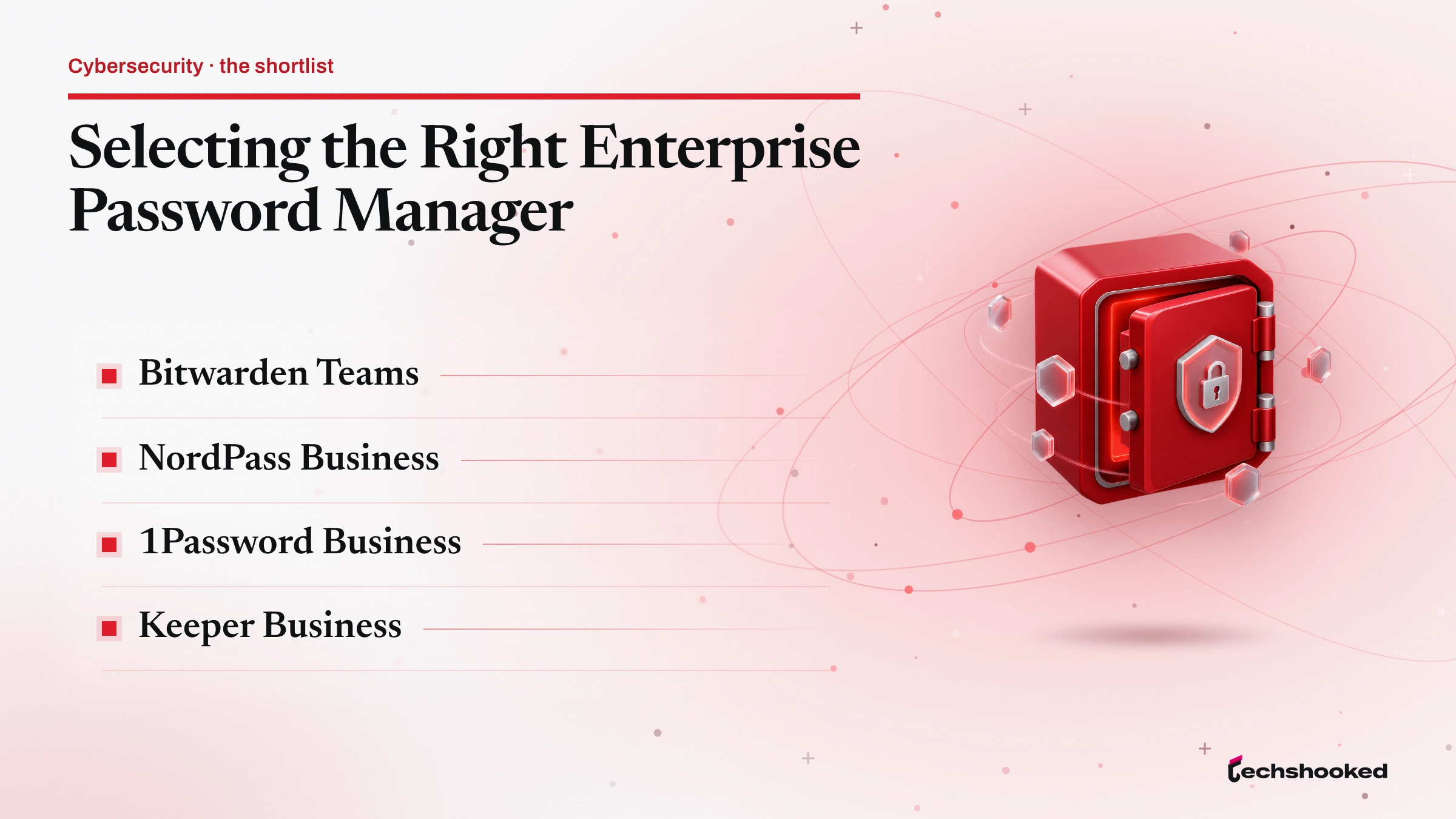
A password manager selection for an enterprise rarely has a single correct answer, but the buyer's profile narrows the field quickly. The framework below maps four common archetypes to a defensible starting point; final selection still depends on the proof-of-concept results against the organization's specific identity provider and audit-trail requirements.
- SMB under 100 seats with no dedicated IdP. Bitwarden Teams or NordPass Business offer the strongest cost efficiency without sacrificing end-to-end encryption or a verified zero-knowledge claim. The trade is reduced enterprise SSO depth, which matters less below the threshold where lifecycle sync is the dominant operational concern.
- Mid-market with Okta or Microsoft Entra ID. 1Password Business delivers the deepest native SCIM provisioning and single sign-on integration against these identity providers, alongside the Secret Key architecture that gives the strongest published defense against vault-exfiltration scenarios.
- Compliance-heavy (HIPAA, FedRAMP, IL4). Keeper Business is the default starting point because FedRAMP Authorization and ISO/IEC 27001 certification are gating credentials that the other vendors do not hold. The audit-trail completeness and BreachWatch credential-exposure monitoring also fit the compliance-program reporting cycle.
- Open-source mandate or self-host requirement. Bitwarden Enterprise is the only entry that combines published Cure53 audits, an open codebase, and a supported self-host deployment, which together satisfy procurement gates in regulated environments that prohibit third-party custody of vault data.
Any of the five qualified vendors closes the credential stuffing attack surface that a no-password-manager posture leaves open and standardizes end-to-end encryption across every stored credential, which is the underlying point of the exercise. Credential stuffing remains the highest-yield attack against any workforce that has not adopted at least that much, and end-to-end encryption gives the vault contents a defensible posture even when an attacker reaches the storage layer. The differences in zero-knowledge architecture, audit trail, and emergency access workflow are second-order optimizations on top of that first-order control that organizations either have in place or do not.
Further reading
- Difference Between Encryption And Tokenization (hub reference for the encryption architecture underpinning every zero-knowledge claim)
- Secure SaaS Applications At Scale (SSPM field guide covering credential integration at the SaaS layer)
- MFA vs SSO: A Comprehensive Comparison (federation patterns that sit underneath credential vault deployment)
- Best Practices For Securing Regulated Data (control patterns for PCI DSS, HIPAA, and GDPR scope alongside credential vaults)
- Splunk vs IBM QRadar Pricing (SIEM selection for teams evaluating audit-log export compatibility with their credential vault)
- NIST SP 800-63B (authentication and lifecycle management baseline) and the OWASP Authentication Cheat Sheet (credential management reference)
Frequently Asked Questions
What happens if an employee forgets their master password in an enterprise password manager?
Recovery options depend on the vendor's architecture and the policies the administrator has configured before the event occurs. Most enterprise password managers offer at least two pathways: an account-recovery kit generated at enrollment (1Password's Emergency Kit) or an admin-initiated account recovery that requires the employee to re-enroll and re-encrypt their vault. Some vendors (Dashlane Business in SSO-only mode) eliminate the master password entirely, delegating authentication to the corporate IdP, which means a forgotten master password is simply not a failure mode. Security teams should document their chosen recovery workflow in the onboarding runbook before any vault is provisioned, because post-incident recovery paths are narrower and more disruptive than pre-configured ones.
Is SCIM provisioning necessary if we already use SSO?
SSO handles authentication but does not provision or deprovision vault accounts. Without SCIM, a departing employee's vault account persists until an administrator manually removes it, creating a window in which the former employee retains access if the IdP session token is cached or if any credential was shared outside the SSO-gated vault. SCIM 2.0 closes this gap by syncing directory changes (new users, group membership changes, deactivations) automatically to the password-manager back-end. In environments with high employee turnover or contractor populations, automated lifecycle sync reduces offboarding risk from a manual multi-step process to a near-real-time automated one.
What should an organization do if its password manager vendor reports a breach?
The first action is to verify the scope of the breach against the vendor's official incident notice, specifically whether encrypted vault data was exfiltrated and whether the encryption key material was stored server-side. If vault data was exfiltrated but remained client-side encrypted (zero-knowledge architecture holding), the immediate risk is confined to offline cracking attempts against weak master passwords. Organizations should rotate all high-value credentials immediately, tighten master-password complexity requirements for all accounts, and evaluate whether the vendor's breach-response timeline and breach notification transparency meet their contractual and regulatory obligations before deciding whether to migrate.