End-to-end encryption is a data protection method that encrypts a message on the sender's device and decrypts it only on the recipient's device, so that no intermediary, including the messaging service itself, can read the content in between. The design goal is narrow and absolute: a message only appears in decrypted form for the person sending it and the person receiving it, and the service carrying that message between them never holds a key capable of unlocking it. That distinction, between a provider that merely moves encrypted bytes and a provider that could theoretically read them, is what separates genuine E2EE from the encrypted-but-readable-by-the-host model many services still use.
The mechanics behind that guarantee, public-key exchange, the Signal Protocol's Double Ratchet algorithm, and the forward secrecy it produces, explain why E2EE resists both casual interception and a later key compromise. They also explain where the protection stops: E2EE secures message content, not the metadata around it, and that gap sits at the center of an ongoing lawful-access debate between governments and security researchers over whether encrypted messaging services should build in a way for law enforcement to go around it.
How End-to-End Encryption Works
E2EE relies on public-key exchange so two devices can agree on a shared secret without ever transmitting that secret across the network. Each device generates a key pair: a public key it can hand out freely, and a private key it never shares. Public-key exchange lets a sender's device and a recipient's device combine their own private key with the other party's public key and independently arrive at the same shared secret, a value that never has to cross the wire in the first place. According to Cloudflare's explainer on end-to-end encryption, public-key cryptography enables two parties to communicate without having to send the secret key over an insecure channel, which is exactly the property that keeps a network operator or an eavesdropper from reconstructing the key by watching traffic. Any key agreement protocol built on this model, whether it is Diffie-Hellman, RSA-based exchange, or an elliptic-curve variant, shares that same core property: the shared secret is derived independently on both ends, not sent. Standards bodies including the National Institute of Standards and Technology, the Internet Engineering Task Force, and the World Wide Web Consortium publish foundational cryptographic specifications that underpin key exchange schemes used well beyond any single messaging app.
Once that shared secret exists, the decryption key remains on the user's device rather than being held by the service, per the same Cloudflare source. That single design choice is what makes E2EE meaningfully different from a service that merely encrypts traffic on its way to a company's own servers. When end-to-end encryption is used correctly, a message only appears in decrypted form for the person sending the message and the person receiving it, with every hop in between, routing servers, backup systems, customer-support tooling, seeing only ciphertext it cannot open.
That architecture-level description, key exchange first, then per-message encryption, holds regardless of which specific cipher a given implementation uses under the hood. The protocol that has done the most to standardize this key agreement protocol plus ratchet approach for consumer messaging, and the one with the clearest public documentation, is the Signal Protocol.
The Signal Protocol and the Double Ratchet Algorithm
The Signal Protocol is the cryptographic specification most widely credited with defining modern E2EE for consumer messaging, combining a key agreement protocol with the Double Ratchet algorithm for ongoing message security. Signal describes the Signal Protocol as a set of cryptographic specifications that provides end-to-end encryption for private communications exchanged daily by billions of people around the world, and states that after its publication in 2013 the Signal Protocol was adopted not only by Signal but well beyond, according to Signal's own blog post announcing PQXDH. Signal also states it uses elliptic curve cryptography as the public-key cryptosystem supporting many of its specifications.
The protocol runs in stages, each building on the last:
- X3DH key agreement. X3DH, or Extended Triple Diffie-Hellman, establishes a shared secret key between two parties who mutually authenticate each other based on public keys, and provides forward secrecy and cryptographic deniability, per Signal's technical documentation.
- PQXDH key agreement. PQXDH, or Post-Quantum Extended Diffie-Hellman, performs the same key-agreement role as X3DH while adding post-quantum forward secrecy and a form of cryptographic deniability, according to the same Signal documentation.
- The Double Ratchet takes over. Once the initial shared secret from X3DH or PQXDH is established, the Double Ratchet algorithm is used by two parties to exchange encrypted messages based on that shared secret, per Signal's Double Ratchet Algorithm specification (Revision 4, dated 2025-11-04).
- Per-message key derivation. The parties derive new keys for every Double Ratchet message so that earlier keys cannot be calculated from later ones, per the same specification.
- Continuous Diffie-Hellman refresh. The parties also send Diffie-Hellman public values attached to their messages, and the results of those calculations are mixed into the derived keys, again per Signal's Double Ratchet specification.
This stack, key agreement first, then the Double Ratchet, is what Signal itself documents publicly; deeper integration details for how a specific third-party client wires the Signal Protocol into its own app fall outside what Signal's public specification confirms.
Forward Secrecy: Why a Stolen Key Cannot Unlock Old Messages
Forward secrecy is the property that makes E2EE resilient even if a single key is later compromised, because the Double Ratchet's constant key rotation prevents that compromise from reaching backward into earlier conversations. Because the algorithm derives new keys for every message and mixes fresh Diffie-Hellman values into each derivation, earlier keys cannot be calculated from later ones, per Signal's Double Ratchet specification. Signal states plainly that these properties give some protection to earlier or later encrypted messages in case of a compromise of a party's keys.
In practice, that means an attacker who obtains today's decryption key from a compromised device cannot walk that key backward to decrypt yesterday's conversation, because yesterday's key was already discarded and cannot be reconstructed from today's. PQXDH extends this same idea forward: it adds post-quantum forward secrecy on top of the classical version, per Signal's documentation, as a hedge against future decryption capability rather than a claim that any deployed system faces that threat today.
End-to-End Encryption vs. Encryption in Transit and at Rest

E2EE is one of three distinct data protection categories, and confusing it with encryption in transit or encryption at rest is the single most common misunderstanding about what a service actually protects. All three encrypt data, but they answer different questions about who can decrypt it and where.
| Category | What it protects | Who can decrypt | Example |
|---|---|---|---|
| End-to-end encryption | Message content between two specific parties | Only the sender and recipient devices | Signal, other E2EE messaging apps |
| Encryption in transit (TLS/SSL) | Data moving between a client and a server | The server operator, on arrival | A browser connecting to an HTTPS banking site |
| Encryption at rest | Data stored on disk or in a database | Whoever controls the storage system's keys | A cloud provider's stored user files |
TLS, the protocol behind encryption in transit and the successor to the older Secure Sockets Layer, is a protocol for encrypting, securing, and authenticating communications that take place on the internet, and its main use case is securing communications between a client and a server, according to Cloudflare's explainer on how SSL works. Crucially, TLS is implemented between a user and a server, not between two users, per Cloudflare's dedicated end-to-end encryption explainer. That means a service can run TLS on every connection and still let the server operator read message content the moment it arrives, which is precisely the gap end-to-end encryption is built to close. The same source notes that many messaging services offer encrypted communications without true end-to-end encryption, often because the provider still holds a decryption key for moderation, backups, or search features.
Encryption at rest works on a parallel but separate axis. Cloudflare's general encryption explainer states that encryption ensures no one can read communications or data at rest except the intended recipient or the rightful data owner, but for stored data that "rightful owner" is typically the storage operator, not the original sender of a message. A service can therefore be encrypted in transit and encrypted at rest while still allowing the provider itself to read message content, because the provider holds the decryption keys in that model. Only end-to-end encryption removes that provider-side key entirely.
Where End-to-End Encryption Is Used and What It Does Not Hide
E2EE now protects message content across several major consumer platforms, though the specific guarantees and default settings vary by service:
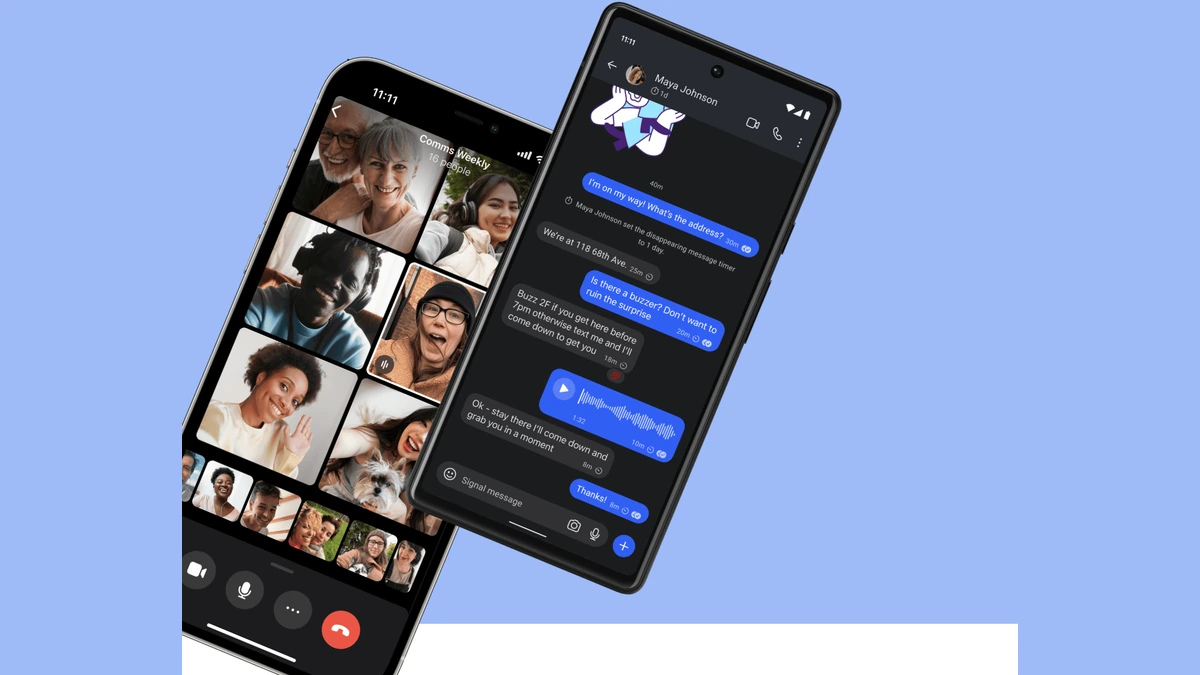
- Signal. Signal states that its end-to-end encryption, powered by the open source Signal Protocol, keeps conversations secure, and that it cannot read messages or listen to calls, and no one else can either, per Signal's own homepage.
- WhatsApp. WhatsApp, owned by Meta Platforms, is widely known as an end-to-end encrypted messaging service for its core chat traffic, one of the platforms that helped bring the Signal Protocol's approach to a mass consumer audience.
- Apple iMessage. iMessage offers end-to-end encryption for messages exchanged between Apple devices over Apple Inc's own messaging service.
- RCS (Rich Communication Services). RCS is the newer cross-carrier messaging standard, developed under the GSM Association, that has moved toward end-to-end encryption support between compatible clients, extending encrypted messaging beyond single-app ecosystems.
What E2EE does not do is hide metadata. Who messaged whom, when, how often, and often which group a message belonged to typically remain visible to the service provider, and by extension to anyone who can compel that provider to disclose it. A fully end-to-end encrypted messaging app can still reveal a detailed picture of a person's communication patterns even when no one can read a single word of the messages themselves.
E2EE also stops at the device. It protects message content in transit and at rest on intermediaries, but not necessarily metadata or a compromised endpoint. A device that is itself compromised, through malware, physical access, or a stolen unlocked phone, exposes messages regardless of how strong the encryption in transit was, because the content is decrypted the moment it reaches a screen a reader can see.
The Lawful-Access and Going-Dark Debate
E2EE sits at the center of a long-running policy conflict between law enforcement agencies seeking lawful access to communications and security researchers who argue that any mandated access mechanism weakens the protection for everyone. Law enforcement officials have repeatedly framed this as a going dark problem, and the two terms below anchor the debate and describe opposite sides of the same problem.
- Lawful access. The general policy position that law enforcement and intelligence agencies should be able to obtain the plaintext of encrypted communications under appropriate legal authorization, typically proposed as some form of mandated backdoor, key escrow, or client-side scanning built into the encryption system itself.
- Going dark. The law-enforcement framing for the situation where end-to-end encryption makes previously interceptable communications unreadable even with a valid warrant, since the service provider itself never holds a key to decrypt content it never held in the first place.
Security researchers and cryptographers, including groups such as the Electronic Frontier Foundation, have argued that a lawful-access mechanism cannot be limited to lawful requesters alone, since any built-in bypass becomes a new attack surface that unauthorized parties can also discover and exploit. That tension, between a capability governments want available on demand and a system that resists being partially weakened without weakening it for everyone, remains an ongoing policy debate rather than settled law in any single jurisdiction, and it shows no sign of resolving as end-to-end encryption becomes the default rather than the exception across consumer messaging.
References
- Signal: Double Ratchet Algorithm specification (Revision 4)
- Signal: technical documentation index (X3DH, PQXDH, Double Ratchet)
- Signal: end-to-end encryption homepage statement
- Signal blog: PQXDH announcement and Signal Protocol history
- Cloudflare Learning: What is end-to-end encryption?
- Cloudflare Learning: How does SSL work?
- Cloudflare Learning: What is encryption?
Further reading
Frequently Asked Questions
Does end-to-end encryption protect metadata like who I messaged and when?
No. End-to-end encryption protects the content of a message, not the metadata surrounding it. The service provider, and anyone who can compel that provider to disclose records, can typically still see who messaged whom, when, and how often, even though the message content itself stays unreadable.
Is TLS/SSL the same thing as end-to-end encryption?
No. TLS/SSL encrypts data between a user's device and a server, so the server operator can still decrypt the traffic on arrival. End-to-end encryption keeps content unreadable to any intermediary, including the service provider itself, because only the sender's and recipient's devices hold the decryption keys.
What happens to old messages if my encryption key is later stolen?
With a protocol built for forward secrecy, such as the Signal Protocol's Double Ratchet algorithm, a stolen key generally cannot decrypt earlier messages. The algorithm derives a new key for every message and mixes in fresh key-exchange values, so past keys cannot be reconstructed from a later one.
Can a messaging app be encrypted but still not offer true end-to-end encryption?
Yes. Many services, including some offered by major cloud providers like Google Cloud and Microsoft Azure, advertise encrypted communications without offering true end-to-end encryption, often because the provider still holds a decryption key for content moderation, backups, or other features. The distinguishing test is whether the decryption key ever leaves the sender's and recipient's own devices.