Meta took action against more than 3.6 million empty "shell pages" in July, working from tips passed on by the Singapore Police Force, and that single sweep accounts for most of the 3.7 million accounts, Pages and pieces of content the company now attributes to its scam partnership with Singapore's police.
The shell pages are the unusual part. They carried no ads and nothing that broke platform rules, so a review system that looks for violating posts would have had no reason to flag them. Meta describes them as infrastructure that scam groups had built in advance, ready to be switched on for a campaign at short notice, and says it is pursuing further disruptions against that tactic. Removing a scam asset before it has touched a single victim is a different job from answering user reports after the fact.
The mechanics are a two-way intelligence exchange that Meta says has run for about two years. Police signals point Meta's investigators at a suspect, and the investigators then trace the network of linked accounts around it. Between January and June 2026, that method led to action against more than 113,000 entities and Pages on Facebook and Instagram, mostly tied to investment scams promising guaranteed or high returns. By Meta's count, the police information let it act on over five times as many assets as were originally flagged. The traffic runs the other way too: Meta says its data helped Singapore police arrest seven men in 2025 over a suspected transnational illegal remote betting operation.
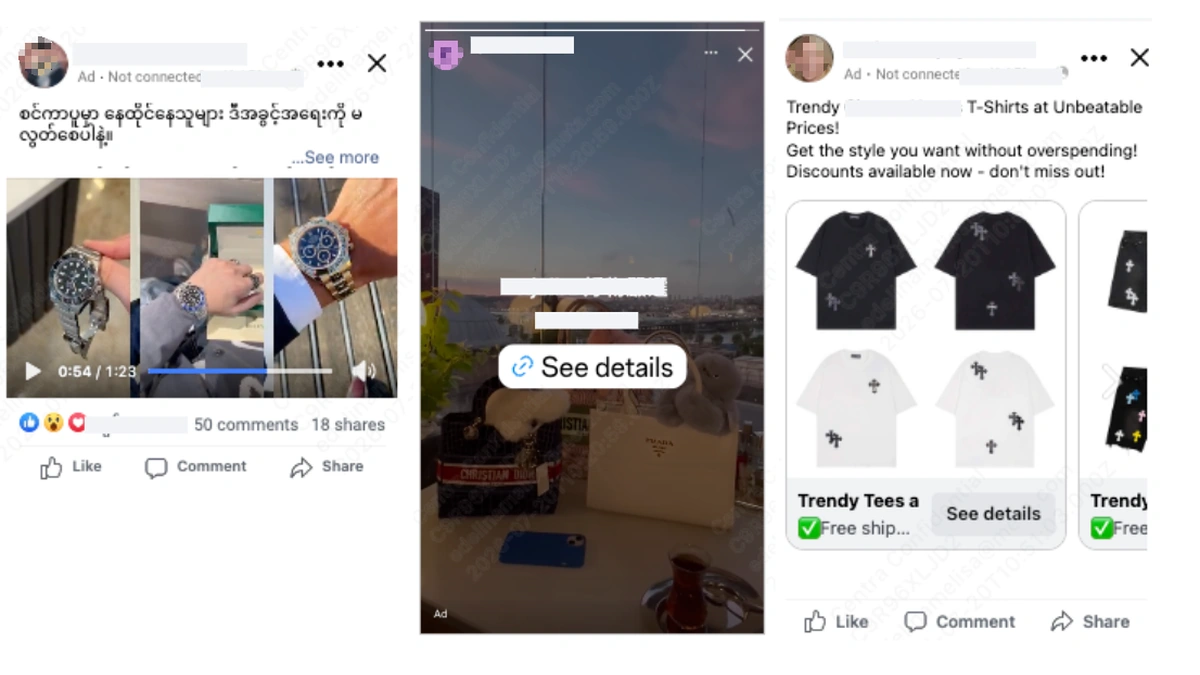
A separate push in June targeted shopping fraud ahead of the school holidays. Meta reports action against more than 33,600 entities pushing misleading prices, fake promotions using well-known brands, inflated product claims and artificial urgency.
Justin Wong, a senior assistant commissioner who heads the force's Cyber Command, said the police plan to expand data sharing with Meta and other online service providers. Daryl Poon, Meta's director of law enforcement outreach for Asia Pacific, framed the value as visibility: police information surfaces threats the company might miss, while Meta supplies the capacity to act at scale.
The Singapore work sits alongside other enforcement numbers Meta cites. A two-week operation in May and June convened by the US Justice Department's Scam Center Strike Force disrupted 1.4 million Facebook and Instagram accounts, Pages and groups, and Royal Thai Police arrested 63 people. Meta also says it has removed 65 million scam ads from its two main apps so far in 2026, 94% of them before anyone reported them. On the consumer side, a public education campaign run with the police and Singapore's National Crime Prevention Council, called One Step Ahead, urges people to turn on two-factor authentication and passkeys and has reached 1.6 million people, according to Meta.
All of these figures are Meta's own, and the company does not say what "action" meant in each case, whether removal, restriction or disablement, or how many of the 3.6 million dormant Pages were individually confirmed as belonging to scam groups rather than swept up with a flagged cluster.