An identity management tool is a software platform that controls how user identities are created, verified, and governed across an organization's applications and data systems. For privacy-conscious enterprises, the choice of platform is also a choice about which vendor sees identity assertions, where audit logs sit, and how quickly an account loses access after a termination event. Four vendors dominate that conversation: Okta, Microsoft Entra ID, PingOne Advanced Identity Cloud, and OneLogin. Each carries a different stance on automated de-provisioning, just-in-time privileged access, and deployment topology, and those differences map directly to measurable privacy outcomes.
What an Identity Management Tool Does
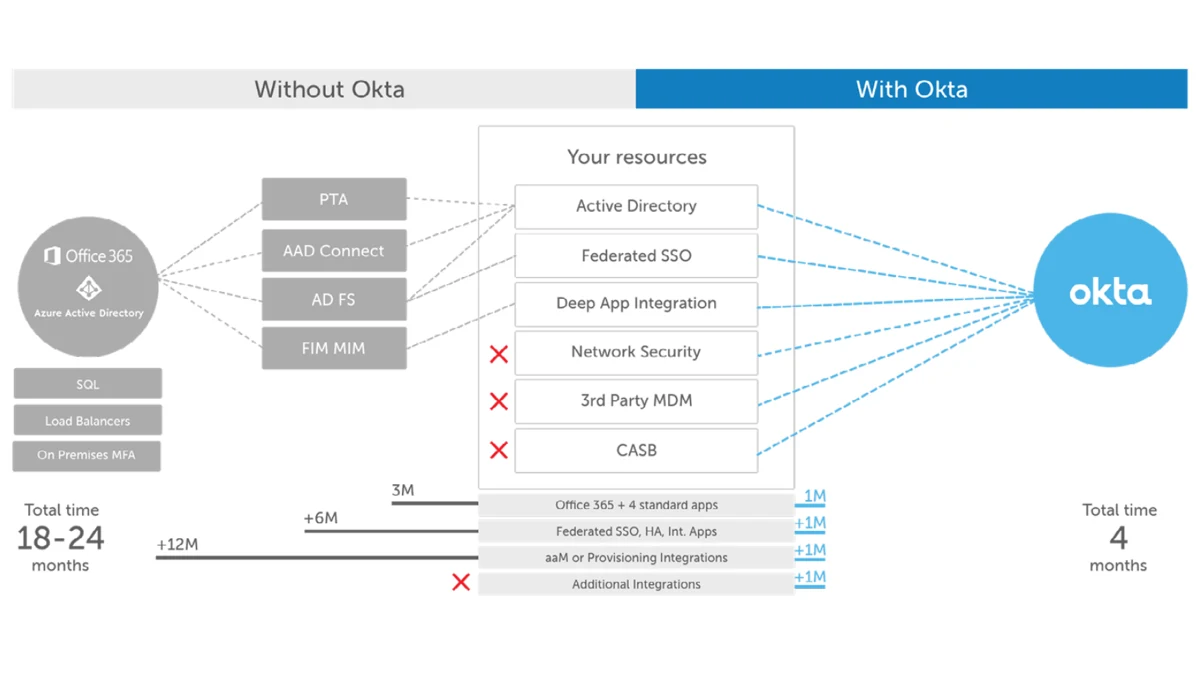
An identity management tool sits between an enterprise directory and every application that needs to know who a user is. The U.S. National Institute of Standards and Technology classifies identity and access management (IAM) as a fundamental cybersecurity capability that determines who can use which resources and under what conditions (NIST: Identity and Access Management). In practical terms, an IAM tool performs four jobs.
- Authentication
- Confirms a user is who they claim to be using passwords, tokens, biometrics, or multi-factor authentication (MFA).
- Authorization
- Decides what an authenticated user is allowed to read, write, or execute, often through role-based or attribute-based policy.
- User provisioning
- Creates, updates, and removes accounts across connected applications, increasingly through the System for Cross-domain Identity Management (SCIM) protocol.
- Audit logging
- Records sign-in events, permission changes, and policy decisions so security teams can investigate incidents and satisfy regulators.
Single sign-on (single sign-on (SSO)) collapses dozens of separate logins into one authenticated session, which reduces credential reuse and gives administrators a single chokepoint for policy. The same chokepoint becomes the privacy control surface that this article evaluates.
Why Privacy Controls Belong in Your IAM Selection Criteria
An identity management tool is one of the highest-use controls a privacy program owns. The NIST Privacy Framework (Version 1.0) is a voluntary tool for managing privacy risk that explicitly ties identity management practices to data-processing outcomes (NIST Privacy Framework). Weak provisioning and standing privilege are not abstract IT debts. They are the mechanisms by which personal data ends up in the wrong hands.
- Over-provisioning. New hires inherit role templates that grant access to systems they will never touch, expanding the personal data footprint each user can reach.
- Standing privileges. Administrators retain elevated rights around the clock, so any compromise of one credential exposes regulated data continuously rather than during a narrow window.
- Orphaned accounts. Terminated employees keep working access for days or weeks because manual de-provisioning lags HR events, violating data-minimization principles.
- Cross-domain data leakage. Inconsistent identity state across SaaS apps allows former contractors to remain active in a CRM after losing access to the directory.
- Audit blind spots. Without unified sign-in telemetry, privacy teams cannot prove which accounts touched which records during a breach investigation.
Treating IAM as a privacy risk management discipline reframes the buying process. Instead of comparing feature checklists, security and privacy leads compare how each vendor enforces least-privilege access by default.
The Four Vendors at a Glance
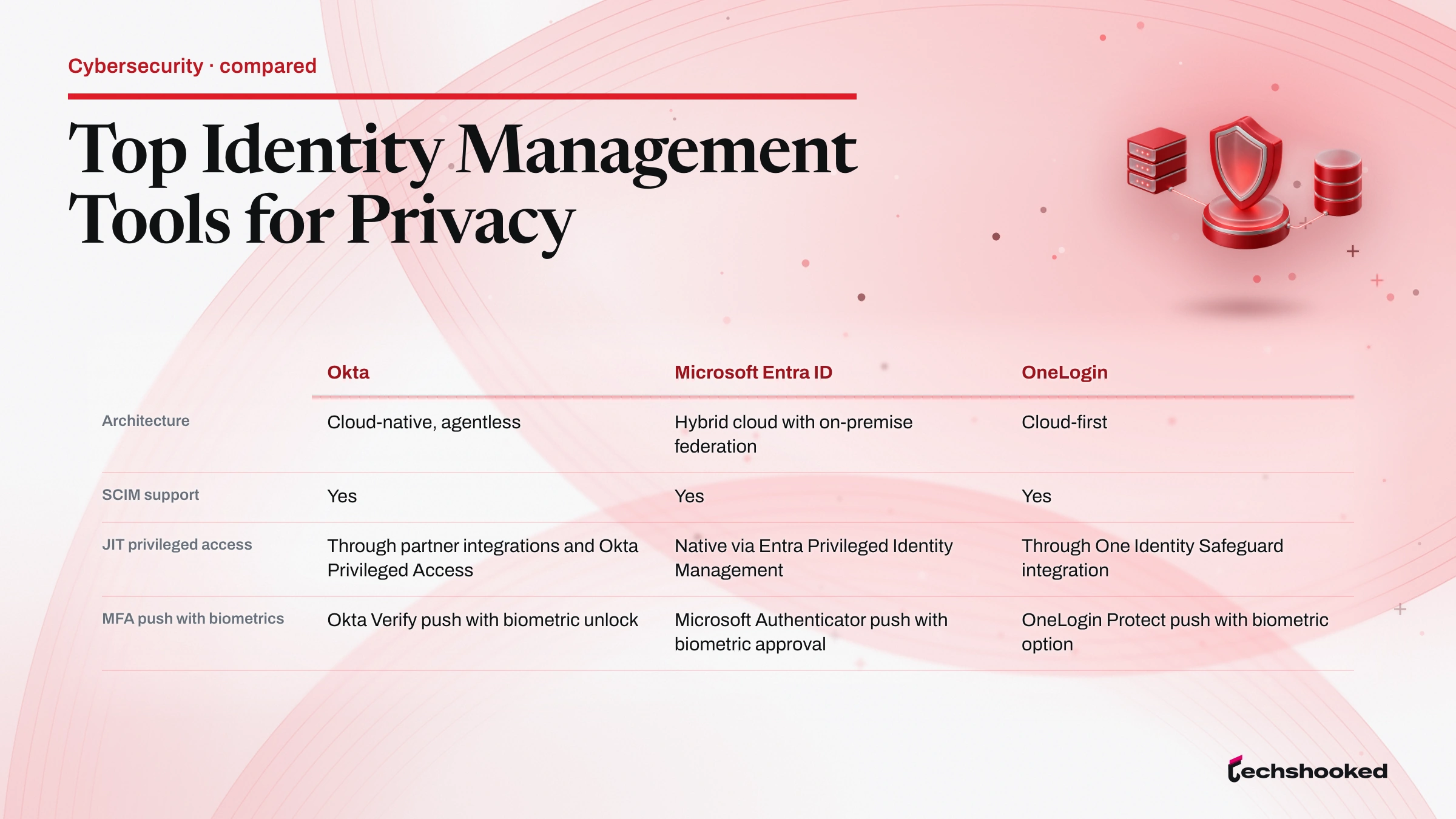
The dominant identity management tools in the enterprise market take noticeably different architectural positions. Okta is cloud-native. Microsoft Entra ID is built around a hybrid model that federates with on-premise Active Directory. PingOne Advanced Identity Cloud, formerly ForgeRock Identity Cloud, offers the broadest topology range (PingOne Advanced Identity Cloud documentation). OneLogin, now part of One Identity, remains cloud-first.
| Vendor | Architecture | SCIM support | JIT privileged access | MFA push with biometrics | Deployment options |
|---|---|---|---|---|---|
| Okta | Cloud-native, agentless | Yes | Through partner integrations and Okta Privileged Access | Okta Verify push with biometric unlock | SaaS |
| Microsoft Entra ID | Hybrid cloud with on-premise federation | Yes | Native via Entra Privileged Identity Management | Microsoft Authenticator push with biometric approval | SaaS, hybrid |
| PingOne Advanced Identity Cloud | SaaS for workforce, consumer, and B2B identities | Yes | Via PingOne Protect and policy | PingID and ForgeRock Authenticator push with biometric response | SaaS, private cloud, on-premise |
| OneLogin (One Identity) | Cloud-first | Yes | Through One Identity Safeguard integration | OneLogin Protect push with biometric option | SaaS |
The table shows that SCIM is now table stakes. Where the vendors diverge is in privileged identity management, biometric strength of push notification authentication, and the depth of deployment topology options available to teams that cannot send identity data to a public cloud.
SCIM Provisioning and De-provisioning as a Privacy Control
Every modern identity management tool relies on SCIM provisioning to keep account state consistent across SaaS applications. RFC 7644 defines SCIM as an HTTP-based protocol that reduces the cost and complexity of user management while applying existing authentication, authorization, and privacy models (IETF RFC 7644: SCIM Protocol). Microsoft Entra identity platform documentation confirms that SCIM is used to automatically create user identities and roles in cloud SaaS applications connected to the directory (Microsoft Entra identity platform).
The privacy payoff is in de-provisioning. When a SCIM event fires within minutes of an HR termination, the window during which personal data remains reachable through a departed account closes immediately. Manual processes, by contrast, often leave that window open for days. A typical SCIM-driven user provisioning cycle runs in four steps.
- Identity source emits an event. An HR system or directory records a join, move, or leave event for a specific user.
- IAM platform translates the event into SCIM calls. The identity management tool maps attributes to the target application's SCIM schema and issues HTTP requests.
- Target applications create, update, or deactivate accounts. Each connected SaaS app applies the change, including license release and group membership updates.
- Audit log captures the round trip. Cross-domain identity management telemetry feeds the security information and event management system for review.
Teams subject to GDPR, HIPAA, or sector-specific data minimization rules should validate that every business-critical SaaS application in their estate supports SCIM, not only the headline integrations on a vendor marketing page.
Privileged Identity Management and Least-Privilege Access
The strongest differentiator among these identity management tools is how each one handles privileged identity management. Microsoft Entra PIM offers just-in-time (JIT) privileged access, which the Azure security fundamentals documentation describes as a control that reduces excessive permissions by granting elevated roles only when needed and only for a bounded duration (Microsoft: Identity management overview). Okta exposes similar capabilities through Okta Privileged Access and partner integrations, while Ping leans on policy enforced by PingOne Protect.
JIT access matters for privacy because standing administrative rights expand the blast radius of any credential compromise. A configuration that enforces just-in-time privileged access typically follows five steps.
- Define eligible roles. Mark which directory or application roles require activation rather than permanent assignment.
- Require justification and approval. Force the requester to provide a ticket reference and route higher-risk roles through a second approver.
- Bound the activation window. Cap session length at one to eight hours depending on role sensitivity.
- Step up authentication on activation. Require fresh multi-factor authentication at the moment of elevation, not only at initial sign-in.
- Log and review activations. Stream every elevation to the audit pipeline and review patterns weekly for anomalies.
Pairing JIT access with least-privilege access defaults shrinks both the standing footprint of regulated data and the number of identities that can act on it at any moment.
MFA Depth: Push Notifications, Biometrics, and External Factors
An identity management tool earns its keep at the moment of authentication. Microsoft documentation defines multi-factor authentication as a process that requires two or more verification methods at sign-in (Microsoft: Identity management overview). Vendors implement that requirement with very different depth.
- Microsoft Entra ID Protection. Uses machine learning to detect anomalous sign-in patterns and trigger risk-based MFA challenges in real time.
- PingOne Advanced Identity Cloud push. Sends push notification authentication to Android or iOS devices through the PingID mobile app and the ForgeRock Authenticator app, with biometric response support (PingOne Advanced Identity Cloud: MFA push).
- Microsoft Authenticator and Okta Verify. Bind push approval to a specific device and require biometric unlock on the handset before the approval is sent.
- External authentication methods. Microsoft Entra ID supports external authentication methods that allow Okta to act as a second factor for Entra-managed sign-in flows (Okta: Configure Okta as Microsoft Entra ID external authentication method).
Risk-based push notification authentication tied to anomalous sign-in signals raises the cost of credential theft without forcing every login through a hard token. Privacy teams should confirm that anomaly telemetry stays in a region they accept and that biometric templates remain on the user's device rather than in vendor cloud storage. Authentication patterns are compared in detail in MFA vs SSO.
Deployment Topology and Data Residency Considerations
The deployment topology of an identity management tool decides where identity assertions, audit logs, and biometric metadata physically live. That decision is the foundation of any honest privacy risk management plan.
- SaaS-only
- Okta and OneLogin route all identity traffic through vendor cloud infrastructure. Operationally simple, but identity telemetry crosses tenant and regional boundaries the vendor controls.
- Hybrid
- Microsoft Entra ID federates with on-premise Active Directory, so directory state can remain on-premise while authentication flows traverse the cloud. Suits organizations that have heavy legacy estates but accept cloud-side sign-in handling.
- On-premise sovereign
- PingOne Advanced Identity Cloud supports private-cloud and on-premise deployments. Appropriate where regulators require identity data to stay inside a defined jurisdiction or where the entity operates classified workloads.
Procurement teams should map each topology pattern against contractual data-residency commitments before shortlisting a vendor, not after.
How to Choose an Identity Management Tool for Privacy
Selecting an identity management tool through a privacy lens reorders the usual scorecard. Speed of integration matters less than the controls that bound personal data exposure. The following checklist works for most enterprise shortlists.
- Confirm SCIM coverage across your real SaaS estate. List every application that processes personal data and verify SCIM provisioning support on each, not only the marquee integrations.
- Require JIT for every privileged role. Eliminate standing administrative rights as a default position rather than an aspiration.
- Insist on biometric, device-bound push MFA. Treat SMS-only fallback as a finding, not a feature, and prefer least-privilege access defaults for every role template.
- Match deployment model to data-residency obligations. Validate hybrid or sovereign options when GDPR, HIPAA, or sector rules apply.
- Stream identity telemetry to your own SIEM. Audit logs that only live in the vendor portal will fail an incident-response drill.
- Pilot with a real termination scenario. Time how long it takes for access to disappear across every connected app after a simulated HR event.
Pair the result with a broader review of enterprise privacy tools and, for engineering teams evaluating identity platforms by developer ergonomics, our guide to Auth0 alternatives for developers. Readers focused on the upstream question of how identities become surveillance signals can continue with our piece on digital identity.
Further reading
Frequently Asked Questions
What should businesses consider when choosing an identity management tool for privacy?
Businesses should prioritize SCIM-based automated de-provisioning, JIT privileged access controls, and hosting topology options that match their data-residency requirements. SCIM (System for Cross-domain Identity Management) ensures accounts are removed promptly when employees leave, eliminating orphaned credentials. JIT access limits how long elevated permissions exist. On-premise or private-cloud deployment keeps identity data within a defined jurisdiction, which matters for organizations subject to GDPR or sector-specific data-localization rules.
Does topology affect the privacy of an identity management tool?
Yes. A SaaS-only IAM tool routes identity assertions and audit logs through the vendor's cloud infrastructure, while hybrid or on-premise deployments keep that data within a network boundary you control. Okta is cloud-native and agentless. PingOne Advanced Identity Cloud supports cloud, private-cloud, or on-premise deployments. OneLogin is cloud-first. Microsoft Entra ID covers hybrid scenarios through federation with on-premise Active Directory. Organizations with strict data-residency obligations should validate which topology each vendor supports before shortlisting.
Is SCIM provisioning a privacy feature or just an IT efficiency tool?
SCIM provisioning is both: RFC 7644 defines it as a protocol that reduces user management complexity while explicitly applying existing authentication, authorization, and privacy models. From a privacy standpoint, the most valuable SCIM capability is automated de-provisioning. When an account is removed within minutes of a termination event rather than days or weeks later, the window for unauthorized access to personal data closes immediately. Vendors including Microsoft Entra ID and PingOne Advanced Identity Cloud use SCIM to synchronize identity state across SaaS applications.