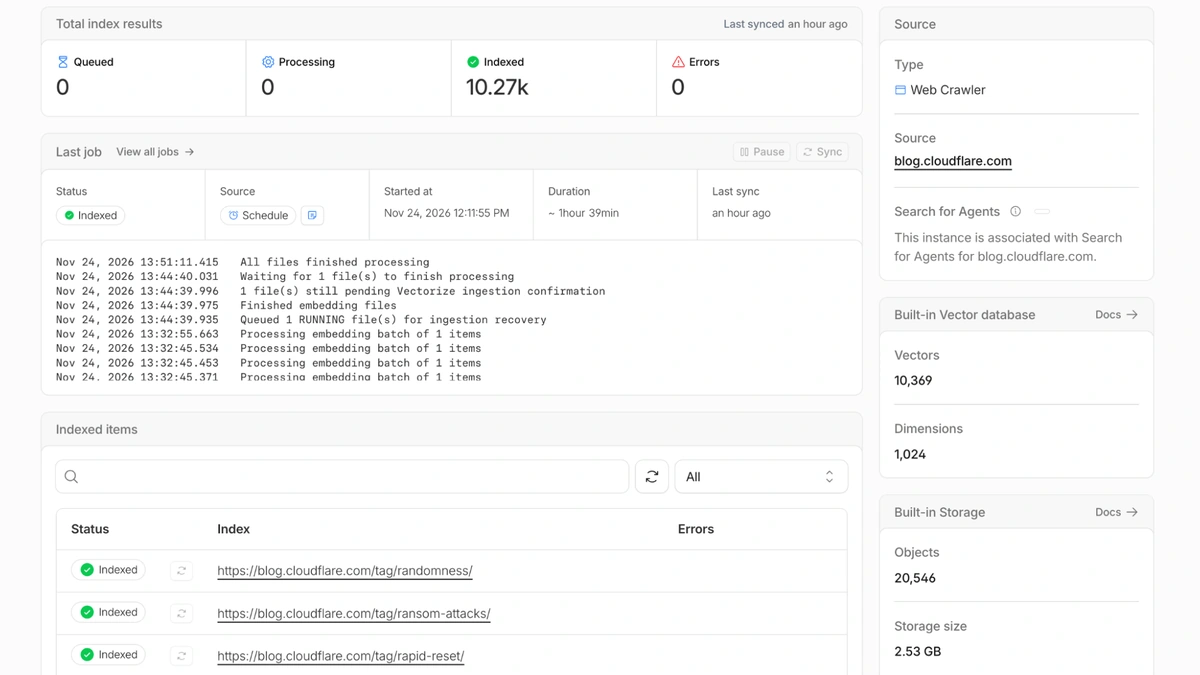
Search for Agents lets a Cloudflare customer switch on agent-readable search for an entire domain from the zone's Quick Actions panel or through the API. Cloudflare then creates an AI Search instance, crawls and indexes the site, and serves results at /.well-known/search on the customer's own domain. The endpoint returns retrieved passages in Markdown with source references and relevance scores, not a generated answer, so the agent's own model does the answering.
Every HTML page on a site with Search for Agents enabled gets four meta tags in its head: agent:instructions, agent:endpoint, agent:method and agent:documentation. When Markdown for Agents is also on, a request sent with an Accept: text/markdown header receives the same details as YAML front matter. Requests still pass through the domain's bot management, AI Crawl Control and WAF settings, so those settings can also govern which agents reach the endpoint.
Queries can go in a plain GET request with a q parameter or through the HTTP QUERY method, with the search text in a plain-text or JSON body. Cloudflare says QUERY is an IETF Proposed Standard published in June 2026 as RFC 10008, co-authored by its own James Snell, and that curl and undici are adopting it.
The instance Search for Agents creates starts with hybrid vector and keyword search and discovery crawling through sitemaps and links up to five hops deep. The crawl limit is 100,000 pages, subject to instance limits, with a 24-hour sync interval. Each query returns at most 10 chunks above a 0.4 match threshold, reranking and query rewriting are off, and a similarity cache holds results for 48 hours. Some settings, including the embedding model and data source, cannot be changed after creation. Cloudflare's setup guide labels the feature beta on all plans.
Accounts on Workers Free run into a ceiling before they reach those defaults. Workers Free crawls at most 500 pages a day, while Workers Paid has no daily crawl cap, per Cloudflare's limits and pricing page. At that rate, a 5,000-page site needs at least 10 days to finish its first index. AI Search billing begins December 1, 2026. Each account gets included usage every month, and anything beyond it is charged at these rates:
| Usage | Included monthly | Beyond included |
|---|---|---|
| Ingestion tokens | 5 million | $0.75 per million (image processing adds $0.50 per million) |
| Storage | 10 GB-month | $2.00 per GB-month |
| Semantic queries | 1,000 | $0.75 per 1,000 |
| Full-text queries | 1,000 | $0.10 per 1,000 |
Cloudflare turned on Search for Agents for its own developer documentation before launch. In its demonstration, an OpenCode session asked for the maximum push size of Cloudflare Artifacts found the endpoint from the homepage, queried it and got the correct answer. Cloudflare expects agents that find the endpoint to reuse it several times in the same session.