Jest is a JavaScript testing framework that ships with built-in assertions, mocking, and code coverage so teams can run unit and integration tests without additional library configuration.
Choosing between Jest, Mocha, and Cypress is not a matter of which testing framework is superior overall; each tool is optimized for a distinct position in the JavaScript testing stack. Picking the wrong tool for a given test layer adds configuration overhead, slows the CI pipeline, or produces results that do not reflect real browser behavior. The comparison below maps each framework to the layer where it delivers the most value.
Three Testing Layers, Three Tools
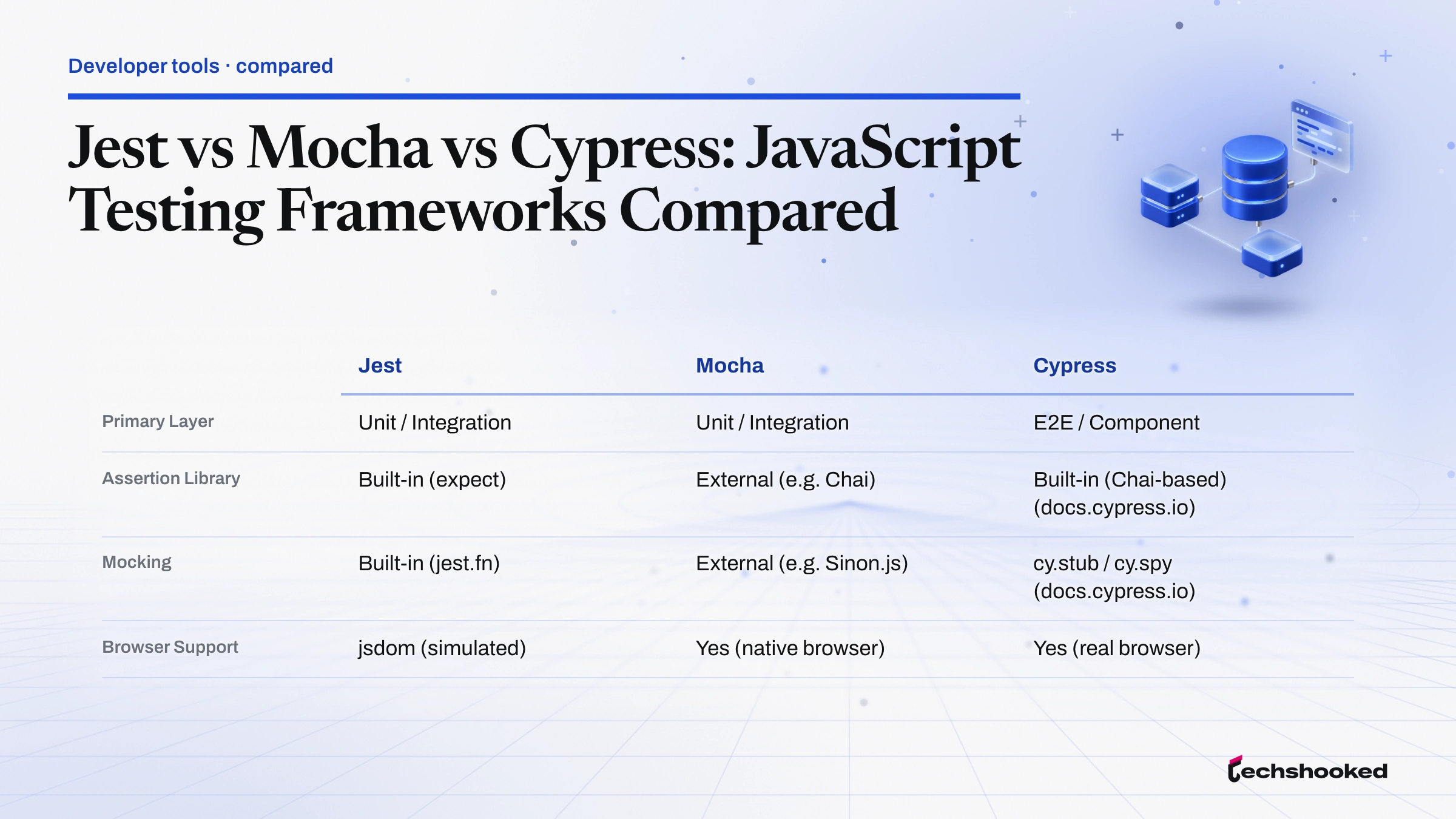
Jest, Mocha, and Cypress are purpose-built for different positions in the JavaScript testing stack: unit and integration testing, flexible composition-based testing, and end-to-end browser automation respectively. Unit testing validates isolated functions and modules; integration testing verifies interactions between components and services; end-to-end testing (E2E) exercises the full application through a real browser. Each testing framework ships with defaults that optimize for exactly one of those layers. The table below gives a high-level orientation before the per-tool sections go deeper.
| Framework | Primary Layer | Assertion Library | Mocking | Browser Support | CI Headless Mode |
|---|---|---|---|---|---|
| Jest | Unit / Integration | Built-in (expect) | Built-in (jest.fn) | jsdom (simulated) | Yes, out of the box |
| Mocha | Unit / Integration | External (e.g. Chai) | External (e.g. Sinon.js) | Yes (native browser) | Yes, with configuration |
| Cypress | E2E / Component | Built-in (Chai-based) (docs.cypress.io) | cy.stub / cy.spy (docs.cypress.io) | Yes (real browser) | Yes, official CI action |
How Jest Works
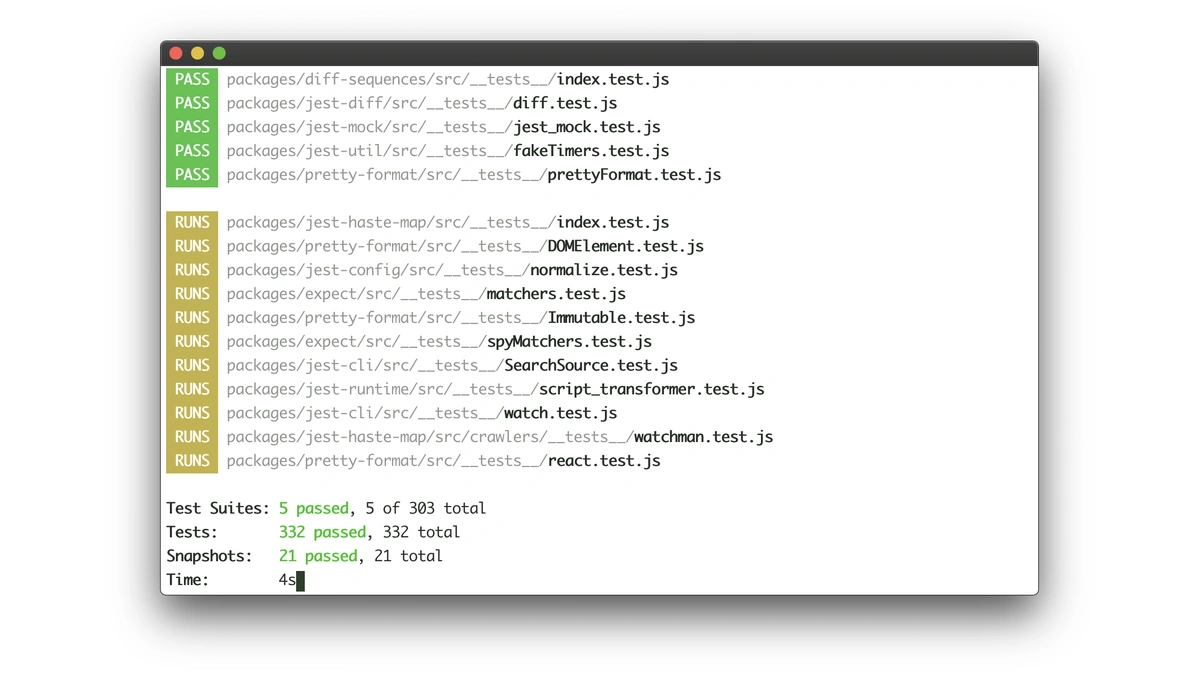
Jest is a zero-configuration testing framework maintained under the OpenJS Foundation that bundles a test runner, assertion library, mock function system, and code coverage reporter into a single npm package (jestjs.io). The stable release line is version 30, per the Jest version history. Node.js 18.x is the minimum supported runtime, a requirement introduced with the version 30 line as documented in the Jest 30 upgrade guide. The framework's design goal is minimal setup so developers spend time writing tests rather than wiring tooling. The when to use TypeScript over JavaScript guide covers the TypeScript configuration that the ts-jest transformer simplifies further.
- Zero-configuration setup. The framework aims to work out of the box for most JavaScript projects, detecting test files by convention and requiring no separate config file for common setups (jestjs.io).
- Parallel process isolation. Tests run in parallel across separate worker processes, improving performance on multi-core machines and enforcing test isolation: a crash in one test file does not abort the suite. Each file runs in its own Node.js VM context so global state never bleeds between files (jestjs.io).
- Native code coverage. The runner collects code coverage across the entire project, including files that no test imports directly, giving teams a full picture of untested code without installing an external reporter (jestjs.io).
- Built-in mock function support. The custom module resolver substitutes any import with a mock function or mock module at the test level, without installing Sinon.js or any external mocking library (jestjs.io).
- Snapshot testing for UI. The snapshot testing feature serializes a component's rendered output on first run and fails future runs when output changes unexpectedly, making it practical for React UI regression testing without a browser.
How Mocha Works
Mocha is a feature-rich JavaScript testing framework that runs on Node.js and in the browser, providing the test runner and lifecycle hooks while leaving assertion style and mocking strategy to the developer (mochajs.org). Mocha's design philosophy is composability: pick the assertion library and mock function provider that fits the project rather than accepting defaults. This makes Mocha well-suited for integration testing scenarios where teams need precise control over each dependency in the test stack. Tests run serially by default, which enables flexible, accurate reporting and correct mapping of uncaught exceptions to the test that triggered them; a --parallel flag is available as an opt-in mode for suites that can safely run concurrently (mochajs.org). Mocha v12.0.0 requires Node.js ^20.19.0 or >=22.12.0, as documented in the full Mocha documentation.
- Mocha + Chai. Chai provides BDD-style
expectandshouldinterfaces and a TDD-styleassertmodule, giving the assertion library the same expressive surface as the built-inexpectAPI without locking the project to a single bundled toolchain. - Mocha + Sinon.js. Sinon.js adds spies, stubs, and mock functions to Mocha test suites. The combination gives teams the equivalent of a built-in mock function system, with the flexibility to update Sinon independently of the test runner.
- Mocha + nyc for code coverage. Because Mocha ships no coverage reporter, teams add nyc (the Istanbul command-line interface) to collect code coverage in the same formats produced natively by other runners, closing the gap for Mocha-based projects that need CI pipeline coverage gates.
How Cypress Works
Cypress is an end-to-end testing (E2E) framework that runs test code inside the same browser process as the application under test, giving it direct access to the DOM, network layer, and JavaScript runtime. Unlike Jest or Mocha, the tool does not simulate a browser environment: it controls a real browser, making it the right choice for tests that must validate rendering, user interaction, and network behavior together. The framework offers end-to-end and component tests as its two primary test modes, and is also adaptable for unit testing, API testing, visual testing, and accessibility testing (Testing Types). For CI pipeline integration, the official GitHub Action v7 is the recommended binding for GitHub Actions workflows (GitHub Actions CI Integration). The Python vs JavaScript vs Java comparison covers language-level factors that influence which test toolchain fits a given backend.
Component tests are fast and isolated but do not verify overall application quality and do not call external APIs or services; E2E tests cover the full flow (Testing Types). The best practices guide recommends targeting stable selectors and avoiding coupling tests to implementation details. A typical E2E test runs through four stages:
- Visit. The framework opens a URL in a real browser using
cy.visit(), establishing the full application context including cookies, local storage, and service workers. - Interact. Commands like
cy.get()andcy.click()drive user actions. The runner automatically retries queries until elements appear, reducing flaky assertions caused by async rendering. - Assert. Chai-based assertions verify DOM state, network responses, or JavaScript values (Assertions reference). Assertions are chained directly on command results.
- Screenshot on failure. When an assertion fails, the runner captures a screenshot and video of the browser state, giving developers actionable diagnostics without manual reproduction in the CI pipeline.
Detailed Comparison: Jest vs Mocha vs Cypress
Jest leads on out-of-the-box developer experience, Mocha leads on composability, and Cypress leads on real-browser fidelity. The table below covers the key axes a team evaluates when selecting a testing framework. Code coverage, assertion library flexibility, and test isolation are the three dimensions where the frameworks diverge most sharply in practice. Every cell claim is sourced to the framework's primary documentation.
| Attribute | Jest | Mocha | Cypress |
|---|---|---|---|
| Configuration required | None for standard projects (jestjs.io) | Minimal runner config; assertion library separate (mochajs.org) | Moderate; browser and baseUrl setup (docs.cypress.io) |
| Assertion library | Built-in expect API (jestjs.io) | External: Chai, Node assert, or custom (mochajs.org) | Built-in Chai-based API (docs.cypress.io) |
| Mocking built-in | Yes: jest.fn(), jest.mock() (jestjs.io) | No: requires Sinon.js (mochajs.org) | Yes: cy.stub(), cy.spy() (docs.cypress.io/stub, docs.cypress.io/spy) |
| Code coverage | Built-in; covers untested files (jestjs.io) | External: nyc / Istanbul (mochajs.org) | Via Istanbul plugin; not the primary use case |
| Snapshot testing | Yes, native (jestjs.io) | No native support | No native support |
| Browser execution | jsdom (simulated DOM) | Real browser or jsdom with configuration (legacy.mochajs.org) | Real browser required (docs.cypress.io) |
| CI headless support | Yes, no extra steps (jestjs.io) | Yes, with headless browser config (mochajs.org) | Yes, GitHub Actions v7 action (docs.cypress.io) |
| React ecosystem fit | Strong: snapshot testing, jsdom, CRA default (jestjs.io) | Moderate: requires setup for JSX transforms | Strong for E2E and component testing (docs.cypress.io) |
| Parallel test execution | Per-process by default (jestjs.io) | Serial by default; opt-in --parallel flag (mochajs.org) | Parallel via Cypress Cloud dashboard |
Test isolation differs across all three frameworks. Jest runs each test file in a sandboxed Node.js VM context, so global state never bleeds between files. Mocha runs tests in a shared process by default, giving experienced teams finer control over setup sequences but requiring discipline to avoid cross-test contamination. Cypress gives each spec file a fresh browser session for E2E testing, though application state accumulates within a file unless tests reset it explicitly.
Choosing the Right Testing Framework for Your Project
Jest is the right default for React and Node.js projects that need fast unit and integration testing with minimal configuration overhead. The decision depends on the test layer the project is missing and how each testing framework fits the CI pipeline. Background on API design tradeoffs that often determine integration testing surface area is covered in the GraphQL vs REST for beginners guide. The four project scenarios below map to a recommended framework based on test layer and CI pipeline requirements.
- React SPA with unit and snapshot tests
- Use Jest. It ships snapshot testing and a jsdom environment configured for React out of the box, with no separate assertion library or mock function setup required. Code coverage across untested files makes it practical for tracking test completeness as the component library grows (jestjs.io).
- Node.js microservice with custom assertion needs
- Use Mocha with Chai and Sinon.js. Integration testing of HTTP services often benefits from BDD-style assertions and precise stub behavior that Chai and Sinon provide independently. Mocha's serial execution model keeps test output readable during debugging, and the opt-in
--parallelflag accelerates large suites when isolation is confirmed (mochajs.org). - Full-stack application requiring browser flow validation
- Use Cypress for end-to-end testing. It runs tests in a real browser against a local development server, intercepting and asserting on network requests, DOM state, and JavaScript runtime values in the same context. Pair with Jest for unit testing the frontend components that the E2E layer exercises (docs.cypress.io).
- CI-only headless regression suite
- Combine Jest for unit and integration testing with Cypress for browser automation. The former runs with zero configuration in any CI environment. The latter integrates with the official GitHub Actions v7 action for headless browser execution in the same CI pipeline (docs.cypress.io).
References
- Jest Official Homepage: zero-configuration setup, parallel execution model, mock function system
- Jest: Getting Started: code coverage and project configuration documentation
- Jest Version History: current stable release tracking
- Jest: Upgrading to Jest 30: Node.js 18.x minimum requirement and dropped-version details
- Mocha Official Homepage: serial execution default, opt-in parallel mode, framework overview
- Mocha Full Documentation: Node.js version requirements, browser support, async and promise handling
- Testing Types: E2E and component test modes, test tradeoffs
- Best Practices: recommended usage patterns and selector guidance
- GitHub Actions CI Integration: official GitHub Action v7 binding for headless CI runs
- Assertions: Chai-based assertion API documentation
- cy.stub() API: stub command API reference
- cy.spy() API: spy command API reference
Further reading
Frequently Asked Questions
What is the main difference between Jest and Mocha?
Jest ships a complete testing stack with built-in assertions, mock functions, and code coverage in a single package. Mocha provides only the test runner and lifecycle hooks, requiring separate libraries for assertions and mocking. Jest is faster to set up for new projects; Mocha gives experienced teams precise control over every dependency.
Is Cypress suitable for unit testing?
Cypress is optimized for end-to-end browser automation and component testing, not unit testing. Its own documentation states it offers end-to-end and component tests as primary modes. For unit and integration tests use Jest or Mocha, and reserve Cypress for tests that require a real browser and DOM.
Which testing framework is best for React applications?
Jest is the standard choice for React unit and integration testing. It ships with built-in mocking and supports snapshot testing for UI component regression. For React end-to-end browser flows, pair Jest with Cypress running against a local development server.