A Data Privacy Impact Assessment is a structured compliance process that identifies, evaluates, and mitigates privacy risks before a high-risk data processing activity goes live.
The European regulator writes the term as Data Protection Impact Assessment in GDPR Article 35, and the abbreviation DPIA covers both phrasings in practitioner use. The obligation is not optional for processing that crosses the statutory triggers, and a missing or incomplete DPIA is one of the most common findings in supervisory authority enforcement actions. The artifact set the team produces, not the methodology in the abstract, is what an auditor inspects when the file is opened.
Most teams that fail a DPIA review fail on procedural artifacts: a risk register without owner names, a residual risk statement that was never signed, a review schedule that never triggered. The operator-grade question is how to embed the DPIA into the same engineering rhythm that ships features, so the artifact set arrives complete the first time and stays current as the system changes.
When a DPIA Is Legally Required
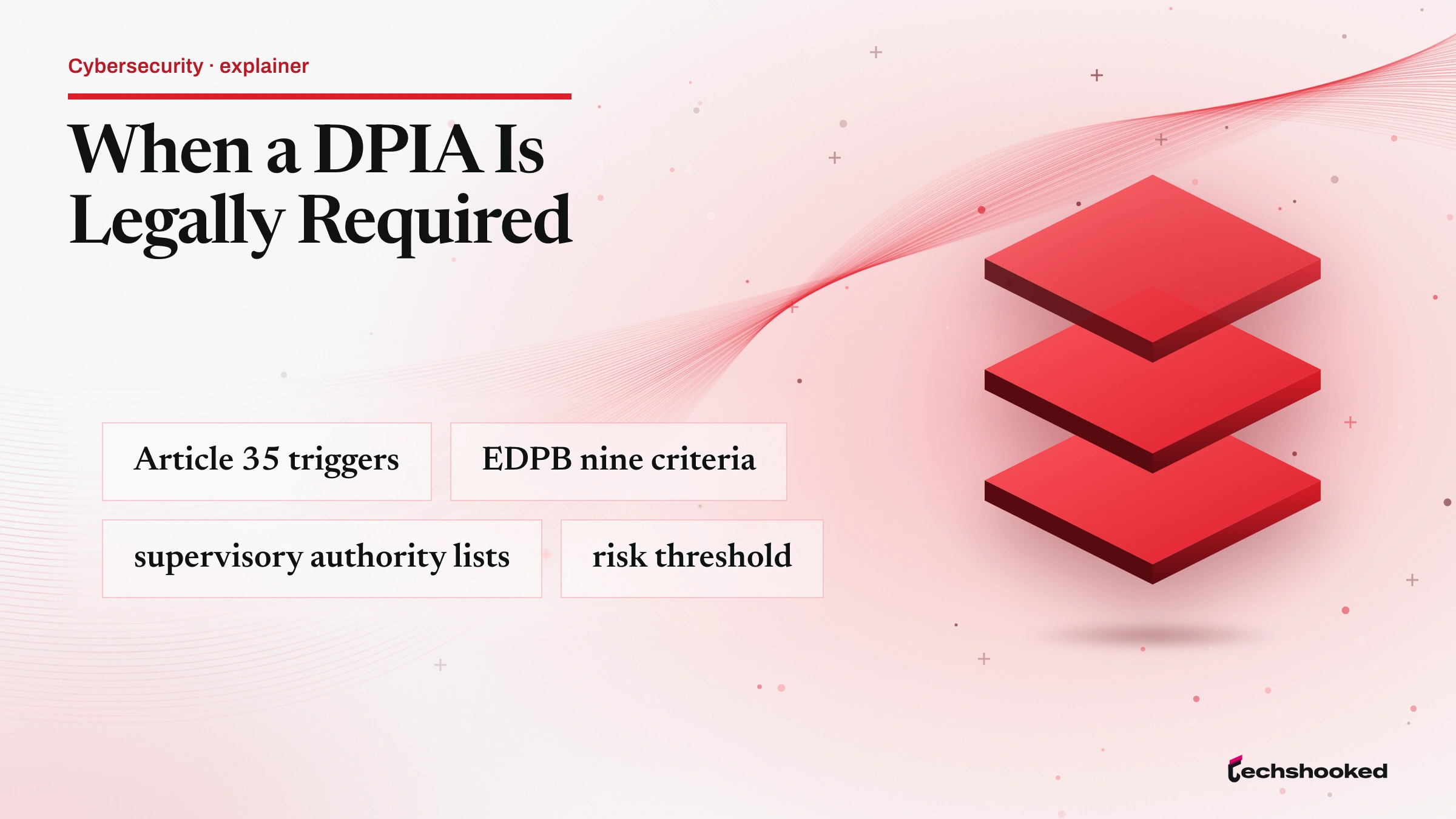
A Data Privacy Impact Assessment is legally required under GDPR Article 35 whenever a planned processing activity is likely to result in a high risk to individuals' rights and freedoms. The legal threshold is two-part: three statutory triggers create an automatic obligation, and the European Data Protection Board (EDPB) publishes nine indicative criteria that organizations apply as a two-out-of-nine test for cases that fall outside the automatic triggers. Article 35 also obliges controllers to track the supervisory authority list for their jurisdiction, since each authority publishes its own cataloge of processing operations that always require a DPIA.
CCPA and CPRA in California, the NIST Privacy Framework in the United States, and ISO/IEC 29134:2023 internationally follow analogous risk-triggering logic but are not legally identical to Article 35. A US controller operating under the NIST Privacy Framework conducts a Privacy Impact Assessment that maps to the GOVERN.CT-P control; the methodology overlaps, the regulatory wrapper does not. Treat the frameworks as a stack of compatible methodologies, not as substitutes for the GDPR Article 35 obligation when EU data subjects are in scope.
GDPR Article 35 Mandatory Triggers
Article 35(3) names three categories of processing that always require a DPIA, regardless of any further criteria check:
- Large-scale processing of special categories of data (health records, biometric identifiers, criminal records). A biometric time-and-attendance system that enrolls thousands of employees hits this trigger.
- Systematic monitoring of publicly accessible areas. CCTV analytics across a transit network or a retail estate hits this trigger.
- Automated decision-making, including profiling, that produces legal or similarly significant effects on individuals. A credit-scoring machine learning model that drives loan decisions hits this trigger.
EDPB High-Risk Criteria and the Two-out-of-Nine Test
For processing that does not fall under one of the three statutory triggers, EDPB guidance lists nine indicative criteria: evaluation or scoring, automated decision-making with legal effects, systematic monitoring, sensitive or special-category data, large-scale processing, matching or combining datasets, processing on vulnerable data subjects, innovative technology use, and cross-border transfers that block data subject rights. Meeting any two of the nine crosses the recommended threshold for initiating a DPIA. The two-out-of-nine test is a regulator-aligned heuristic, not a statutory bar, and several supervisory authorities accept a single criterion when the affected population is broad. Hub-side pseudonymisation choices, including the difference between encryption and tokenization, often determine whether a borderline activity stays under the threshold or crosses it.
The DPIA Process: Eight Required Steps
A Data Privacy Impact Assessment that satisfies Article 35 follows eight procedural steps codified in the regulation and refined in EDPB guidance. Each step produces a deliverable that an auditor will request by name. Skipping a step or producing a thin artifact is the operative failure mode; the regulator is not grading the answers, it is checking that the analysis happened and that the analysis is documented.
Steps 1 Through 4: Scoping and Risk Identification

Steps one through four scope the processing activity and surface the risks. Step one describes the processing in operational terms: the data flow, the actors, the systems, the retention periods, the purpose. Step two assesses necessity and proportionality against the stated purpose. Step three confirms the lawful basis for processing under Article 6 (and Article 9 for special categories of data). Step four builds the privacy risk register: each risk scored on a likelihood-times-severity matrix, owner assigned, control candidates listed. The scope boundary for personally identifiable information (PII) is set here. If PII categories sit outside the documented scope, the DPIA misses them, and the audit finding writes itself.
Steps 5 Through 8: Mitigation, Sign-off, and Consultation
Steps five through eight apply controls, compute what is left, and route the result for sign-off. Step five maps privacy by design measures (data minimisation, pseudonymisation, access controls, encryption in transit and at rest) to the identified risks. Step six recalculates the risk score after the controls land; this is the residual risk number that drives the next decision. Step seven routes the DPIA to the data protection officer (DPO) for consultation and written opinion. Step eight escalates to the supervisory authority for prior consultation under Article 36 if the residual risk remains high after all mitigation is applied. The full eight-step flow:
- Describe the processing activity, its purpose, and the underlying data flows.
- Assess necessity and proportionality against the documented purpose.
- Identify and record the lawful basis for processing under Article 6 (and Article 9 where applicable).
- Build the privacy risk register with likelihood-times-severity scoring and named owners.
- Apply privacy by design controls and OWASP ASVS technical measures to each identified risk.
- Recalculate residual risk after the controls are applied.
- Route to the DPO for consultation and a written opinion on the DPIA's sufficiency.
- Submit a prior-consultation request to the supervisory authority where residual risk is still high.
Authentication is one of the most frequently cited Step 5 mitigations for unauthorized-access-to-PII risk; MFA vs SSO: A Comprehensive Comparison covers the federation patterns most teams deploy as the access-control control evidence. For SaaS processing context that often defines the scope boundary in Step 1, see How To Secure SaaS Applications At Scale. The control cataloge most engineering teams cite for the Step 5 mitigation evidence comes from the OWASP Application Security Verification Standard Section 8 (Data Protection).
Engineering Artifacts the DPIA Must Produce
A DPIA is graded on its artifact set, not on the elegance of its analysis. A complete file contains six documents that a supervisory authority or an internal auditor will request by name. Absent artifacts, not wrong answers, are the leading cause of audit failure; teams that lose DPIAs almost always lose them on a missing data-flow diagram or an unsigned residual risk statement. The artifact set maps cleanly onto the NIST SP 800-53 Rev 5 PT (Privacy) control family, which most US-regulated controllers use as a parallel evidence framework. The NIST SP 800-53 Rev 5 privacy overlay enumerates the same artifacts in different language.
- Data-flow diagram
- A system-level diagram annotated with personally identifiable information categories, storage locations, processing actors, third-party recipients, cross-border transfer points, and retention periods. The diagram is the single document an auditor opens first.
- Processing description document
- A narrative that names the purpose, the lawful basis for processing, the data minimisation rationale, and the necessity and proportionality argument. Length is not the point; specificity is.
- Privacy risk register
- A table of risks, each row carrying likelihood and severity scores, owner names, mapped controls, and a residual score after controls. Missing severity scores or missing owners are the most common audit-finding categories.
- Post-mitigation risk statement
- A signed declaration from the DPO that the remaining risk after controls is either acceptable or sufficient to trigger prior consultation with the supervisory authority. The signature line is what auditors check.
- Prior-consultation request
- Filed with the data protection authority under Article 36 only when leftover risk remains high after mitigation. The file includes the DPIA itself, the DPO opinion, and a description of compensating measures considered.
- Review schedule and trigger list
- A documented review cadence (annual at minimum) plus the trigger events that force re-assessment: system architecture change, regulatory change, breach event, data subject rights complaint trend, vendor change in the data flow.
Each artifact is a deliverable a sprint can produce. The engineering team holds the data-flow diagram and the technical control evidence; the DPO holds the opinion and the prior-consultation decision; product owns the necessity-and-proportionality narrative. For tooling that consolidates the artifact set into a single record-of-processing system, see Enterprise Privacy Tools.
Integrating DPIA into Sprint and CI/CD Cycles
The DPIA stops being a compliance afterthought once it sits inside the sprint cadence. Teams that run the assessment as a one-off pre-launch exercise consistently miss high-risk processing changes that ship between assessments; teams that gate sprints on a lightweight DPIA screen catch the same changes before code merges. The NIST Privacy Framework GOVERN.CT-P category names this pattern as the US-side governance control, and the NIST Privacy Framework describes the same loop in framework-neutral terms. The CISA Cross-Sector Cybersecurity Performance Goals reference data-protection baselines that a sprint-gate screen can use as the minimum-control threshold.
- Design-phase screen. Every feature ticket touching personal data carries a one-page screening form. The form asks whether the change is high-risk processing, applies the two-out-of-nine check, and records the answer in the ticket.
- Abbreviated DPIA template. When the screen returns yes, the team initiates an abbreviated DPIA template before sprint execution begins. The template inherits the existing data-flow diagram and asks only what is new or changed.
- Definition of done. A completed DPIA review is a definition-of-done criterion for any feature touching PII. No DPIA status, no merge to main; this keeps the artifact current with the code.
- CI/CD gate. A pipeline hook reads a manifest field on each pull request flagged as a data-flow change and blocks the merge if the DPIA status field is blank. The gate is mechanical, not advisory, which is what makes it stick.
Not every sprint needs a full DPIA, and scoping discipline is what prevents DPIA fatigue. A change that affects only the rendering layer of a page does not move the residual risk on PII processing; a change that adds a new third-party recipient to a data flow does. The screen exists to separate the two cases, and the privacy risk register tracks the running total across sprints. Zero-trust segmentation, covered in Implement Zero Trust Network Architecture, often serves as the Step 5 control that drops a borderline change below the high-risk threshold. For regulated-sector control patterns that feed the DPIA evidence base, see Best Practices For Securing Regulated Data.
DPIA vs PIA: Scope and Jurisdictional Differences
A DPIA, formally titled Data Protection Impact Assessment in the regulation, is the GDPR-specific instrument required by the high-risk-processing article; a privacy impact assessment (PIA) is the broader jurisdiction-agnostic concept used in the NIST framework, the international ISO/IEC 29134 standard, and US federal agency practice under OMB guidance. The two methodologies share risk-identification logic; the regulatory obligation wrapper differs. The ISO/IEC 29134:2017 standard defines the methodology baseline that most non-GDPR PIA programs cite.
| Attribute | DPIA (The regulation) | PIA (NIST / ISO/IEC 29134) |
|---|---|---|
| Legal status | Mandatory for high-risk processing under EU GDPR | Recommended practice, not a statutory obligation in most jurisdictions |
| Triggering test | Three statutory triggers plus two-out-of-nine EDPB criteria | Risk-based screening defined by the adopting organization or agency |
| Lawful basis for processing | Required documentation under Article 6 (and Article 9 for special categories) | Documented purpose; lawful-basis terminology not used |
| National regulator consultation | Mandatory prior consultation if the surviving exposure stays high after controls | No mandatory regulatory escalation path |
| Primary reference | The Article 35 obligation, EDPB guidelines | NIST PF GOVERN.CT-P, ISO/IEC 29134 |
Common DPIA Audit Failures and How to Avoid Them
A DPIA fails an audit on patterns regulators and DPOs cite repeatedly, and each pattern has a one-line fix. The recurring failure modes:
- DPIA conducted post-deployment. Running the assessment after the processing goes live inverts the Article 35 obligation. Fix: gate go-live on a completed DPIA, not a planned one.
- Risk register with no severity scores or owners. A risk row without a score and an owner is documentation theater. Fix: enforce the severity and owner columns at template level so blank rows cannot be saved.
- Risk that survived controls statement missing or unsigned. A DPIA without a signed the un-eliminated risk line cannot trigger the Article 36 prior-consultation logic. Fix: route the DPIA through the DPO signature step before the file closes.
- Scope confined to technical risks. Many DPIAs assess only software controls and omit legal and organizational risks, including vendor contracts and cross-border data subject rights. Fix: include legal and procurement reviewers in the Step 4 risk-identification workshop.
- No review trigger mechanism. A DPIA that never re-opens after sign-off goes stale within a release cycle. Fix: bind review triggers to deployment events, architecture changes, and breach incidents in the change-management system.
Related Reading
Credential management is the most frequently cited DPIA mitigation control after authentication itself; Best Password Managers For Business covers the operational patterns DPOs accept as evidence. For data-in-transit controls cited in the Step 5 mitigation list, see Role of TLS/SSL in Data Protection.
Further reading
- Difference Between Encryption and Tokenization (hub guide on pseudonymisation choices that determine DPIA threshold crossing)
- MFA vs SSO: A Comprehensive Comparison (authentication patterns cited as DPIA Step 5 access-control mitigation)
- How To Secure SaaS Applications At Scale (SaaS processing context that frames DPIA scope definition)
- Best Practices For Securing Regulated Data (control patterns that feed the DPIA evidence base)
Frequently Asked Questions
When is a DPIA legally required under GDPR?
A DPIA is legally required under This regulation whenever a planned processing activity is likely to result in a high risk to individuals' rights and freedoms. Three categories are mandatory regardless of the two-out-of-nine test: large-scale processing of special categories of data (health, biometric, criminal records), systematic monitoring of publicly accessible areas, and automated decision-making that produces legal or similarly significant effects. Supervisory authorities also publish lists of processing types that always require a DPIA in their jurisdiction, and organizations operating across multiple EU member states must track the most restrictive list that applies to their data-flow footprint.
What counts as high-risk processing under Article 35?
High-risk processing under Article 35 is defined through the EDPB's nine criteria: evaluation or scoring of individuals, automated decision-making with legal effects, systematic monitoring, processing of sensitive or special-category data, large-scale processing, matching or combining datasets, processing of data about vulnerable subjects, use of innovative technology, and cross-border transfers that prevent data subjects from exercising rights. Meeting any two of these nine criteria crosses the threshold that EDPB guidance recommends for initiating a DPIA, even when none of the three statutory mandatory triggers apply.
Who in the organization owns the DPIA artifact?
The controller owns the DPIA and bears legal responsibility for its completeness, but the data protection officer must be consulted on its conduct and outcome. In practice, the DPO's role is advisory and audit-facing; the business-unit or product team sponsoring the processing activity is accountable for initiating the DPIA, supplying the data-flow and risk information, and implementing the agreed mitigation controls. Engineering teams own the technical artifact set (data-flow diagrams, the register entries, control evidence); the DPO owns the sufficiency opinion and the prior-consultation decision.