A cloud ML platform is a managed cloud service that packages data preparation, model training, experiment tracking, and deployment infrastructure into a unified environment for data science and engineering teams. The three dominant offerings, AWS SageMaker, Google Vertex AI, and Azure Machine Learning, converge on a similar feature checklist but diverge sharply on pricing mechanics, MLOps depth, and how tightly they pull a team into a single cloud ecosystem. The selection decision rarely turns on raw capability parity. It turns on where the team already runs data, billing, and identity, and how much rework an exit would cost two years from the day the first model ships.
What a Cloud ML Platform Actually Provides
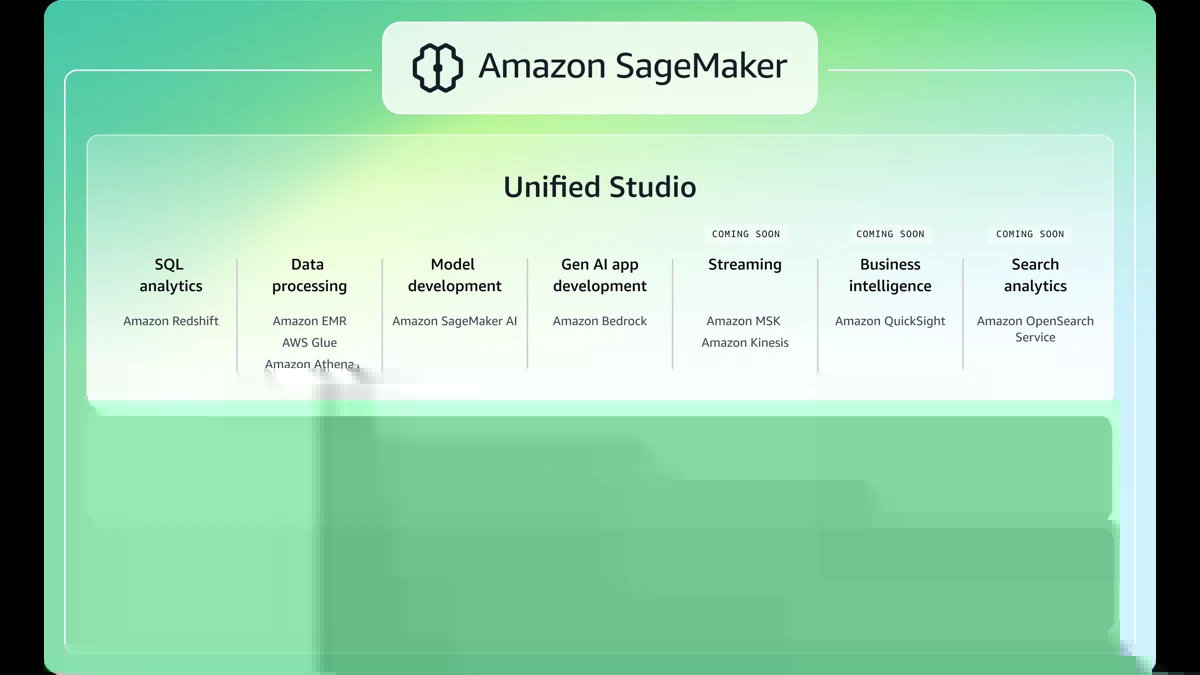
A cloud ML platform consolidates the tooling that data teams previously stitched together from open-source components, container registries, and bespoke scripts. The category spans notebooks, dataset versioning, a feature store for serving consistent inputs across training and inference, a model registry for version control over trained artifacts, machine learning operations (MLOps) pipeline orchestration, and managed endpoints for online and batch inference. Most vendors also bundle automated machine learning (AutoML), bias and drift monitors, and integrations with the host cloud's identity and billing.
The promise of a managed ML platform is removing the undifferentiated work of provisioning GPUs, wiring permissions, and standardizing experiment tracking so a team can focus on the model itself. The tradeoff is cloud ecosystem lock-in. Pipeline code written against SageMaker Pipelines does not run on Vertex AI without rewrites, and the feature store schemas differ. For teams choosing their first cloud machine learning platform, the right starting point is the broader selection framework in how to choose a machine learning platform, and a refresher on model categories at supervised vs unsupervised machine learning.
AWS SageMaker: Capabilities and Trade-offs
Azure Machine Learning is the cloud ML platform that leans hardest into enterprise governance, with native hooks into Azure Active Directory, Azure DevOps, Microsoft Purview for data lineage, and the Responsible AI dashboard for fairness and explainability reporting. The Azure ML designer offers a low-code drag-and-drop canvas for teams that want to standardize pipeline templates across business units, and the model registry tracks artifacts with built-in approval gates that map to enterprise change-management workflows. AutoML capability covers classification, regression, forecasting, and computer vision, with hyperparameter sweeps driven by HyperDrive.
Pricing on Azure ML separates the managed service (no surcharge on most paths) from underlying Azure VM compute. Standard_DS3_v2 CPU nodes run around $0.20 per hour, ND-series 8-GPU instances clear $25 per hour for distributed training, and dedicated managed endpoint deployment is billed on the same VM SKUs. Current rates are at azure.microsoft.com/pricing/details/machine-learning. Reservation and spot pricing can cut sustained training costs by 40 to 70 percent on the same SKUs, which matters for teams running continuous retraining jobs.
- Strengths: tightest enterprise identity and governance integration, mature Responsible AI tooling, strong Azure DevOps and GitHub Actions hooks for MLOps pipeline automation.
- Weaknesses: the designer surface obscures generated code, distributed training ergonomics trail SageMaker for very large clusters, and feature store maturity is younger than the AWS and Google equivalents.
- Best fit: Microsoft-shop enterprises with Azure DevOps pipelines, AAD-governed access, and regulated workloads that benefit from built-in fairness reporting.
Head-to-Head Comparison: SageMaker vs Vertex AI vs Azure ML
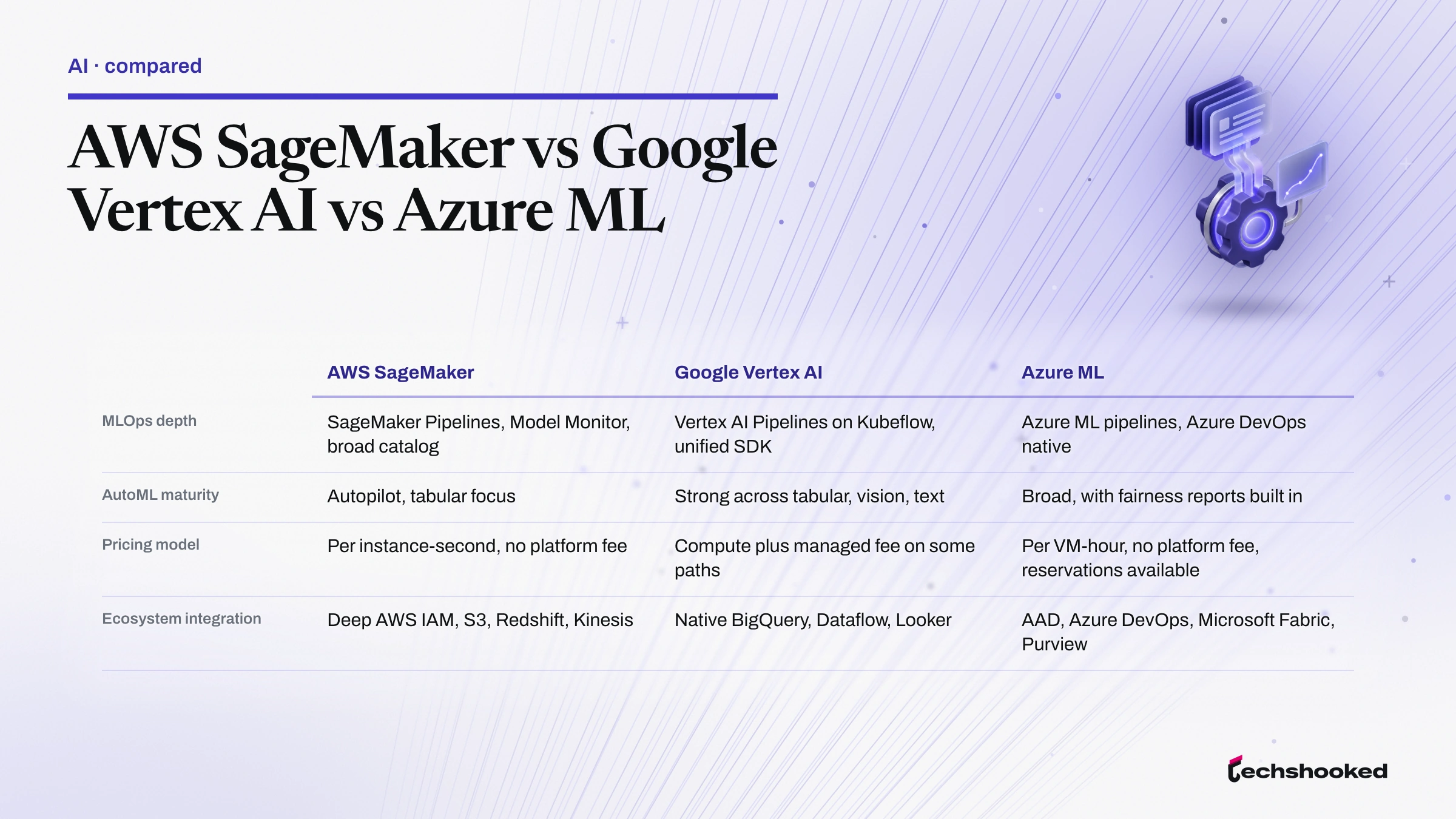
A direct comparison of the three cloud ML platform offerings exposes where the marketing parity breaks down. The table below compares MLOps depth, AutoML maturity, pricing model mechanics, ecosystem integration, experiment tracking, and multi-cloud support. Pricing cells reflect ranges AWS, Google Cloud and Microsoft publish on the pages cited in earlier sections; per-region SKUs differ, so check the SageMaker, Vertex AI and Azure Machine Learning pricing pages linked above before scoping a budget.
| Dimension | AWS SageMaker | Google Vertex AI | Azure ML |
|---|---|---|---|
| MLOps depth | SageMaker Pipelines, Model Monitor, broad catalog | Vertex AI Pipelines on Kubeflow, unified SDK | Azure ML pipelines, Azure DevOps native |
| AutoML maturity | Autopilot, tabular focus | Strong across tabular, vision, text | Broad, with fairness reports built in |
| Pricing model | Per instance-second, no platform fee | Compute plus managed fee on some paths | Per VM-hour, no platform fee, reservations available |
| Ecosystem integration | Deep AWS IAM, S3, Redshift, Kinesis | Native BigQuery, Dataflow, Looker | AAD, Azure DevOps, Microsoft Fabric, Purview |
| Experiment tracking | SageMaker Experiments | Vertex AI Experiments, Vizier | Azure ML run history, MLflow native |
| Multi-cloud support | Limited, AWS-only managed | Limited, GCP-only managed | Arc-enabled ML extends to other clouds |
On inference latency, SageMaker and Vertex AI both offer sub-50ms p99 for warm endpoints on appropriately sized GPU instances, while Azure ML's managed online endpoints fall in a similar range when paired with premium SKUs. The harder difference is cold-start behavior on serverless endpoints, where Vertex AI prediction containers initialize faster than SageMaker Serverless Inference for sparse-traffic workloads. For a model training job that needs hundreds of accelerators, SageMaker's distributed training libraries and elastic fabric adapter networking still lead on raw throughput, with Vertex AI closing on TPU pods and Azure ML competitive on ND-series InfiniBand clusters.
Choosing the Right Cloud ML Platform for Your Team
Selecting a managed ML platform is rarely a pure capability decision; the answer almost always tracks the data gravity, identity perimeter, and billing relationship the team already has with a hyperscaler. The framework below assumes the team has at least one production data science workload to host and is choosing the managed ML platform that minimizes integration friction without locking out reasonable exit options. Cloud ecosystem lock-in is real, and the cost compounds with every pipeline, feature, and trained artifact added to a single vendor's surface.
- If the analytics stack lives in AWS (S3 data lake, Redshift warehouse, Glue ETL), pick SageMaker. The IAM, VPC, and PrivateLink integrations remove weeks of plumbing, and per-instance billing aligns with existing EC2 cost discipline.
- If BigQuery is the warehouse of record and analysts already write SQL against it, pick Vertex AI. BigQuery ML and Vertex AI Pipelines give SQL-first teams a low-friction path to production without exporting data.
- If the organization is a Microsoft enterprise with Azure DevOps, AAD-governed access, and regulatory reporting needs, pick Azure ML. The Responsible AI dashboard and Purview lineage are not optional in many compliance contexts.
- If multi-cloud is a hard requirement, prefer Azure ML with Arc-enabled compute or run an open-source layer (Kubeflow, MLflow) on managed Kubernetes across providers. Accept that you give up the deepest managed features in exchange.
- If the team has no incumbent cloud, weigh hiring market in your region, training-credit availability, and the long-term cost of egress before committing. Read AI risks and limitations for the governance issues that any managed ML platform will eventually surface.
Further reading
- How to choose a machine learning platform
- Supervised vs unsupervised machine learning
- AI risks and limitations
SageMaker, Vertex AI, and Azure ML all use pay-as-you-go pricing for compute time, with billing per second of training or inference.
Frequently Asked Questions
Which is more cost-effective: AWS SageMaker or Google Vertex AI?
Cost-effectiveness depends on workload pattern. SageMaker charges per instance-second for training with no platform surcharge on most services, while Vertex AI bundles compute and managed service fees that can be lower for AutoML tasks. Teams running continuous batch training at scale on AWS infrastructure typically find SageMaker cheaper; teams already in Google Cloud with BigQuery-heavy pipelines tend to save on Vertex AI due to native data transfer pricing. Obtain per-region rates from aws.amazon.com/sagemaker/pricing and cloud.google.com/vertex-ai/pricing before projecting costs.
Can I use open-source frameworks like PyTorch or TensorFlow on all three platforms?
Yes. SageMaker, Vertex AI, and Azure ML all support PyTorch, TensorFlow, scikit-learn, and XGBoost through managed container images. Each platform also allows custom Docker containers for frameworks not covered by the defaults, so framework choice alone should not drive platform selection.
What are the switching costs if I migrate from one cloud machine learning platform to another?
Switching costs center on three areas: data egress fees (typically $0.08 to $0.12 per GB out of a cloud region), re-engineering of platform-specific pipeline code (SageMaker Pipelines, Vertex AI Pipelines, and Azure ML pipelines use different SDKs), and retraining team familiarity. Estimating migration effort at 20 to 40 engineering hours per production pipeline is a reasonable starting baseline for scoping discussions.