An open-weight model is a neural network whose trained parameters are publicly released so that anyone can download, run, and modify them independently of the original vendor. That single property changes the operating model for a builder. A closed model lives behind an API endpoint, where the vendor owns the weights, the inference stack, and the upgrade path. An open-weight model lands as a set of files on the builder's own infrastructure, ready for fine-tuning, quantization, or distillation. The decision between the two is rarely ideological. It comes down to control, cost, compliance, and how much operational burden a team is willing to absorb in exchange for a deeper say in how the model behaves. The tradeoffs play out across every layer of a production AI system, from licensing to GPU utilization, and the right answer often varies by workload within the same product.
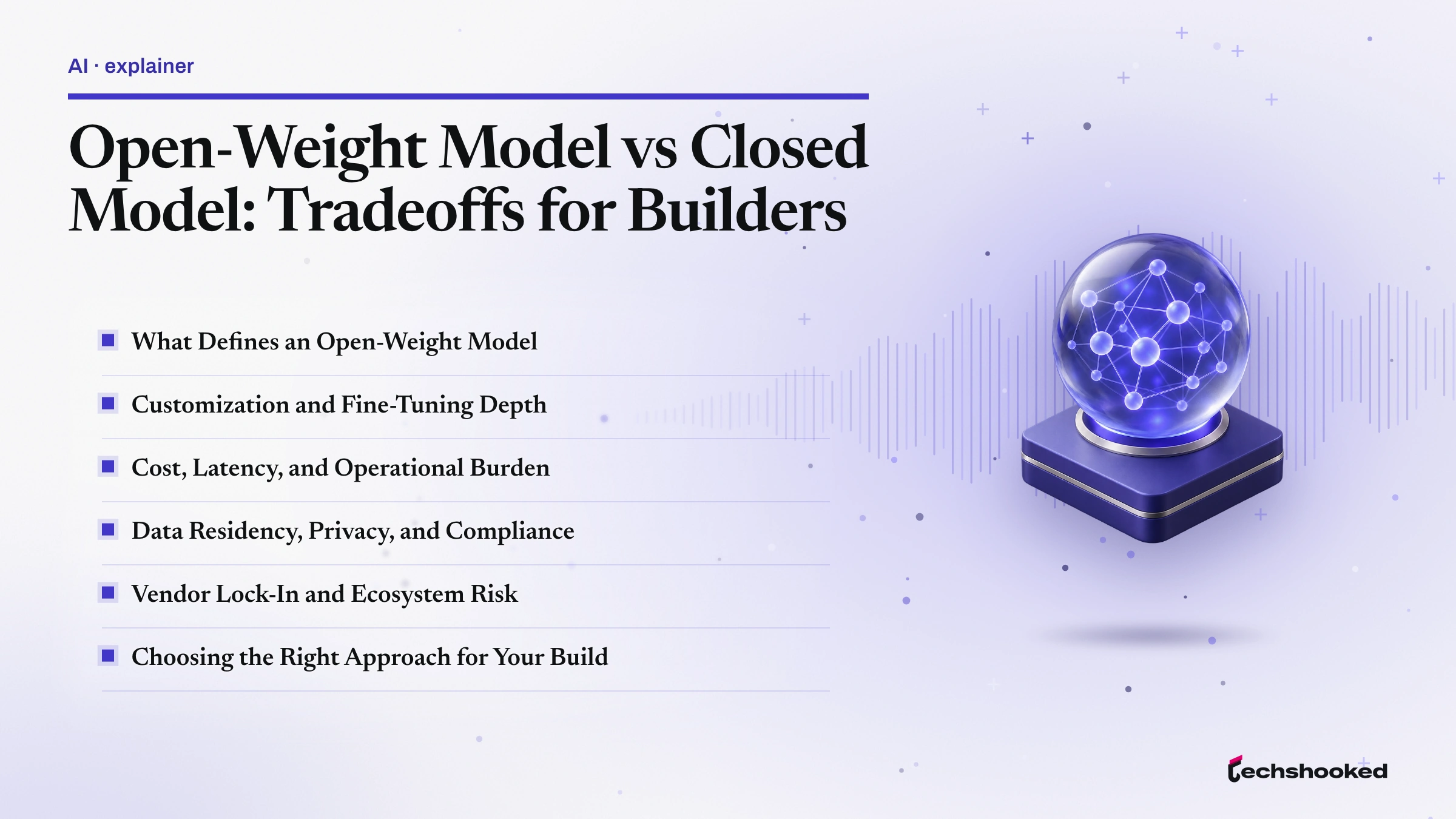
What Defines an Open-Weight Model
An open-weight model is defined by the public availability of its trained parameters, not by the openness of its training data or source code, a distinction that matters because some released weights still carry commercial-use restrictions. OpenAI draws the line directly, treating open weights as a category separate from full open source: the parameters are downloadable, but the training pipeline, dataset composition, and evaluation harness usually are not (OpenAI, Open Weights and AI for All). The model license sits on top of that release and decides what a builder can legally do with the weights. Some licenses are permissive, on the order of Apache 2.0 or MIT. Others attach conditions that turn the choice into a procurement question: the Llama community license from Meta adds a monthly-active-user threshold above which a separate Meta agreement is required, while the Gemma terms from Google carry a prohibited-use policy that restricts certain applications. The release format matters too. Hugging Face has become the de facto distribution layer, where each model card lists the license, the parameter count, and the supported quantization formats next to the download. The mechanics of how those parameters are learned in the first place are covered in large language models, their architecture, and what their training pipeline can and cannot fix.
- Model weights: the trained parameter tensors, released as files a builder can download, inspect, and load into an inference runtime.
- Model license: the legal terms attached to those weights, ranging from permissive (Apache, MIT) to restricted commercial use.
- Open-weight model: weights public, training code and data often not, with the license deciding the commercial envelope.
- Open-source AI: the stronger label, requiring training code, data pipeline, and weights to all be open under a recognized license.
The Closed Model: What the API Abstracts Away
An open-weight model releases its weights; a closed model does the opposite, giving builders access only to an API endpoint while keeping the parameters, architecture details, and training pipeline internal to the vendor. The closed model approach is the dominant deployment shape for frontier systems from OpenAI, Anthropic, and Google, where capabilities like GPT-4 class reasoning, Claude tool use, or Gemini multimodal grounding ship as managed services. The vendor handles scaling, GPU allocation, safety updates, and model swaps. The builder sends prompts, pays per token, and inherits whatever capability the current release exposes through the API. That trade is real value. A closed model means no GPUs to operate, no fine-tuning pipeline to maintain, and no compliance posture to defend on the inference stack itself. It also means the builder accepts a thicker layer of abstraction. Anthropic, for example, ships Claude as a managed product through the Anthropic API and partner clouds such as AWS and Google Cloud, rather than as downloadable weights (Anthropic, News and product updates). The cost of that simplicity is visibility: a closed model is opaque on internals, opaque on training data, and subject to vendor policy changes that can rewrite the economics of an application overnight.
- Vendor API: the network endpoint a builder calls to run a closed model, billed per input and output token.
- Managed inference: the vendor owns the GPUs, autoscaling, observability, and safety pipeline around the model.
- Capability ceiling: a closed model exposes only what the vendor decides to ship, with no access to the underlying weights for adaptation.
- Policy surface: usage policies, rate limits, and data retention terms are set by the vendor and can change with notice.
Customization and Fine-Tuning Depth
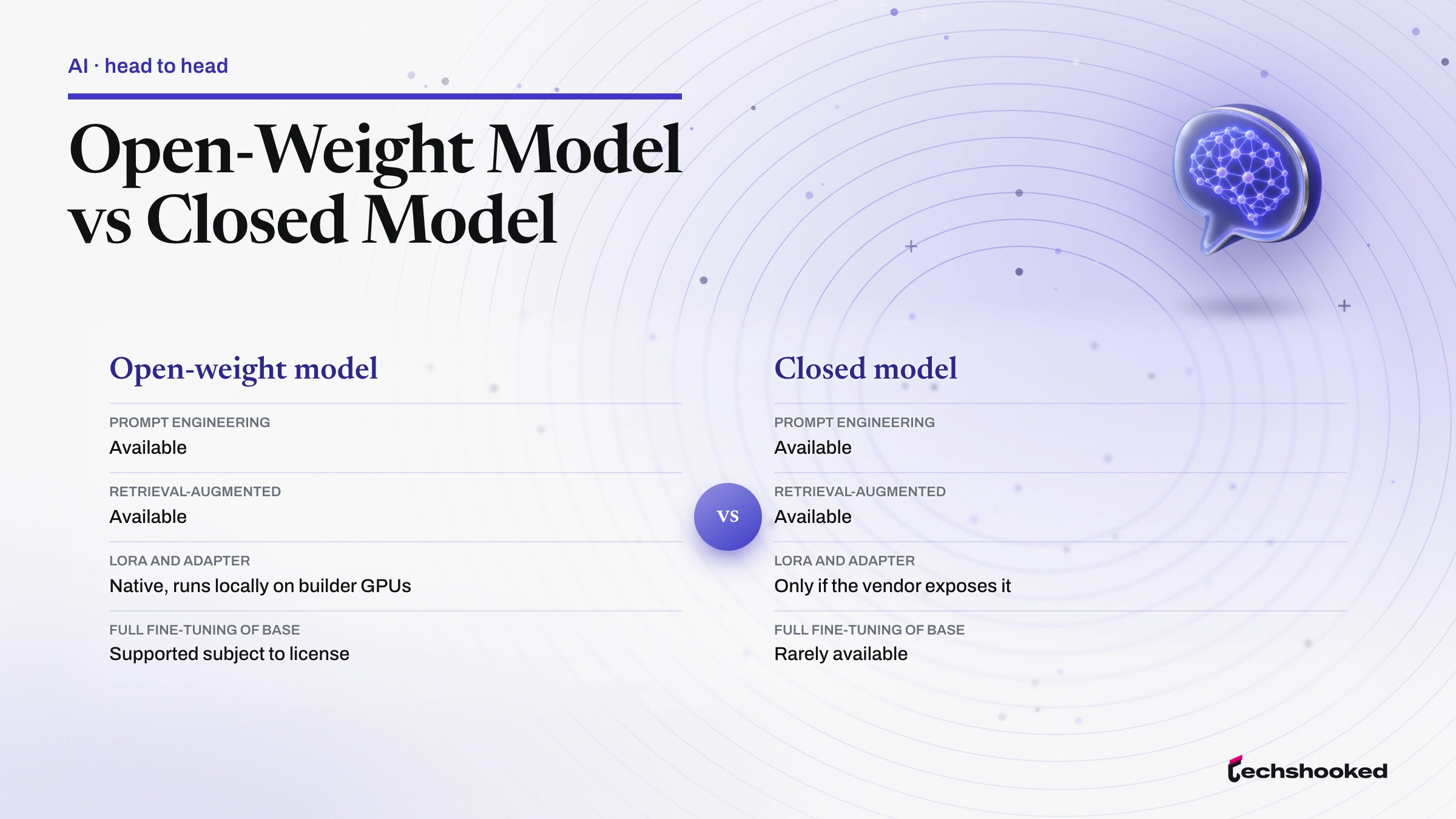
An open-weight model gives builders full access to its parameter space, enabling techniques such as full fine-tuning, LoRA adapters, and quantization that go well beyond the prompt-level adaptation a closed model typically offers. The depth of that access is what teams pay for in operational burden. Full fine-tuning rewrites every weight in the network, useful when the target domain diverges sharply from the base distribution and a team has the compute budget to spend. Parameter-efficient fine-tuning, most commonly LoRA, trains small adapter matrices on top of the frozen base, capturing most of the domain gain at a fraction of the GPU hours. Quantization shrinks the model footprint by reducing weight precision, often from 16-bit down to 8-bit or 4-bit, so a 70-billion-parameter open-weight LLM can run on a single high-memory GPU rather than a multi-node cluster. Mistral has framed open release explicitly around this kind of deployment flexibility, packaging its earlier 7-billion-parameter model under Apache 2.0 specifically so any team could fine-tune and serve it without restriction (Mistral AI, Announcing Mistral 7B). A closed model usually limits the builder to prompt engineering, retrieval grounding, and whatever managed fine-tuning the vendor exposes, with no visibility into how those adapters interact with future base-model upgrades.
| Adaptation technique | Open-weight model | Closed model |
|---|---|---|
| Prompt engineering | Available | Available |
| Retrieval-augmented generation | Available | Available |
| LoRA and adapter fine-tuning | Native, runs locally on builder GPUs | Only if the vendor exposes it |
| Full fine-tuning of base weights | Supported subject to license | Rarely available |
| Quantization (8-bit, 4-bit, GGUF) | Supported, builder controls precision | Not exposed |
| Architectural surgery (layer pruning, distillation) | Supported | Not available |
Cost, Latency, and Operational Burden
An open-weight model shifts the cost structure from per-token API pricing to fixed infrastructure expenditure, a tradeoff that favors self-hosting at sustained high throughput but often disadvantages low-volume or unpredictable workloads. A closed model bills cleanly per million tokens, so the inference cost scales linearly with usage and the marginal request is cheap to reason about. An open-weight model carries fixed costs that are hidden in the API quote: GPU instance hours, autoscaling overhead, observability, on-call rotation, and the staff time to keep an inference server healthy. The break-even shifts with utilization. A self-hosted deployment that runs near full GPU capacity through the day can drive per-request inference cost well below an equivalent closed-model call. The same deployment running at 20 percent utilization is almost always more expensive than an API. Latency moves in both directions too. A closed model often sits in a vendor region the builder cannot pick, adding network hops. A self-hosted open-weight LLM placed inside the application VPC can deliver lower tail latency, especially for streaming use cases where every additional round trip is felt by the user.
- Measure baseline throughput: daily and peak tokens per second, so the GPU sizing math is grounded in real load rather than headroom estimates.
- Price the closed model envelope: compute the per-token cost at projected volume to set the open-weight target a self-hosted stack must beat.
- Size the GPU fleet honestly: include redundancy, off-hours idle, and the headroom needed for traffic spikes before declaring a saving.
- Add the operational tax: on-call engineering, monitoring, model updates, and security patching are recurring costs, not one-time setup.
- Validate the break-even monthly: usage drifts, model prices fall, and a decision that made sense at launch may not hold six months in.
Data Residency, Privacy, and Compliance
An open-weight model can satisfy strict data residency requirements because inference runs entirely within the builder's own environment, keeping regulated data off third-party infrastructure. For teams in healthcare, financial services, or any jurisdiction that pins data to a specific country, that property is often the deciding factor. A self-hosted open-weight LLM can sit inside an existing VPC, an on-premises data center, or a sovereign cloud region without the data ever crossing a vendor boundary. The closed model alternative is improving in this area through enterprise contracts that pin processing to specific regions and contractual zero-retention terms, and the major API vendors now document those guarantees as part of their enterprise offers. The deeper point is that privacy is not automatic on either side. An open-weight deployment that ships prompt logs to an unsecured analytics warehouse is no more private than an API. The advantage of an open-weight model is that the builder controls the entire data path. The cost is that the builder is responsible for every link in that chain, from disk encryption to access controls to logging hygiene, and the compliance audit lands on the builder rather than the vendor.
- Data residency: with an open-weight model, inputs and outputs never leave the builder's infrastructure unless the builder routes them out.
- Regulatory mapping: open-weight deployments can be pinned to a specific country or region to satisfy GDPR, HIPAA, or sector-specific rules.
- Logging discipline: the builder owns prompt logs, traces, and evaluation data, and is responsible for retention and access policies.
- Vendor data terms: closed-model enterprise contracts can offer zero-retention and region pinning, but the legal posture is still vendor-managed.
- Threat model boundary: the security perimeter for an open-weight model is the builder's stack, not the vendor's.
Vendor Lock-In and Ecosystem Risk
An open-weight model decouples a team's application logic from any single vendor's roadmap, which reduces the risk that a pricing change, a model deprecation, or a policy update forces a disruptive migration. Vendor lock-in on a closed model is rarely a single decision. It accumulates through prompt templates tuned to a specific model's quirks, fine-tuning runs anchored to a vendor's training surface, and observability stacks wired to proprietary telemetry. When the vendor retires a snapshot or shifts pricing, the application carries that weight. OpenAI, Anthropic, and Google all publish their own open-weight or partially open releases as part of a broader strategy, with OpenAI maintaining a dedicated catalog of its open models (OpenAI, Open Models). An open-weight model gives the builder a permanent copy of the model weights. Even if the publishing vendor disappears or changes terms on future releases, the existing weights still run, and the application can be migrated to a different base model on the builder's own timeline. The trade is that the builder accepts the ecosystem risk that comes with operating the model: drivers, runtimes, and inference servers all become part of the stack the team owns.
- Audit the integration surface: identify every prompt template, tool schema, and fine-tune that is bound to a specific closed model's behavior.
- Keep a portable abstraction: route model calls through an internal interface so swapping providers is a configuration change, not a rewrite.
- Maintain an open-weight fallback: keep at least one self-hosted model warm for the workloads where vendor lock-in would be most damaging.
- Track license drift: open-weight licenses can tighten between versions, so a procurement review on every major release is cheap insurance.
Choosing the Right Approach for Your Build
An open-weight model is the stronger default when a team has GPU infrastructure, strong data-governance requirements, or a need for deep fine-tuning; a closed model is the stronger default when time-to-production, managed reliability, and access to the most capable frontier systems outweigh the cost and control tradeoffs. The decision is rarely all-or-nothing. Many production systems route requests across both, sending high-volume, latency-sensitive, or privacy-constrained traffic to a self-hosted open-weight LLM and reserving a closed model for the small share of requests that genuinely need frontier capability. That hybrid pattern lets a team capture the inference cost advantage of open weights on the bulk of traffic while still reaching a Claude or GPT-class system for the hardest tasks. Google's Gemma family, OpenAI's open releases, and Mistral's catalog are now realistic substrates for a serious self-hosted deployment, and the gap to closed frontier models on common workloads keeps narrowing. The right question is not which side wins in the abstract. It is which model class fits each workload inside the application, and whether the team has the staffing to run the open-weight path well enough to deliver on its promise.
| Builder situation | Open-weight model | Closed model |
|---|---|---|
| Strict data residency or on-prem requirement | Strong fit | Limited to vendor enterprise terms |
| Need to ship in weeks, no GPU team | Weak fit | Strong fit |
| Sustained high token throughput | Lower inference cost at scale | Linear per-token billing |
| Frontier reasoning or multimodal grounding | Gap is narrowing but still real | Current capability ceiling |
| Deep fine-tuning or distillation needed | Native and unrestricted | Limited to vendor-exposed tuning |
| Tolerance for vendor lock-in | Low, weights are portable | High, switching cost grows over time |
References
- OpenAI, Open Weights and AI for All
- OpenAI, GPT Open-Source Model Card
- OpenAI, Open Models
- Google AI for Developers, Gemma 4 Model Card
- Mistral AI, Announcing Mistral 7B
- Anthropic, News and Product Updates
Further reading
Frequently Asked Questions
What is the difference between open-weight and open-source AI models?
Open-weight means the trained parameters are publicly released for download and use; open-source means the training code and data pipeline are also available. A model can release its weights under a restricted commercial license while keeping its training dataset and code proprietary, so the two labels are not interchangeable.
Can I fine-tune open-weight LLMs for commercial use?
It depends on the specific model license. Some open-weight releases permit commercial fine-tuning freely, while others impose restrictions such as monthly active user caps or prohibitions on use in certain products. Builders must read the license for the exact model family and version before deploying a fine-tuned variant commercially.
Are open-weight models cheaper than closed API models?
Open-weight models can reduce per-inference cost at high throughput once infrastructure is in place, but the break-even depends on GPU utilization, staffing, and workload volume. For low-volume or unpredictable workloads, a closed API is often cheaper because it carries no fixed hosting overhead.
Can I run open-weight and closed models together in the same application?
Yes. Many production systems route tasks across both: an open-weight model handles high-volume, latency-sensitive, or privacy-constrained requests while a closed API handles tasks that require frontier capability. The routing logic can be based on task type, cost thresholds, or data classification.
Does using an open-weight model guarantee my data stays private?
Running an open-weight model on your own infrastructure means inference data does not leave your environment, which supports data residency and privacy goals. Privacy is not automatic, however: the builder is responsible for securing the hosting environment, access controls, and any logging pipelines around the model.