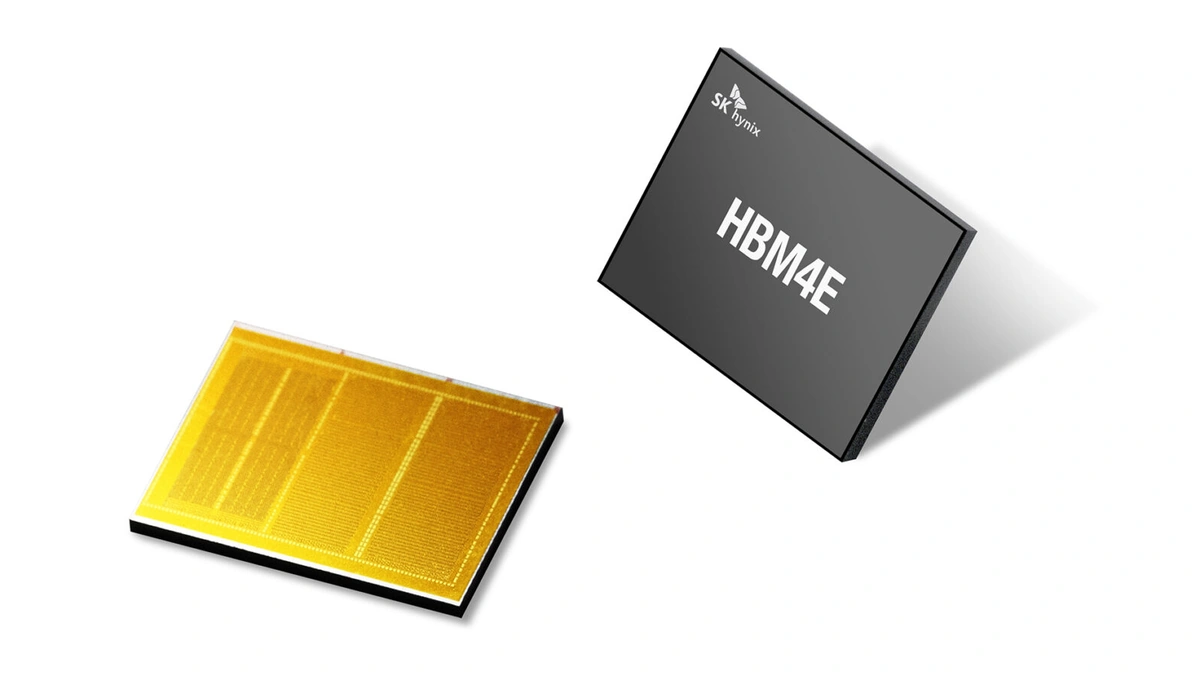
SK hynix has shipped samples of HBM4E, its next-generation high-bandwidth memory for AI, to major customers ahead of a planned mass production ramp. According to SK hynix, the 12-layer stack reaches a maximum speed of 16Gbps per pin, a 60% jump over HBM4's 10Gbps rating, and packs 48GB of capacity into a single stack.
The company attributes two structural advances for the leap. First, SK hynix uses Advanced MR-MUF (Mass Reflow Molded Underfill, a process that injects liquid protective material between stacked dies) to achieve the 12-high configuration while holding heat resistance 17% lower than HBM4. Second, revised interface design and latency optimization let the stack sustain stable operation at high bandwidth, which SK hynix says translates directly to faster data throughput for AI training and inference workloads running on large-scale accelerators.
Power efficiency rises more than 20% from the previous generation, a detail that matters at datacenter scale: AI clusters running thousands of accelerator cards accumulate memory power draw as a significant fraction of total facility load. A 20% reduction per stack, across a multi-thousand-GPU system, compounds into meaningful savings on cooling and power infrastructure.
The competitive context: Samsung began sampling its own HBM4E design roughly a month earlier, claiming 14Gbps per pin. SK hynix's published 16Gbps figure would represent a clear per-pin bandwidth lead if both claims hold at customer validation. HBM4E succeeds HBM4, which SK hynix has been shipping in volume to partners including NVIDIA; the company cites its track record with HBM3, HBM3E, and HBM4 supply as evidence it can execute a timely mass-production transition.
"SK hynix has laid the foundation to strengthen its AI leadership with HBM4E based on its market-leading technological capabilities and manufacturing expertise," said Ahn Hyun, President and Chief Development Officer. The company did not specify a mass production timeline beyond noting it will "work closely with partners" on timing.
For engineers specifying AI accelerator platforms, the practical question is qualification schedule: samples today typically precede qualified mass supply by six to twelve months, meaning HBM4E-based systems are most likely a 2027 accelerator generation story rather than an immediate upgrade path.