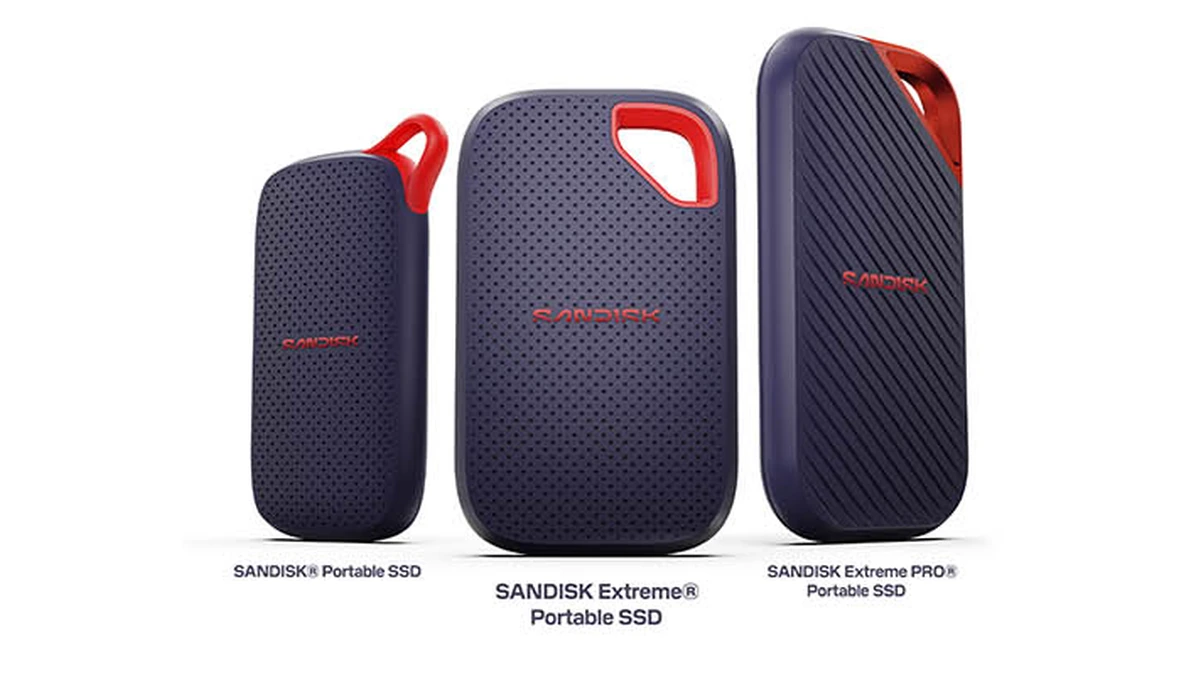
Moving up to 1,000 high-resolution photos in under a minute, or 10 minutes of 12K video in under a minute, is now the kind of transfer speed SanDisk is designing consumer portable drives around. The company has restructured its portable SSD line into three tiers instead of one general-purpose model: the SANDISK Portable SSD for everyday backups, the SANDISK Extreme Portable SSD for creative and photo work, and the SANDISK Extreme PRO Portable SSD for professional video editing. Only the middle tier, Extreme, was shipping as of the February 2026 announcement; the rest of the lineup is set to roll out through the second half of 2026.
The spec gap between the three tiers is wide. The base SANDISK Portable SSD tops out at 1,000MB/s read speeds in 500GB to 2TB capacities, aimed at students and family archivists who mostly need reliable backup rather than raw throughput. The Extreme, available now from $259.99 for 1TB up to 4TB, doubles that to 2,000MB/s, roughly twice its predecessor's speed according to SanDisk. The Extreme PRO, arriving in the second half of 2026 in 2TB to 8TB capacities, doubles it again to 4,000MB/s, the tier built for the real-time editing and multi-stream workflows that come with working in 12K footage. Both Extreme models add IP65 dust and water resistance, drop protection to three meters, and 256-bit AES password encryption, features the base model skips in favor of a lower price and a two-meter drop rating.
SanDisk's own framing leans heavily on AI-generated content as a driver of the redesign, alongside rising photo and video resolutions. That's a real trend but also a convenient one for a storage vendor to point to when justifying a three-tier product split, since files generated or upscaled by AI tools do tend to run larger than their predecessors, much the way 4K video pushed storage requirements up a decade ago. What is more concrete is the timing gap: SanDisk shipped only its middle tier in February 2026 and is holding the entry-level and professional models for the second half of the year, a staggered rollout that lets the company test demand and manufacturing at the mid-range price point before committing capacity to the cheaper and pricier ends of the lineup.