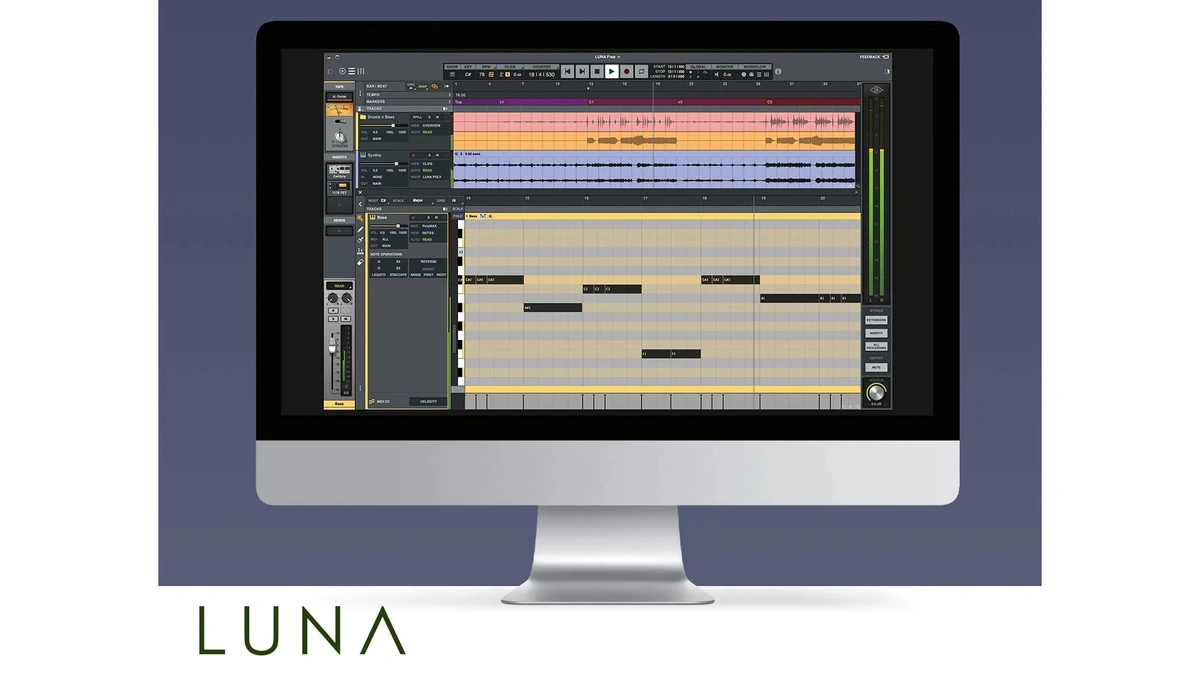
Universal Audio pushed a major update to LUNA, its digital audio workstation (DAW) that has anchored the company's push beyond hardware since 2020, into general release. The refresh puts more of a session on autopilot, aiming the software at anyone chasing a fleeting idea rather than only engineers running a full mix.
Universal Audio built the release, LUNA 3.0, around LUNA Play, a pared-down capture mode. Open it, plug in a guitar or microphone, and the software works out what's connected, dials in a rough level, and drops in a matching UAD plug-in preset before a musician even reaches for a fader. The company positions it as a way to jam along with a reference track or grab a take the instant inspiration hits, rather than fighting through routing and gain-staging first.
That capture mode, along with a handful of session-management additions (folder tracks, a rebuilt piano roll with editing that follows the song's scale, a zoom-aware grid, gain automation on individual clips, and four tracks of stem separation) comes at no cost in LUNA Free. The paid edition, LUNA Studio, costs $199 outright or rides along with UA's Spark Studio subscription, priced at $19.99 a month or $149.99 a year, which throws in the company's entire catalog of native plug-ins. Paying unlocks a deeper feature set: splitting a mix into six stems instead of four, turning a recorded performance into MIDI data, transcribing lyrics and pulling out chord changes (work handled by Moises, an outside audio-AI partner), plus UA's own recreations of analog tape machines and consoles modeled on API, Studer, and Ampex gear.
LUNA arrived in 2020 promising something rival DAWs did not: signal paths modeled directly on hardware licensed from Neve, API, Studer, and Ampex rather than generic emulations. Six years later, that hardware pedigree reads like only half the pitch. Automating the grunt work of getting sound into a computer, tasks a musician used to handle manually before a note got recorded, is now central to how Universal Audio wants LUNA to compete.
Bill Putnam Jr., Universal Audio's CEO, framed the release around losing momentum mid-idea, saying the goal was to stop "the tech" from getting in a musician's way once inspiration strikes. The update is live now on macOS and Windows, and for the first time, most of that automation sits in the version that costs nothing.