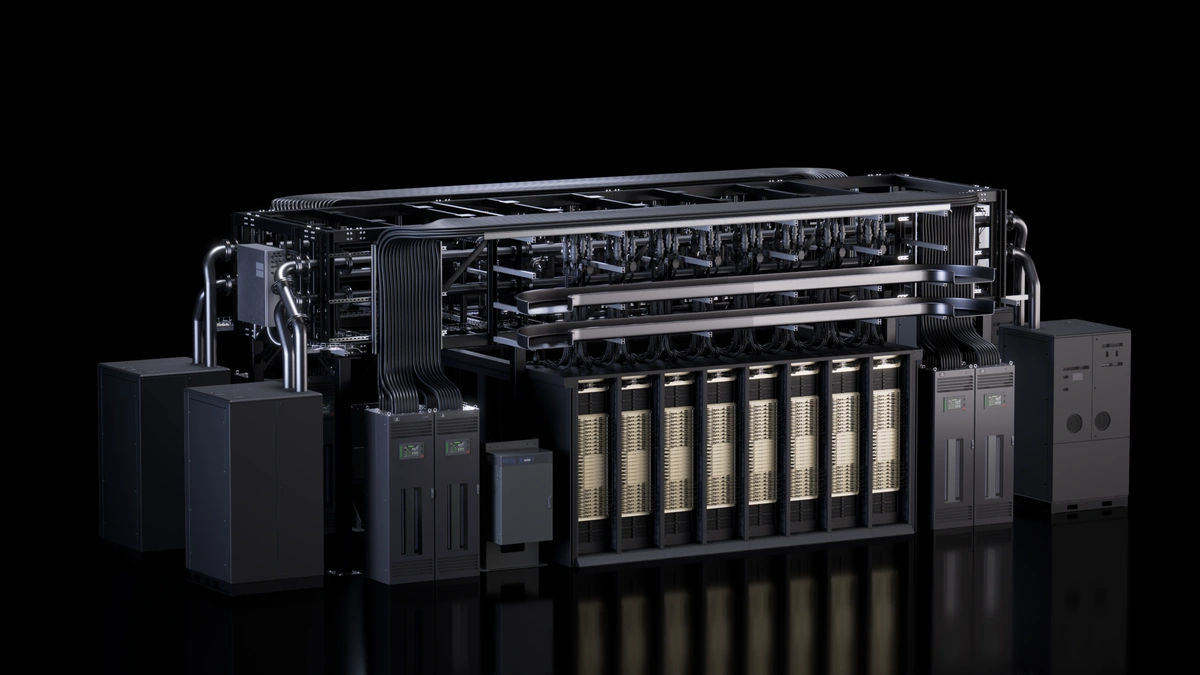
NVIDIA Vera Rubin rack and compute tray designs are now available to other hardware makers, after NVIDIA contributed them to the Open Compute Project at its Global Summit in San Jose on Monday.
The NVIDIA Vera Rubin designs travel through NVIDIA's MGX architecture. NVIDIA says the updated MGX 1.2 specification adds blind-mate liquid cooling at rack scale, a liquid-cooled 5,000A busbar and native 19-inch equipment support. Racks can reach 250kW, and the compute trays are fanless and liquid-cooled, with configurable I/O bays. Builders gain shared power and cooling interfaces, which NVIDIA expects to shorten assembly, testing and servicing compared with one-off designs.
A separate Vera CPU rack specification takes MGX beyond accelerators. NVIDIA positions it for agentic AI work such as tool calling, orchestration and sandboxed execution, while the NVIDIA Vera Rubin NVL72 stays the platform for large-scale training and inference.
Facility standards came out alongside the hardware. NVIDIA joined AMD, Google and Meta on Open Data Center Specification v0.7, a blueprint covering power, cooling and physical layout. Google, Meta, Microsoft and NVIDIA also published a Grid Resilience Specification, which asks large AI sites to stay connected through utility disturbances and return to near-full load in under two seconds. The practical effect is that makers of NVIDIA Vera Rubin gear can design against a published target instead of waiting on one customer's private requirements.
Networking got the most partner activity. For its NVIDIA Vera Rubin clusters, Meta is adopting Spectrum-6 Ethernet switches for its own switch, N-IceCube, which sits in the liquid-cooled IcePack rack. Spectrum-X Multiplane lets a cluster split GPU traffic across as many as eight network planes, a design NVIDIA says scales beyond 100,000 GPUs. With Cisco, NVIDIA announced plans for USFP, a pluggable optical form factor about the size of OSFP that targets 400Gb/s per lane, with TE Connectivity and Amphenol on cages and connectors. Google's Falcon transport protocol is also headed to future NVIDIA ConnectX-10 SuperNICs and BlueField DPUs.
On the software side, NVIDIA released open source pieces of DSX OS: Config Manager, Cluster Readiness Engine, Rack Management Service and a Cluster API provider for bare-metal onboarding. Visionbay, meanwhile, showed K-1, an 800 VDC factory design built with Vertiv power and thermal gear. Most of the networking items are plans for future parts, so the test is whether rack builders outside NVIDIA's own ecosystem adopt the liquid-cooling interfaces.