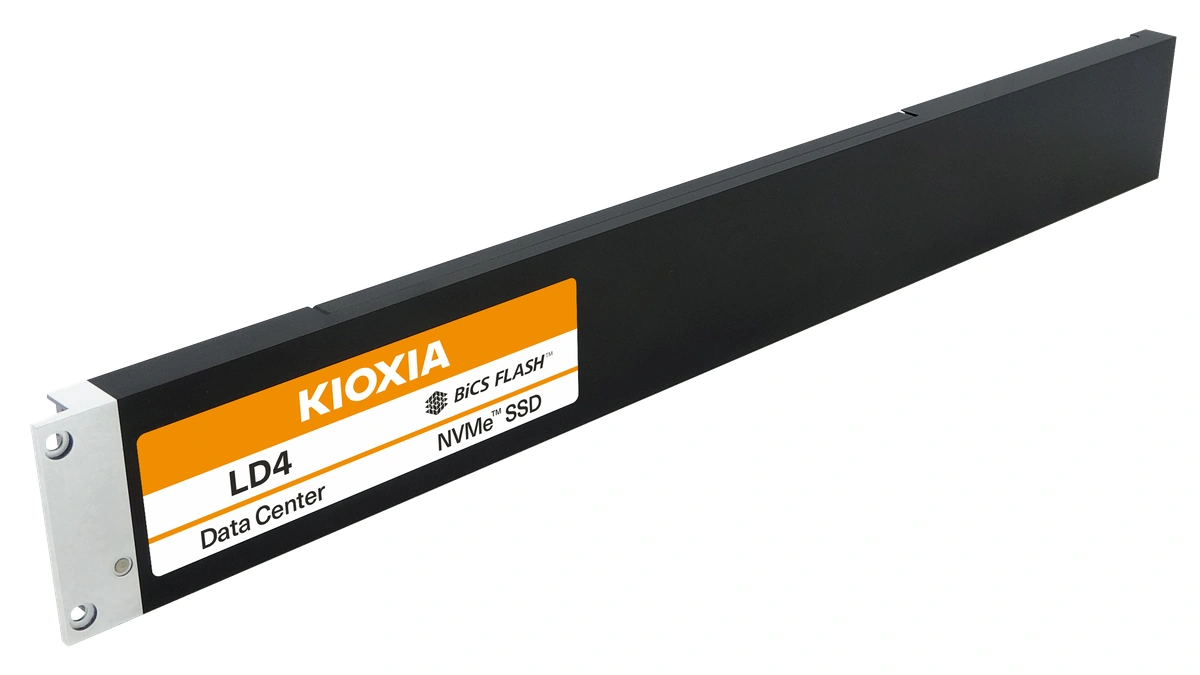
Kioxia has added a long-format drive to its data center lineup. The Kioxia LD4 Series is the company's first E1.L SSD built on generation 8 BiCS FLASH QLC memory, and it is aimed at the densest 1U servers that hyperscale operators fill with read-heavy data.
E1.L is the extended-length member of the EDSFF family, built to pack capacity into a 1U chassis. Capacity is the point: the 15.36 TB and 30.72 TB models are offered now, and a validated architecture leaves room for 122.88 TB. According to Kioxia, the Kioxia LD4 drives use a single-port design, comply with NVMe 2.0e and support the Open Compute Project's Datacenter NVMe SSD Specification 2.6. The interface in the spec list is labeled PCIe 5.0, yet the label carries a "Gen 4 x4" note, and a footnote cites speeds up to 16 gigatransfers per second, the per-lane rate of the fourth generation. Fifth-generation links run at 32.
Buyers comparing the Kioxia LD4 against other drives will want the datasheet to settle which link speed applies, because the generation gap changes real-world bandwidth. The announcement gives no throughput, IOPS, endurance or price figures.
QLC memory stores four bits in each cell. That raises capacity per chip at the cost of write endurance, which is why it fits workloads where data is written once and read many times. Neville Ichhaporia, who runs the SSD business unit at Kioxia America, framed the Kioxia LD4 around that profile, pointing to AI workloads that need large pools of fast-to-read storage.
For now the Kioxia LD4 is not on general sale. Kioxia says the drives are going to select customers as samples and will be shown at the 2026 OCP Global Summit in San Jose, October 12 to 15.