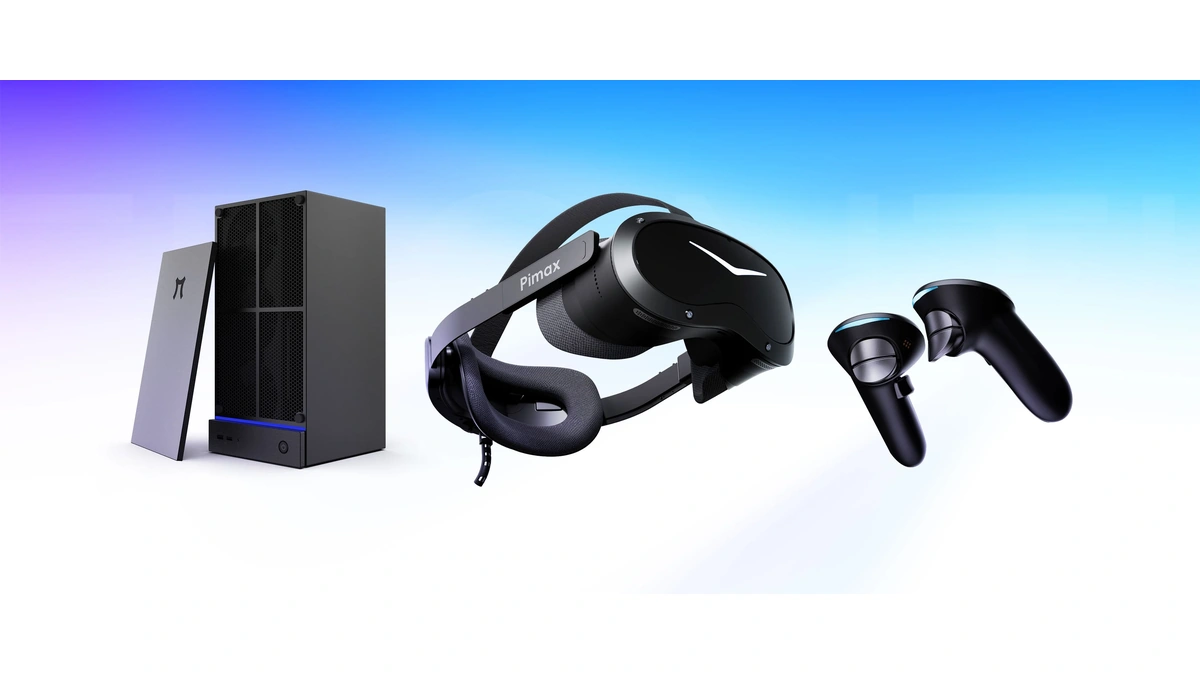
Pimax Crystal Pro sends the GPU's native image to its display panels without video encoding, but only when a buyer adds the optional 60GHz AirLink kit. The wireless PC VR headset relies on its eye tracking to pick which part of the frame gets that treatment, a technique the maker calls Native Foveated Streaming.
Per Pimax, the base headset streams over built-in Wi-Fi and ships with a dedicated Wi-Fi 6E adapter, so the encoded path stays the default. The third-generation kit adds two headset antennas and two room antennas working as a 2x2 MIMO link, which the company describes as a first for 60GHz on a VR headset. Pimax rates combined throughput at up to 6 Gbps, enough for an image equal to 2880 x 2880 pixels per eye at up to 90Hz inside the user's focus area. It puts the added latency under 2 milliseconds. The signal does not pass through walls.
Pimax Crystal Pro costs $1,399 on its own. The bundle with the AirLink kit is $1,899, and the kit sells separately for $599, so buying them together saves $100. Shipping dates have not been set. A $1 reservation takes $20 off the headset, or $50 off the bundle, at launch. The practical choice is between a cheaper headset that encodes its picture and a $500 step up that trades wall penetration for an unencoded one.
Pimax Crystal Pro uses 2880 x 2880 QLED panels per eye behind aspheric glass lenses, with a 110 degree horizontal field of view and 35 pixels per degree. Refresh rates run at 72, 90 and 120Hz, and Mini-LED local dimming covers 576 zones per eye at 200 nits. Tracking comes from Pimax SLAM 2.0 with four cameras, while Omnivision eye tracking samples at 120Hz. The headset has no internal battery, so a 16,000mAh external pack comes in the box, and a DisplayPort cable option covers wired use.
Two companion products arrived alongside Pimax Crystal Pro, both without prices or dates. The Ringless VR Controllers track through the headset's cameras plus infrared LEDs and a motion sensor, replacing the ring on earlier Pimax controllers, and snap together with a pin to act as a Windows and Steam gamepad. The Spation is a mini PC built from desktop parts, pairing a high-end AMD processor with either an AMD or an Nvidia graphics card, and it runs Windows or SteamOS. Pimax Play is also getting a dedicated Linux client.