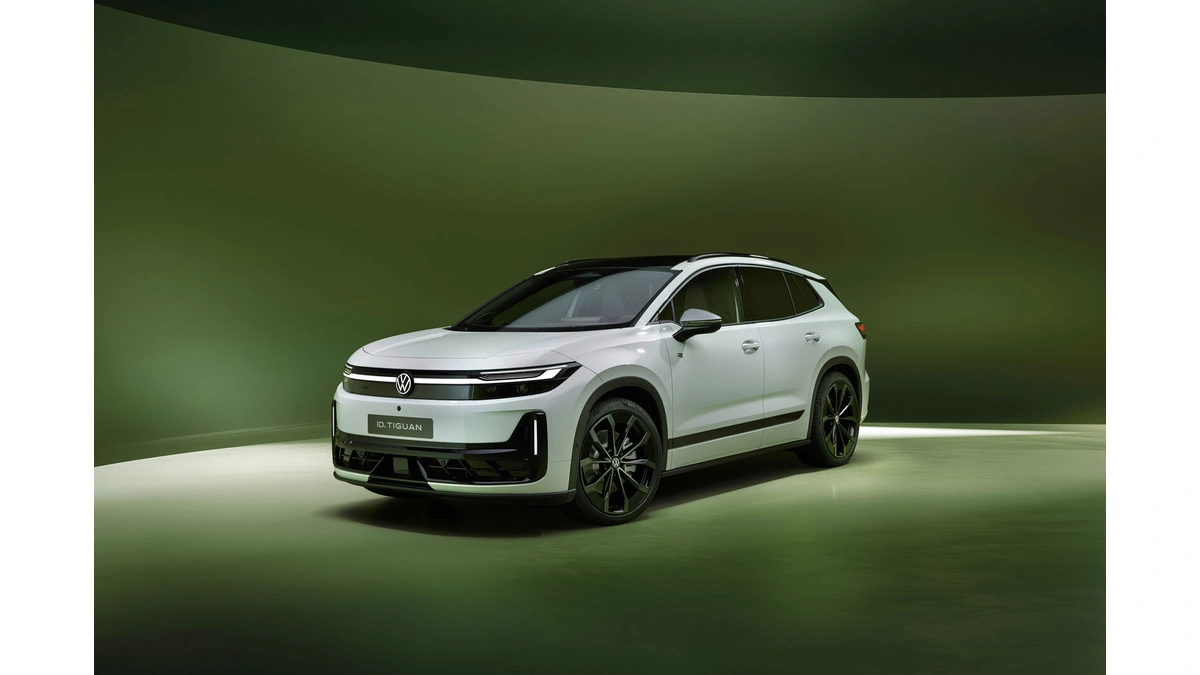
Volkswagen will replace the ID.4 and ID.5 with the Volkswagen ID. Tiguan, a single electric SUV due in showrooms in early 2027, leaving the brand with one model where it now sells two. It will sit next to the gasoline, diesel and hybrid Tiguan instead of displacing it.
The pitch to buyers is continuity. The outgoing pair has seen more than 950,000 units built, and Volkswagen brand CEO Thomas Schäfer described the Tiguan as the company's best-selling model worldwide. The new car is built in Emden, while the combustion Tiguan comes from Wolfsburg.
Per Volkswagen, there are three drivetrains. A rear-wheel-drive version makes 140 kW (190 PS) from a 58 kWh battery. A second rear-wheel-drive version makes 210 kW (286 PS) from a 77 kWh pack, and a 220 kW (299 PS) 4MOTION all-wheel-drive variant uses the same larger battery. WLTP range reaches up to 600 km (about 373 miles), a European test figure that tends to run higher than US EPA ratings. Towing is rated at 1,800 kg with the smaller battery and 2,000 kg with the larger one. Trims are Trend, Life, Style and R-Line, with up to 534 liters of luggage space and a 32-liter front trunk.
The cabin carries the bigger changes. A 12-inch display in front of the passenger is, Volkswagen says, a first for a European model from the brand, alongside a 10-inch driver display and a 15-inch center screen. A privacy mode keeps the passenger screen out of the driver's view, and sound can be routed to paired Bluetooth headphones. Volkswagen ID. Tiguan buyers get what the company frames as an interior with the presence of a vehicle from the next class up, a description that is the company's own rather than a measured one.
Controls move back toward hardware. Climate functions sit on a button bar in the center console, volume and track selection use a controller, and the steering wheel has physical buttons in place of touch surfaces. Two Qi2 wireless charging pads sit at the front. A "Retro" view recreates the blue and red gauges of a Golf IV in the driver display, with the power meter standing in for a rev counter, and the center screen offers a virtual garage of six classic Volkswagen models.
Driving aids include standard one-pedal driving and a new Connected Travel Assist that can change lanes on motorways and stop the car at red traffic lights. Optional equipment adds massaging and ventilated front seats, a 480-watt Harman Kardon audio system and a panoramic roof. A smartphone Digital Key can be shared with others, and an optional PowerSocket adapter provides vehicle-to-load power for devices such as e-bikes.
Pre-sales open on 13 October in Germany and many other European countries, starting at 42,695 euros (about $47,850 at the 1.1206 dollar-per-euro rate on October 9). Volkswagen's release names no US plans, so American shoppers have only the European specifications to go on for now.