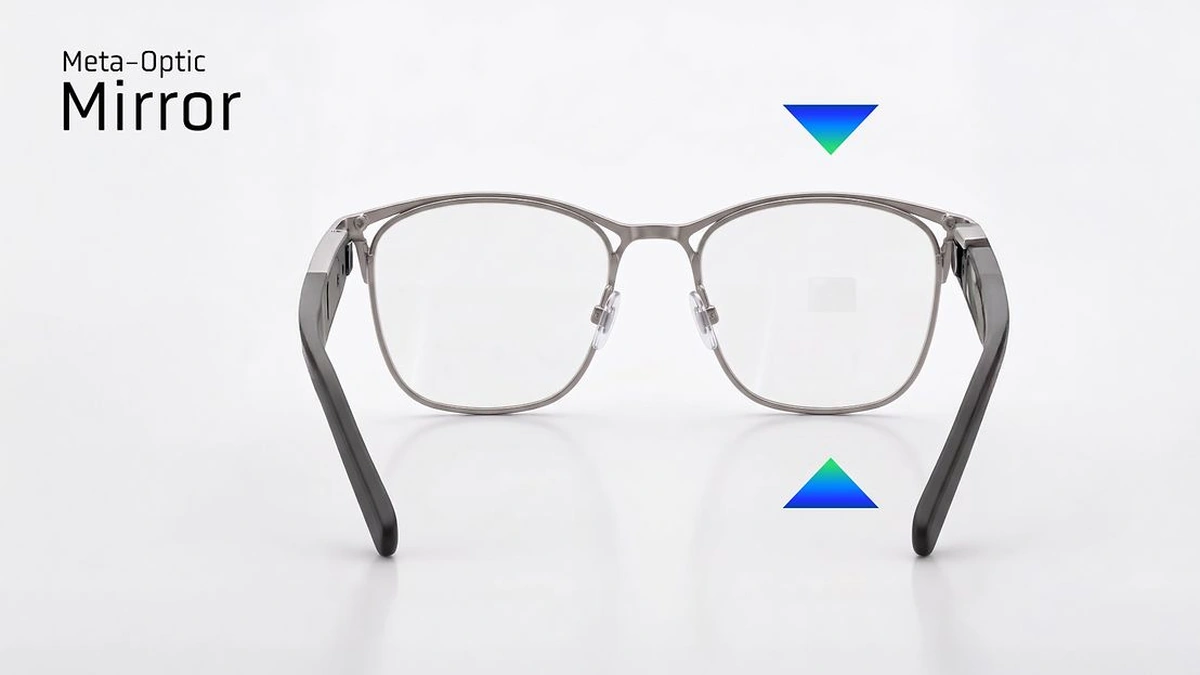
TDK says it has demonstrated the first direct retinal projection display for smart glasses to use a meta-optic mirror, a flat reflector thin enough to sit inside an ordinary-looking lens. For now, it works in monochrome only.
The reflective layer is 150 nanometers thick, and TDK lists the light it lets through at about 80 percent, which the company puts on par with an ordinary eyeglass lens. Direct retinal projection aims laser light at the retina itself instead of lighting a screen. In TDK's description, earlier designs needed a curved mirror in front of the eye to do that, which made a natural-looking frame hard to achieve. Here, nanoscale reflectors laid out across a flat surface bend incoming laser light by a different amount at each position, so the flat mirror stands in for the curve.
TDK credits the design with two further advantages. The image reaches only the wearer, so people facing them cannot see what is being displayed, which the company presents as a privacy benefit as well as a styling one. Manufacturing is the other: the mirror can be produced with processes comparable to those used for semiconductors, which TDK says opens the way to cost-competitive volume production, in contrast with waveguide displays that it describes as complex and potentially costly to make.
Full color and volume production are still targets. TDK aims to reach both within the next few years, and until color arrives the monochrome image points to simple overlays rather than video. To speed development of RGB light-source modules and optical engines for smart glasses, the company is pairing its own laser and mirror technology with the retinal projection technology and patents of QD Laser, under a business cooperation agreement. TDK says it already has the technology for a compact full-color laser module and for a visible-light laser control device capable of 4K resolution.
The announcement covers components (a mirror, laser modules, optical engines) and does not describe a finished product or give brightness, field-of-view, price or ship-date figures. Visitors can judge the prototype at CEATEC, which opens October 13, and at electronica, November 10 to 13.