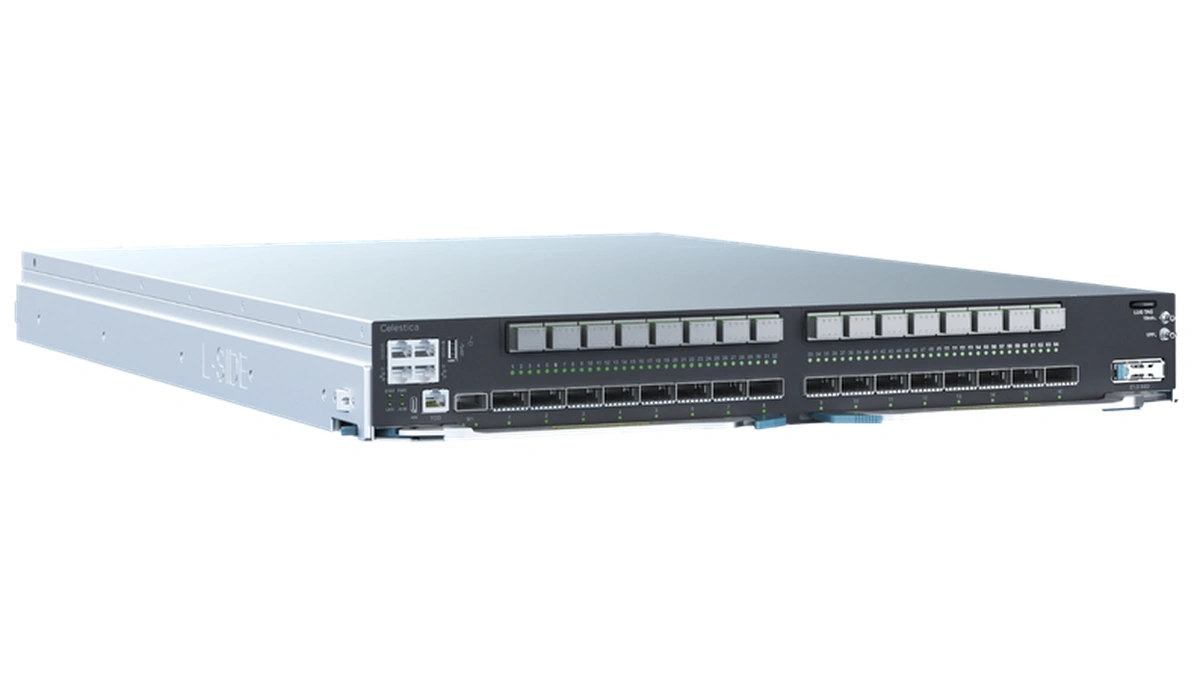
Celestica DS6005 puts the optical engines on the same package as the switch chip, a co-packaged optics design aimed at 1.6T networks inside AI data centers. The front panel no longer carries pluggable optical modules.
The design rests on distance. Co-packaged optics shrinks the electrical path between chip and optics from centimeters to millimeters, and that path is where signals degrade as lane speeds rise from 112G toward 224G. The platform is built around Broadcom's Tomahawk 6 Davisson silicon. The shorter route should lower link power and latency, Celestica says, but it ties any DS6005 power saving to an approved baseline, optical configuration and test method, and publishes no measured figure. The latency gain, it adds, depends on topology and protocol.
The Celestica DS6005 is a fully liquid-cooled ORv3 system with breakout modes from 1.6T down to 800G, 400G and 200G, so one box can serve different accelerator generations. Its lasers sit in field-replaceable external modules that an operator can service on their own, which answers a standard worry about co-packaged designs: that one failed optical part means pulling the entire switch. Control software is SONiC Plus by Celestica, which adds management of the optical engines, laser modules and photonic diagnostics.
Celestica names hyperscalers, NeoCloud providers and AI labs as the buyers. It sees the strongest fit for the Celestica DS6005 in scale-up networks, where accelerators exchange data directly and delay hurts most. It stops short of calling co-packaged optics a replacement for pluggable modules, expecting both to coexist across different tiers of a fabric. That restraint is sensible, since pluggables stay easy to swap and cheap to stock.
Pricing and availability for the Celestica DS6005 are not given. Celestica is showing the DS6005 at the OCP Global Summit in Booth C2, where those details and the missing power numbers are the obvious things to ask about.