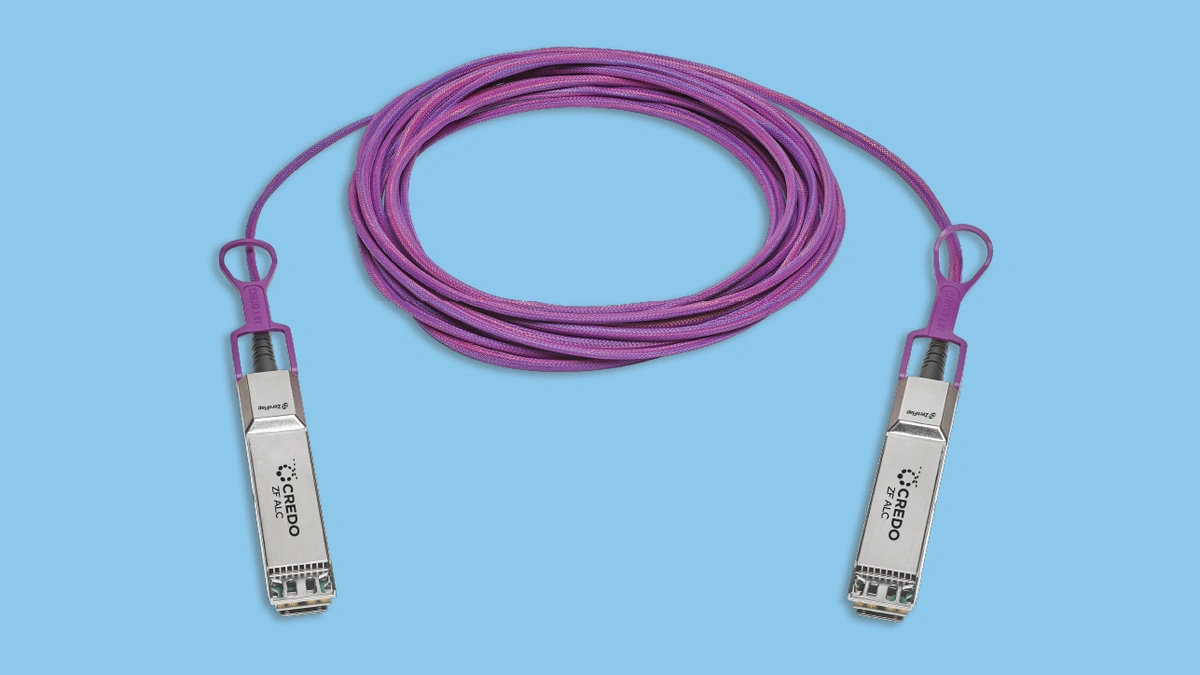
Credo ZeroFlap ALC, a 1.6T active light cable, is meant to carry AI cluster traffic across a data center row, a distance where copper runs short and conventional optics cost too much power.
The Credo ZeroFlap ALC is a dense array of micro-emitters and photodetectors joined by flexible fiber bundles, and Credo says it reaches up to 50 meters in a pluggable form factor at about 12 W per cable end. The company calls it the industry's first row-scale, wide-parallel optical interconnect, a superlative that rests on its own definition of the category.
The headline numbers are design goals rather than measured field results. In its published targets, Credo lists a mean time between failures of 100 million hours, power roughly 30% below comparable active electrical cables (AECs) and a cable 10x lighter than those AECs. Credo gives 2027 as the shipping year.
The engineering bet is to go wide instead of fast. Rather than pushing a few optical channels to extreme speeds, the cable splits high-speed lanes across many slower channels and uses simple NRZ modulation, which avoids the DSP-based signal recovery that adds power and latency to standard transceivers. Spare channels are built into the bundle. If link monitoring sees one weakening, traffic moves to a spare without losing data, Credo says, extending the failover idea behind its ZeroFlap copper cables to optics.
Reliability is what Credo stresses most about the ZeroFlap ALC. In a GPU cluster, a link that drops and retrains can stall every job running across it, so operators often accept a lower peak speed for a link that stays up. Cignal AI analyst Scott Wilkinson, quoted by Credo, described a gap "between copper cables and more expensive, power-hungry traditional pluggable optics," which is where Credo wants this cable to sit.
Credo will show the ZeroFlap ALC at booth B2 of the OCP Global Summit expo hall in San Jose, October 13-15. Until hardware ships, the 12 W and 100-million-hour figures remain claims to check against independent testing.