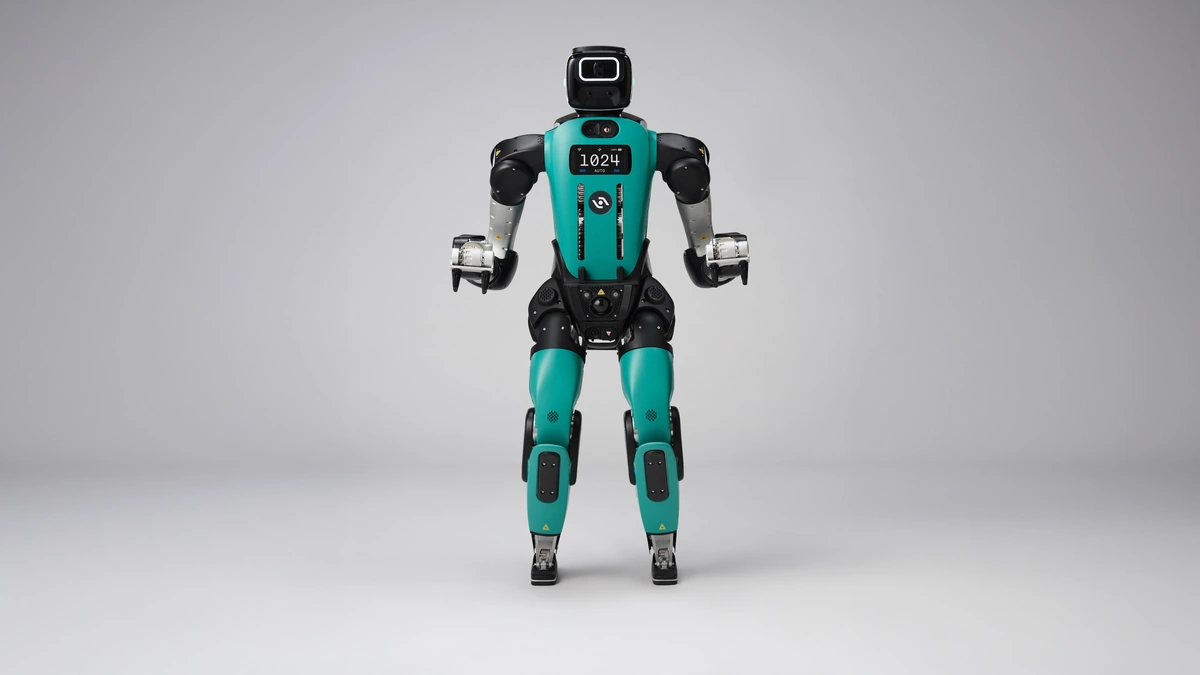
Agility Robotics is trying to answer a question that has stalled humanoid robotics for years: what does it take for a robot to work next to people without a cage around it? The company says its answer is Digit 5, a redesigned version of its warehouse robot built to share floor space with human coworkers rather than being fenced off from them.
Agility Robotics frames Digit 5 as building on a real-world safety record rather than starting from a clean sheet. The company says the prior model, Digit 4, became the first humanoid robot to pass an independent field evaluation for industrial safety standards administered by the U.S. Occupational Safety and Health Administration, conducted directly on a customer's production line. Agility says Digit 4 has logged more than 65,000 hours of operation at sites run by GXO, Schaeffler, Amazon, and Toyota Motor Manufacturing Canada, and that one GXO facility near Atlanta reached 100,000 totes moved while the robot held roughly 98% accuracy on task.
Working fenceless is a different engineering problem than working reliably in an aisle nobody else enters. Agility Robotics describes three systems meant to close that gap: sensors and AI models that continuously watch for people nearby and make the robot stop, reroute, or drop into a seated position; visual and audio cues meant to signal which way it is about to move; and a separate safety controller, distinct from Digit's main software stack, that Agility says independently oversees those responses when someone gets within an unsafe distance.
None of that amounts to a finished, independently certified safety standard for humanoids yet, and Agility frames it as a work in progress. The company says it is a project leader on a technical report under development through the American National Standards Institute covering dynamically stable industrial mobile robots, humanoids included, and a contributor to a parallel effort at the International Organization for Standardization that it calls the first international safety standard written specifically for the humanoid category. Both remain in draft. Agility is also pairing its safety stack with outside hardware, saying it is the first launch partner for NVIDIA's Halos for Robotics platform, running on NVIDIA's IGX Thor chip and Halos Core software. "Safely operating around people and assets is what moves humanoid robots from pilots to industrial deployments at scale," said Deepu Talla, NVIDIA's vice president of robotics and edge AI.
The physical redesign points the same direction: Agility says the robot lifts heavier loads and reaches higher than its predecessor, with faster charging meant to keep it working through more of a shift, plus a swappable gripper mount for different tasks without swapping the robot itself.
Whether any of this holds up outside a press release is a separate question from whether customers are buying it. Agility Robotics says it has more than $300 million in multi-year orders for Digit 5, built at RoboFab, its dedicated humanoid assembly plant in Salem, Oregon, and plans to sell Digit outside North America for the first time, starting in the European Union and United Kingdom. Until an outside body signs off on a finished humanoid safety standard, the fenceless claim rests on Agility's own testing and whatever OSHA reviewed on that one production line.