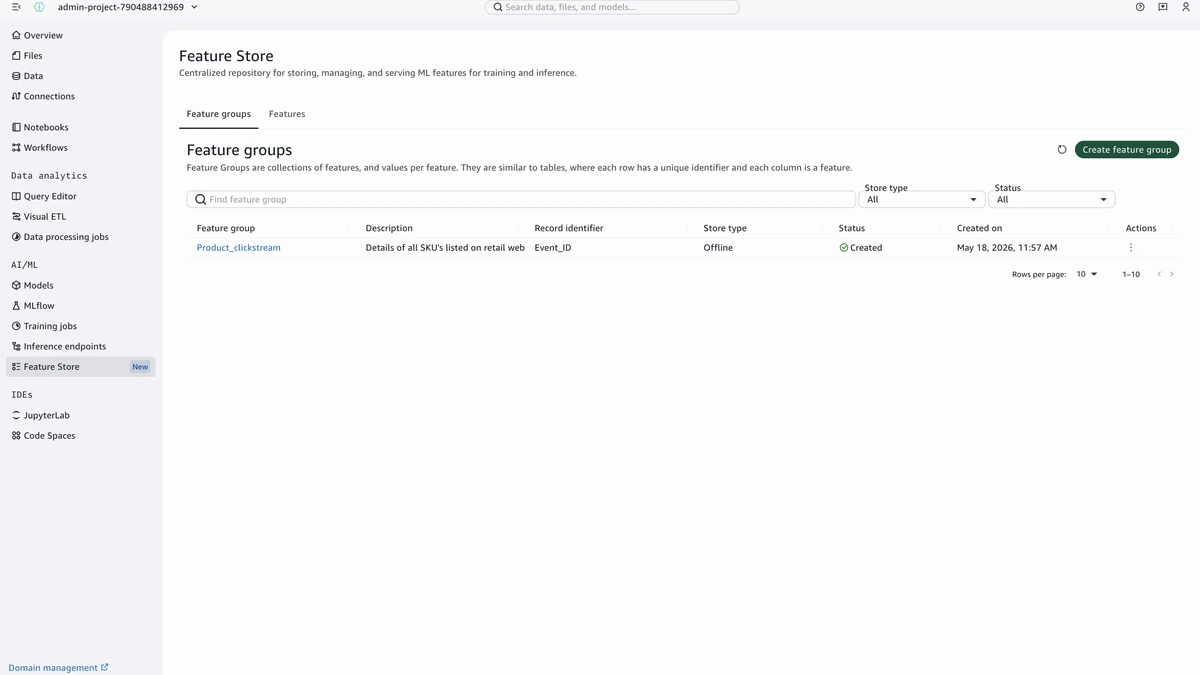
Amazon SageMaker Feature Store is going after a pair of problems that tend to build quietly rather than break loudly: metadata that balloons over time, and access controls that never quite match the sensitivity of the data inside. AWS detailed three changes on May 19, 2026 that tighten governance and rebuild the tooling teams use to manage large offline feature stores.
The most consequential change wires in native AWS Lake Formation integration. Offline stores now register with Lake Formation at feature group creation and enforce column-level, row-level, and cell-level access control with no manual setup, and existing feature groups can opt in through the FeatureGroupManager.enable_lake_formation method, per AWS. For teams that had been stitching permissions together by hand, that moves fine-grained control from a side project to a default.
The metadata problem gets its own fix. Amazon SageMaker Feature Store now exposes Apache Iceberg table properties that govern metadata retention and snapshot lifecycle, including how many previous metadata versions to keep and when snapshots expire. AWS grounds the need in customer numbers that show how fast this compounds: one customer accumulated more than 50 terabytes of metadata files in under a year, and another running more than 40 streaming feature groups watched storage climb from a few gigabytes to over 50 terabytes in the same window. Those are metadata files alone, the bookkeeping around the features, which is exactly the kind of cost that goes unnoticed until a bill or a query slowdown surfaces it.
Holding the release together is a rebuilt Feature Store module in the SageMaker Python SDK v3, version 3.8.0, which AWS describes as a modular design with better performance that drops legacy dependencies such as PyTorch. It covers the full feature group lifecycle, record operations, training dataset extraction, and DataFrame ingestion through APIs including FeatureGroupManager and LakeFormationConfig, so existing pipelines can pick up the governance controls without a rewrite. The low-friction path is the selling point, though whether teams actually retrofit older feature groups, rather than leaving them on the pre-Lake-Formation setup they already trust, is the part that will decide how much of this governance layer gets used.