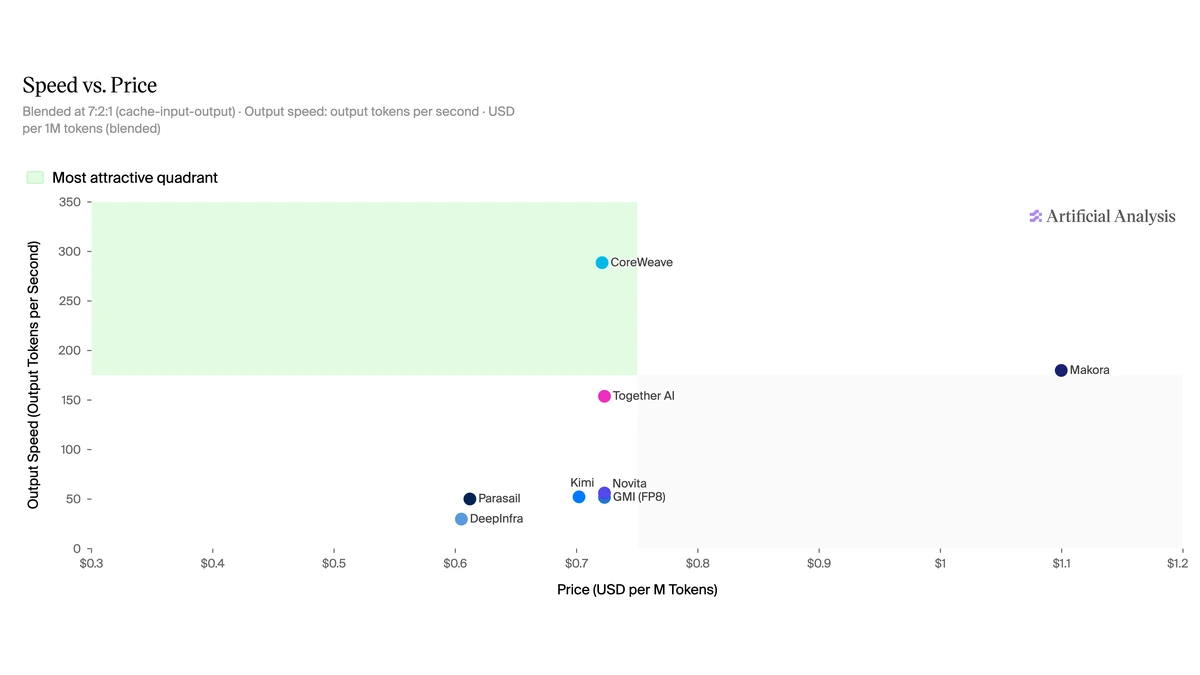
Moonshot AI's Kimi K2.7 Code is now available through CoreWeave's Serverless Inference platform, with CoreWeave ranking first on Artificial Analysis's speed-versus-price chart for the model across all providers. CoreWeave's announcement confirms it delivers the highest token throughput and lowest latency among competing providers at a competitive blended price.
Kimi K2.7 Code is Moonshot AI's latest coding-focused agentic model, built on a trillion-parameter Mixture-of-Experts architecture. Moonshot AI specifies a 256K-token context window, 32 billion active parameters per token, and open weights under a Modified MIT license. Moonshot AI also reports K2.7 Code uses roughly 30% fewer reasoning tokens than its predecessor K2.6 on equivalent tasks, which reduces cost and latency in agentic coding loops that call the model repeatedly.
CoreWeave's Applied Training team optimized the model for NVIDIA's Blackwell hardware by converting the released INT4 weights into NVFP4 format and pairing that quantization with a DFlash speculative decoder. The DFlash speculator was trained on over one million prompts spanning long-context agentic coding and tool-calling tasks, using a modified loss function called D-PACE, which CoreWeave says produced roughly an 8% improvement in speculator acceptance length. That gain directly widens the gap between raw model speed and what the inference stack delivers to end users. CoreWeave contributed D-PACE support back to the TorchSpec project after completing the work.
Artificial Analysis weights its benchmark price metric on a 7:2:1 blend of cache-hit, input, and output token costs, which it argues reflects real production workload distribution more accurately than per-output-token pricing alone. This marks the second consecutive Moonshot AI model for which CoreWeave has held the Artificial Analysis lead, following the same result for Kimi K2.6.
Teams accessing Kimi K2.7 Code through CoreWeave inherit the NVFP4 and DFlash configuration by default on vLLM with no additional setup. CoreWeave offers three deployment paths: Serverless Inference for per-token usage with no infrastructure management, Dedicated Inference for workloads that need control over GPU selection and runtime configuration, and direct deployment on CoreWeave Kubernetes Service for teams that manage the full stack themselves.
The model also appears on OpenRouter, giving developers a second managed path. Whether the benchmark lead holds as other inference providers optimize their own K2.7 Code deployments will depend on how quickly they apply comparable quantization and speculative decoding techniques to Moonshot AI's Kimi K2.7 Code weights.