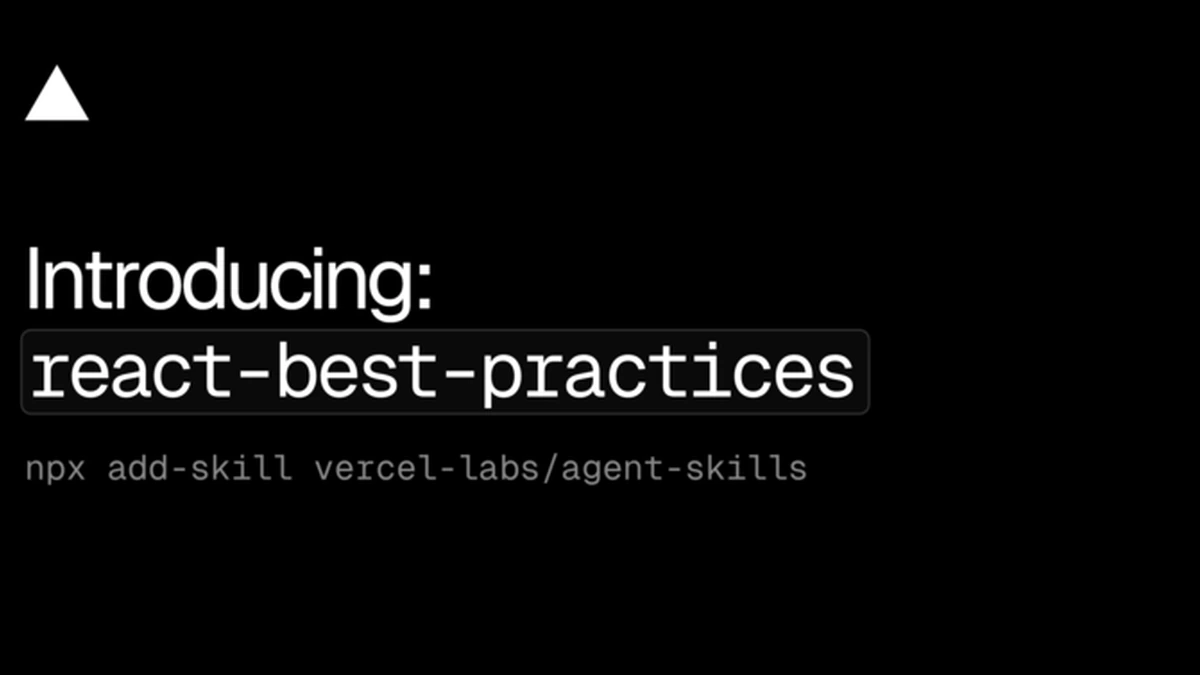
React Best Practices, published by Vercel Labs on January 14, is a bet that the surest way to fix React performance is to write it down. Most of the problems it targets are not exotic. They are the same request waterfalls, oversized bundles, and needless re-renders that creep into a codebase one pull request at a time, and by the time anyone measures them the fix touches dozens of files. The free, open-source guide codifies more than a decade of React and Next.js optimization work from authors Shu Ding and Andrew Qu.
The guide gathers 40-plus rules across eight categories, ordered by impact so a team fixes the expensive problems before the cosmetic ones. The categories run from eliminating async waterfalls and cutting bundle size, through server-side performance, client-side data fetching, re-render and rendering optimization, down to advanced patterns and lower-level JavaScript tuning. The examples stay concrete rather than abstract: parallelizing independent database calls that were awaited in sequence, combining loop iterations that scan the same list twice, and wrapping expensive JSON parsing in a lazy useState callback so it runs once instead of on every render.
What makes this more than another cheat sheet is the delivery. The rules compile into an AGENTS.md file and ship as an installable Agent Skill through npm, so a coding agent can query them directly while it writes code, with Opencode, Codex, Claude Code, and Cursor named as intended consumers. That framing reflects how a growing share of React code is now written, and it sets a modest bar for whether the effort works: the rules only pay off if agents and reviewers actually apply them before a regression lands. Vercel's own argument for the discipline is the sharpest line in the release, that a small regression shipped today becomes a long-term tax on every session until someone pays down the debt.