Zero Trust Architecture is a network security model that eliminates implicit trust by requiring continuous verification of every user, device, and workload before granting access to any resource.
NIST codified the model in Special Publication 800-207, and CISA built its five-pillar maturity framework on the same logical components. Practitioners shorten the term to ZTA (Zero Trust Architecture), and Gartner's adjacent market category, Zero Trust Network Architecture (ZTNA), narrows the same idea to commercial network-access products. The network and segmentation layer is where most ZTA programs stall: identity foundations are well understood, but workload-to-workload enforcement, policy-engine placement, and the migration off VPN tend to be designed by guesswork.
The friction is rarely the standard itself. It sits in the operational gap between the NIST logical model and the network plumbing that has to enforce it: where the policy enforcement point lives, how segmentation boundaries are drawn, what replaces the VPN, and which legacy applications refuse to participate.
What ZTA Replaces: The Perimeter Model's Failure Modes
Zero Trust Architecture replaces the perimeter-based security assumption that anything inside the corporate network is trustworthy by default. The classic castle-and-moat design treated the firewall as a binary boundary: outside the firewall, untrusted; inside, free movement. That assumption never survived the move to hybrid infrastructure. Cloud-hosted workloads sit outside the corporate IP space. Contractors connect from networks the security team does not control. Remote endpoints carry the same VPN privileges the office desktop once held, and a single compromised laptop inherits broad east-west reach into the internal estate.
The blast radius of implicit trust is best illustrated by a flat-network breach. An attacker who phishes one endpoint and lands a foothold on a VLAN with no internal segmentation can reach the database tier, the management plane, and the backup server using the same credentials. Verizon's annual breach reporting has tracked this pattern for a decade: initial access is cheap, lateral movement is what turns it into a costly incident. Perimeter-based security has no answer for lateral movement once the perimeter is breached because every workload trusts every other workload on the same broadcast domain.
The specific places perimeter-based security breaks down in modern estates:
- Cloud workloads in AWS, Azure, and GCP that have no physical perimeter to sit behind, only software-defined network controls.
- Remote and BYOD endpoints whose posture (patch level, EDR status, disk encryption) the security team cannot reliably assert at the gateway.
- Contractor and third-party access into shared services, where the identity provider may not be under enterprise control.
- SaaS applications that hold regulated data outside the corporate IP boundary, where firewall rules are irrelevant.
- Compromised insider accounts that move freely across the flat internal network using credentials the firewall already accepted.
The data-layer counterpart to network-layer ZTA is covered in Difference Between Encryption and Tokenization, where the encryption and tokenization choices determine what an attacker actually gets after lateral movement succeeds. The identity-layer counterpart sits in MFA vs SSO: A Comprehensive Comparison, which covers the IdP and SSO foundations ZTA depends on.
The NIST SP 800-207 Logical Components
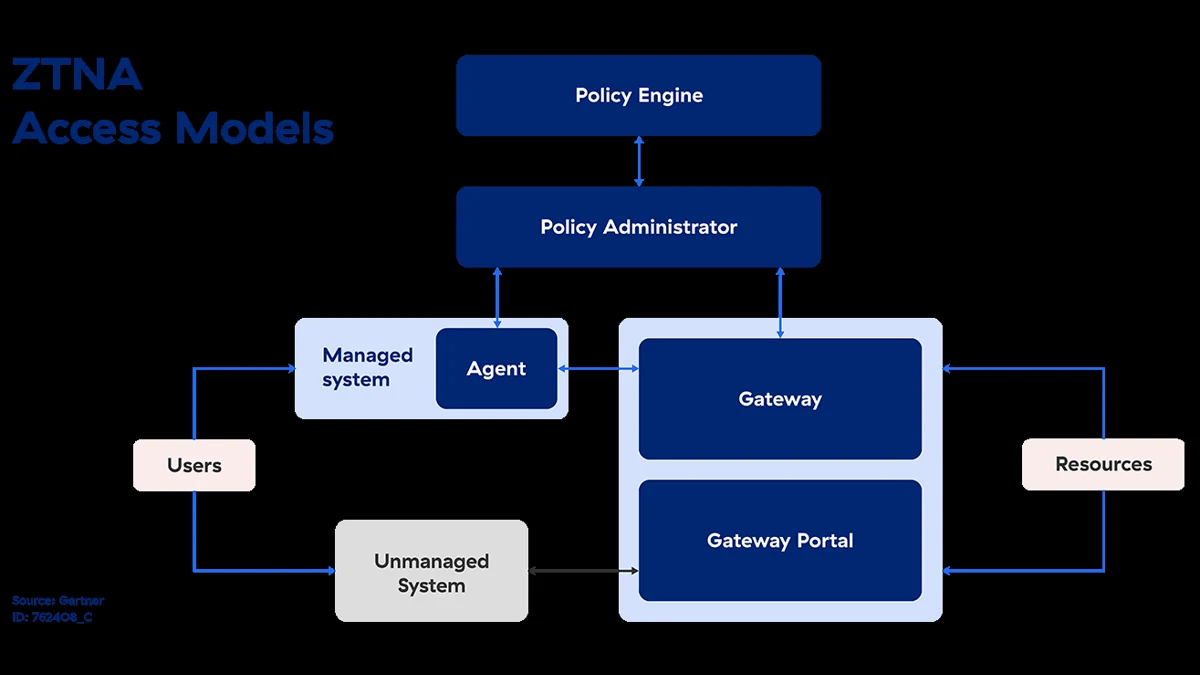
ZTA's reference architecture is defined in seven logical components in NIST SP 800-207, and every production deployment maps to those components even when the vendor names differ. The components split cleanly into a control plane that makes access decisions and a data plane that enforces them.
- Policy Engine (PE)
- The decision logic that evaluates an access request against the trust algorithm. The PE consumes identity claims, device posture, resource sensitivity, and threat intelligence signals, then returns a grant or deny verdict.
- Policy Administrator (PA)
- The component that establishes or terminates the communication path between the subject and the resource on the PE's verdict. The PA configures the policy enforcement point (PEP) with session-specific credentials.
- Policy Enforcement Point (PEP)
- The data-plane choke point that actually permits, blocks, or terminates the connection. The PEP can be a host agent, an identity-aware proxy, a service mesh sidecar, or an SDP gateway.
- Subject
- The requester: a user, a service account, or a workload identity that is asking for access to an enterprise resource.
- Enterprise Resource
- The asset under protection: an application, a database, an API endpoint, a storage bucket, or a management-plane interface.
- Continuous Diagnostics and Mitigation (CDM) System
- The telemetry source that feeds device-state signals (patch level, EDR health, certificate validity) into the policy engine for continuous verification.
- Industry Compliance and Threat Intelligence Feeds
- External signal sources that adjust trust scoring based on regulatory requirements and active threat indicators.
The trust algorithm loop runs on every resource request, not only at login. The subject sends a request to the PEP. The PEP forwards the request context to the policy decision point (PDP), which in NIST terminology aggregates the PE and PA. The PDP evaluates identity, device posture, resource sensitivity, and threat signals against policy, then returns a verdict. The PEP enforces the verdict, opens or refuses the session, and continues to evaluate posture for the life of the connection. Google's BeyondCorp deployment is the production reference for this pattern at scale: the access proxy is the PEP, the device inventory service is the CDM source, and the policy engine adjudicates every request.
Control Plane vs Data Plane in ZTA
The control plane carries the PE, the PA, the CDM system, and the compliance feeds. The data plane carries the PEP and the resource itself. The separation is architecturally load-bearing: access-decision logic never co-locates with the resource, so a compromise of one component does not automatically grant access through the other. A breached web server cannot mint its own access tokens, because the policy decision point that issues them runs in a different administrative boundary with its own identity and audit trail. NIST SP 800-207A extends the same control-plane/data-plane split into cloud-native microservice environments, where the PEP is typically a service-mesh sidecar and the PDP is a cluster-level policy engine.
Microsegmentation: Designing the Network Boundary
Microsegmentation is the network-layer enforcement mechanism that gives ZTA teeth, and it sits where most network segmentation programs underdeliver. Three implementation approaches dominate production deployments, and the choice shapes everything downstream: where the policy ends up, how east-west traffic is inspected, and how lateral movement is constrained after a compromise.
| Approach | Enforcement point | Strengths | Tradeoffs |
|---|---|---|---|
| Host-based | Agent on each workload enforces policy at the OS network stack | Identity-aware at the process level; portable across cloud and on-prem; survives workload migration | Agent footprint on every host; OS coverage limits exposure on appliances and OT devices |
| Network-based | SDN controller pushes ACLs to switches and routers per flow | No host agent required; centralizes policy at the fabric; high throughput | Identity context limited to network attributes; coarser granularity than host-based |
| Hypervisor-based | Segmentation enforced at the virtual switch by the hypervisor | Strong fit for VMware and OpenStack estates; transparent to guest OS | Tied to a specific virtualization platform; weak coverage for bare-metal and container workloads |
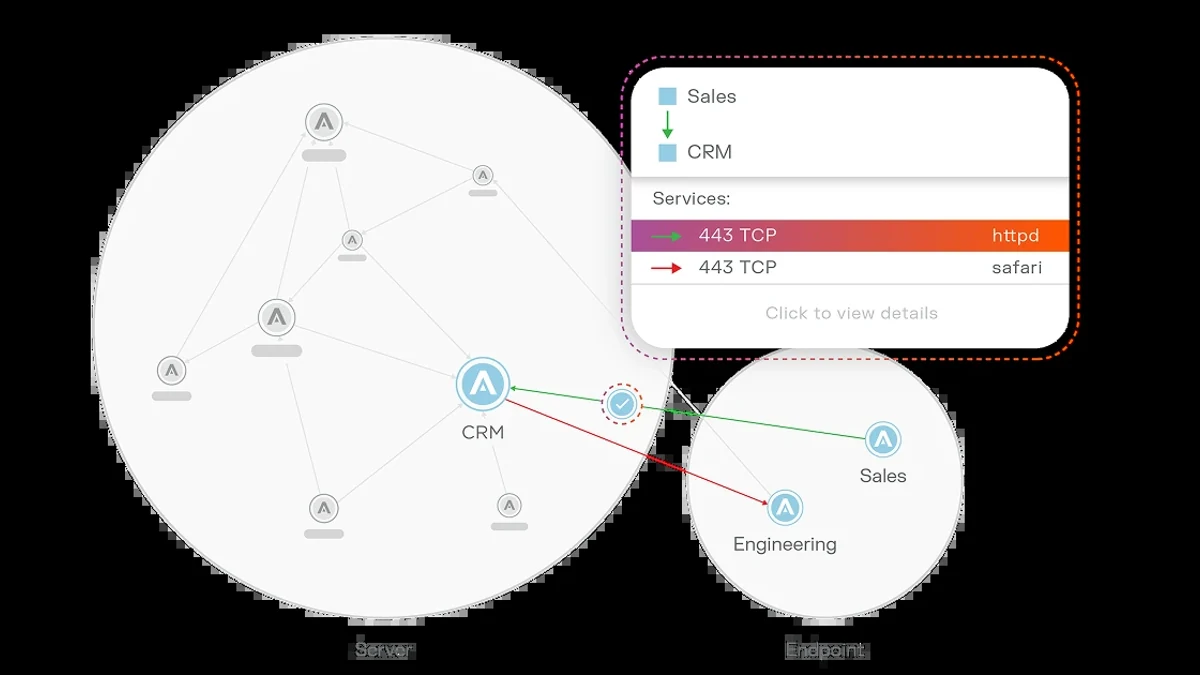
The east-west traffic problem is the reason these workload-level boundaries exist. In a flat VLAN, every workload can open a TCP connection to every other workload on the same broadcast domain. Workload-to-workload allow-lists, enforced at the closest practical control point, replace the default-allow posture with least-privilege access between tiers. A breached web-tier workload cannot initiate a connection to a database-tier workload unless an explicit policy rule permits it, which is what bounds lateral movement after the inevitable initial compromise. VLAN segmentation looks similar at a glance but lacks identity context entirely: a VLAN is a layer-2 broadcast boundary, not an identity-aware policy boundary, and an attacker on the same VLAN traverses it without resistance.
Segment Boundary Design Principles
Segment by workload sensitivity tier, not by subnet. The practical tiering most enterprise programs land on: public-facing (internet-exposed web and API tiers), internal-authenticated (business applications behind SSO), privileged-data (PII stores, payment systems, regulated databases), and management plane (CI/CD, orchestration, secrets, hypervisors). Allow-list rules between tiers are explicit and audited; the implicit allow inside a tier is the first thing to retire. The CISA Zero Trust Maturity Model Networks pillar treats this boundary design as the foundational Networks-pillar capability, and the quarterly east-west allow-list audit is what keeps the boundary from rotting as services move.
Software-Defined Perimeter as the VPN Replacement
The software-defined perimeter (SDP) is the connection model that retires the VPN under ZTA. A VPN grants network-layer access to a subnet once the user authenticates: after the tunnel is up, the remote endpoint has IP reachability to whatever the firewall rules expose. SDP grants application-layer access to a specific resource after continuous posture assessment, and the resource is never exposed to the public internet at all. That dark-network posture is what removes the broad attack surface a VPN concentrator presents.
- The client agent contacts the SDP controller and presents identity claims plus device posture signals.
- The controller validates identity against the IdP and device posture against the CDM source, then evaluates policy.
- The controller issues a single-packet authorization (SPA) token scoped to one resource and one session.
- The client sends the SPA token to the SDP gateway, which is otherwise unreachable on the public internet.
- The gateway verifies the SPA token, opens a session to the exact resource, and proxies traffic with least-privilege access only to that destination.
- The controller continues to evaluate posture for the session lifetime; a posture change revokes the session mid-flight.
Gartner's Zero Trust Network Architecture (ZTNA) market category commercialized this pattern: Zscaler Private Access, Cloudflare Access, and Palo Alto Prisma Access are product examples that implement an identity-aware proxy in front of internal applications. The SDP model depends entirely on a functioning IdP because every connection decision starts from a verifiable identity claim and a device posture signal. Where SDP is most often deployed first is on top of SaaS-hosted business applications; the resource-protection angle for that case is covered in How To Secure SaaS Applications At Scale. The federation patterns that feed continuous verification at the controller are documented in MFA vs SSO: A Comprehensive Comparison.
Implementation Sequence: Seven Steps from NIST 800-207
ZTA implementations that ship on schedule follow a sequence derived from NIST SP 800-207 Section 3 and the CISA Zero Trust Maturity Model pillars. Each step lands a concrete artifact that the next step depends on; skipping artifacts is the most common reason mid-program reviews stall.
- Asset inventory and data-flow mapping. Cataloge every resource and every flow that touches it. The artifact is an inventory plus a flow diagram annotated with data classifications. This step also surfaces shadow services that the policy engine will need to cover later.
- Identity foundation. Stand up the IdP, enforce MFA on all accounts, enroll device certificates, and pipe device posture into the CDM source. Without verifiable identity and posture signals, the policy decision point has nothing to evaluate.
- Define the protect surface. Identify the crown-jewel resources: PII stores, payment systems, the management plane, source code repositories. The CISA Zero Trust Maturity Model Data pillar maps to this step. A data privacy impact assessment often produces the asset classification this step consumes, and the Best Practices For Securing Regulated Data playbook feeds the same classification.
- Design network segmentation boundaries. Define the sensitivity tiers, map the allow-list rules between tiers, and reject implicit allow within a tier. The artifact is a policy matrix that becomes the input to the enforcement tooling.
- Deploy PEP and SDP coverage. Place a policy enforcement point in front of every protect-surface resource, and route all external access through the SDP gateway. New deployments go through the PEP from day one; legacy systems are migrated on a tracked exception list.
- Instrument continuous monitoring. Pipe PEP logs, device-posture changes, and anomalous-access signals into the SIEM. SIEM platform pricing shapes what storage and retention the program can sustain.
- Iterate policy. Run a quarterly east-west allow-list audit, expand protect-surface coverage as new resources land, and tighten the default-deny scope where exceptions have aged out. The policy is a product, not a project.
The CISA Cross-Sector Cybersecurity Performance Goals name MFA (CPG 3.F), least privilege (CPG 3.H), and network segmentation (CPG 3.I) as baseline targets that this sequence satisfies in steps 2, 2, and 4 respectively. The NSA's Embracing a Zero Trust Security Model guidance complements NIST with operational hardening detail for DoD-context deployments.
Where ZTA Fails: Legacy Application Incompatibility
ZTA programs hit predictable walls when they meet applications that pre-date the model. Four failure modes recur across enterprise deployments, and each has a migration path or an exception-handling pattern that prevents the program from stalling on the immovable systems.
- Source-IP authentication. Legacy applications that grant access based on originating IP cannot tolerate a PEP intercepting the connection without re-architecture. The migration path is an identity-aware proxy that terminates the user session and re-originates the connection from a fixed back-end IP the application already trusts, while the identity context lives in the proxy logs. A funded re-platform replaces the IP check entirely.
- Flat database-tier assumptions. Three-tier applications often assume unrestricted east-west traffic from the app tier to every database in the cluster. Workload-level segmentation that drops those flows breaks the application before the team understands why. The fix is to enumerate the legitimate app-to-database flows first, encode them as explicit allow-list rules, then enable enforcement in monitor-only mode for a sprint before flipping to deny.
- OT and SCADA devices without certificate support. Industrial control devices frequently cannot enroll in the certificate infrastructure the identity-aware proxy chain requires. CISA's ICS-specific ZTA guidance recommends a network-layer enclave with a single PEP at the enclave boundary, rather than per-device enrollment that the hardware cannot support. The TLS certificate infrastructure prerequisite still applies at the enclave boundary even when the devices inside cannot terminate TLS themselves.
- Hardcoded network-path assumptions. Applications that embed hostnames, ports, or routing assumptions in configuration break when SDP routing replaces direct network reachability. The exception-list pattern is a network-layer allow-list bypass for the specific legacy host while the migration is funded, with a sunset date in the change record. CSPM visibility for AWS-hosted workloads often surfaces the cloud-resident systems that still carry these assumptions.
The application-layer hardening that supports the PEP-to-resource boundary is codified in the OWASP Application Security Verification Standard Section 9 (Communications) and Section 1.9, which name the mutual-TLS and certificate-validation requirements that legacy applications often cannot satisfy. Those requirements are the prerequisite that defines which systems can participate in the full ZTA control model and which need an enclave bypass.
Further reading
- Difference Between Encryption and Tokenization (hub guide on the data-layer controls that complement network-layer ZTA enforcement)
- MFA vs SSO: A Comprehensive Comparison (identity-layer prerequisites for SDP and the policy decision point)
- How To Secure SaaS Applications At Scale (SaaS resource class that identity-aware proxies most commonly protect)
- Conducting a Data Privacy Impact Assessment (DPIA process that produces the protect-surface asset classification)
- Splunk vs QRadar Pricing (SIEM platforms that ingest the continuous-monitoring signal stream)
Frequently Asked Questions
Does ZTA require replacing the existing firewall and VPN infrastructure on day one?
ZTA does not require a full infrastructure replacement on day one; NIST SP 800-207 explicitly describes an incremental migration path that runs ZTA controls alongside existing perimeter controls during transition. The recommended sequence is to deploy the identity foundation (IdP, MFA, device enrollment) first, then enforce policy on new application deployments while grandfathering legacy systems onto exception lists. Full perimeter decommissioning is a Phase 3 or Phase 4 milestone in most enterprise programs, not a precondition for starting.
What is the minimum IdP capability ZTA requires before workload-level enforcement can begin?
ZTA microsegmentation requires an IdP that issues verifiable claims about user identity, device enrollment status, and at least one posture signal (patch level, EDR status, or certificate validity). SAML 2.0 or OAuth 2.0/OIDC with device-context extensions are the minimum protocol baselines. An IdP that only authenticates users without attaching device context cannot feed the policy decision point with enough signal to enforce workload-level policy; in that case, PEP decisions degrade to user-identity-only rules, which is weaker than the full ZTA control model.
How does ZTA differ from what MFA and SSO already provide?
ZTA extends identity controls from the authentication event to every resource access request across the network layer. MFA and SSO operate at the login boundary: they verify who the user is and issue a session token. ZTA's policy enforcement point intercepts every subsequent resource request within that session and re-evaluates device posture, request context, and resource sensitivity before granting access. A valid SSO session does not grant implicit access to any resource under ZTA; each request is independently adjudicated at the PEP.