Compliance control mapping is a security architecture practice that aligns a single unified control set against multiple regulatory frameworks simultaneously, eliminating duplicate audit work and allowing one piece of evidence to satisfy obligations under PCI DSS, HIPAA, GDPR, and SOX at the same time.
Most organizations handling regulated data sit inside two or more compliance regimes because the data categories overlap inside a single system. A payments table that also stores employee health records ends up in PCI DSS v4.0 scope, HIPAA Security Rule scope, and possibly GDPR Article 32 scope at the same time. The mistake is running three parallel audit programs against that one database. The fix is a cross-framework control map that designs each technical control once, collects the evidence once, and tags the artifact to every framework it satisfies.
The architectural anchor for that map is NIST SP 800-53 Rev 5. Its control families carry crosswalk overlays to PCI DSS, HIPAA, ISO/IEC 27001:2022 Annex A, and SOX IT general controls (ITGCs), which lets a single control statement carry a list of framework citations next to it rather than five disconnected policies that each say the same thing in different language.
Why Regulated Data Triggers Multiple Overlapping Frameworks
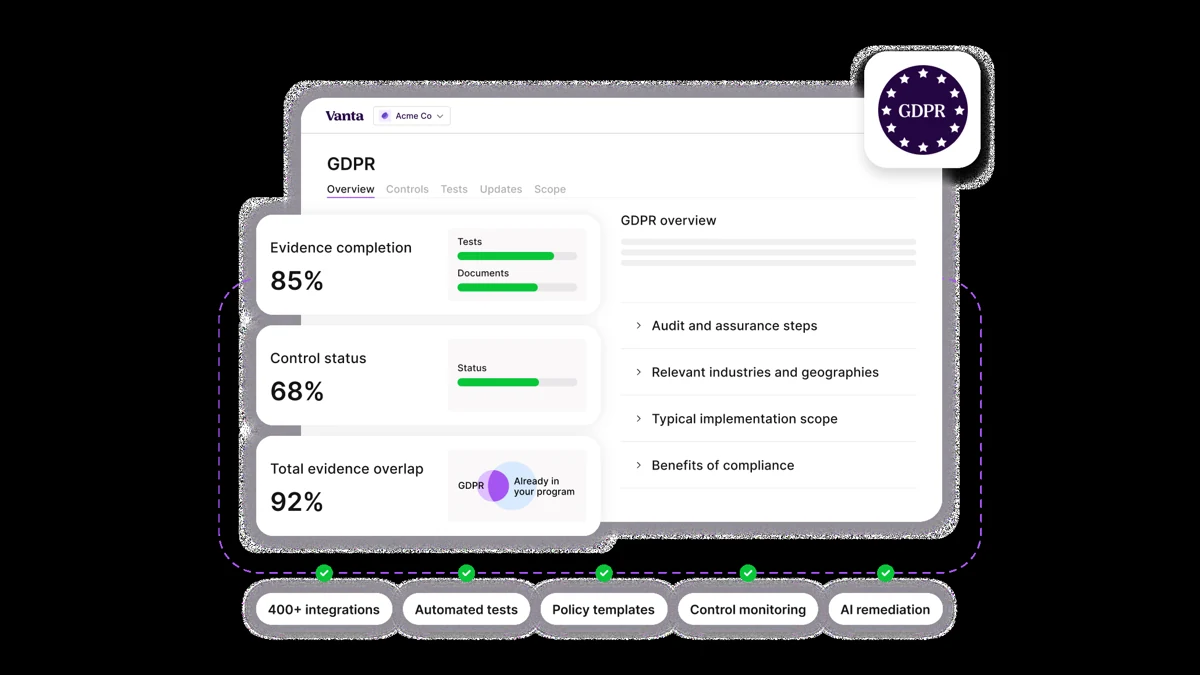
Compliance control mapping starts from the observation that regulated data rarely lives inside one regulatory wrapper. A single customer record can carry a payment card primary account number (in PCI DSS scope), a clinical note (in HIPAA scope), an EU residency flag (in GDPR scope), and an account-balance figure that flows into financial statements (in SOX scope). The system that stores that record is, by construction, subject to four obligation regimes at once, plus ISO/IEC 27001:2022 Annex A if the organization carries an ISO certificate.
Each framework has a precise citation form that the cross-framework control map must use byte-identically:
- PCI DSS v4.0. Applies to any system component inside the cardholder data environment (CDE), defined as the people, processes, and technology that store, process, or transmit cardholder data. Twelve requirements, hundreds of testing procedures, annual QSA assessment for Level 1 merchants.
- HIPAA Security Rule (45 CFR 164.312). Applies to covered entities and business associates handling protected health information (PHI). Technical safeguards under 164.312 cover access control, audit controls, integrity, transmission security, and authentication.
- GDPR Article 32. Applies to controllers and processors of EU personal data. Article 32(1) requires appropriate technical and organizational measures including pseudonymisation, encryption, confidentiality, integrity, availability, and resilience of processing systems.
- SOX Section 404. Applies to public-company financial reporting controls. The IT general controls in scope cover access management, change management, computer operations, and program development for systems supporting financial statements.
- ISO/IEC 27001:2022 Annex A. Ninety-three controls organized into four themes (organizational, people, physical, technological). Functions as a cross-framework superset: most PCI DSS, HIPAA, and SOX requirements map cleanly onto Annex A control numbers.
The five frameworks read like five separate languages describing similar engineering. ISO/IEC 27001 sits at the top of the stack because its 93 controls absorb almost every operational requirement the other four frameworks impose. The NIST SP 800-53 Rev 5 control cataloge carries the formal crosswalk overlays that make this translation auditable. The same risk assessment that drives PCI DSS scope decisions, including the difference between encryption and tokenization, also drives the HIPAA technical-safeguard selection and the GDPR Article 32 measure selection, which is why conducting a data privacy impact assessment is often the upstream input that scopes the GDPR side of the control map.
The Cross-Framework Control Map: Five Frameworks, One Control Set
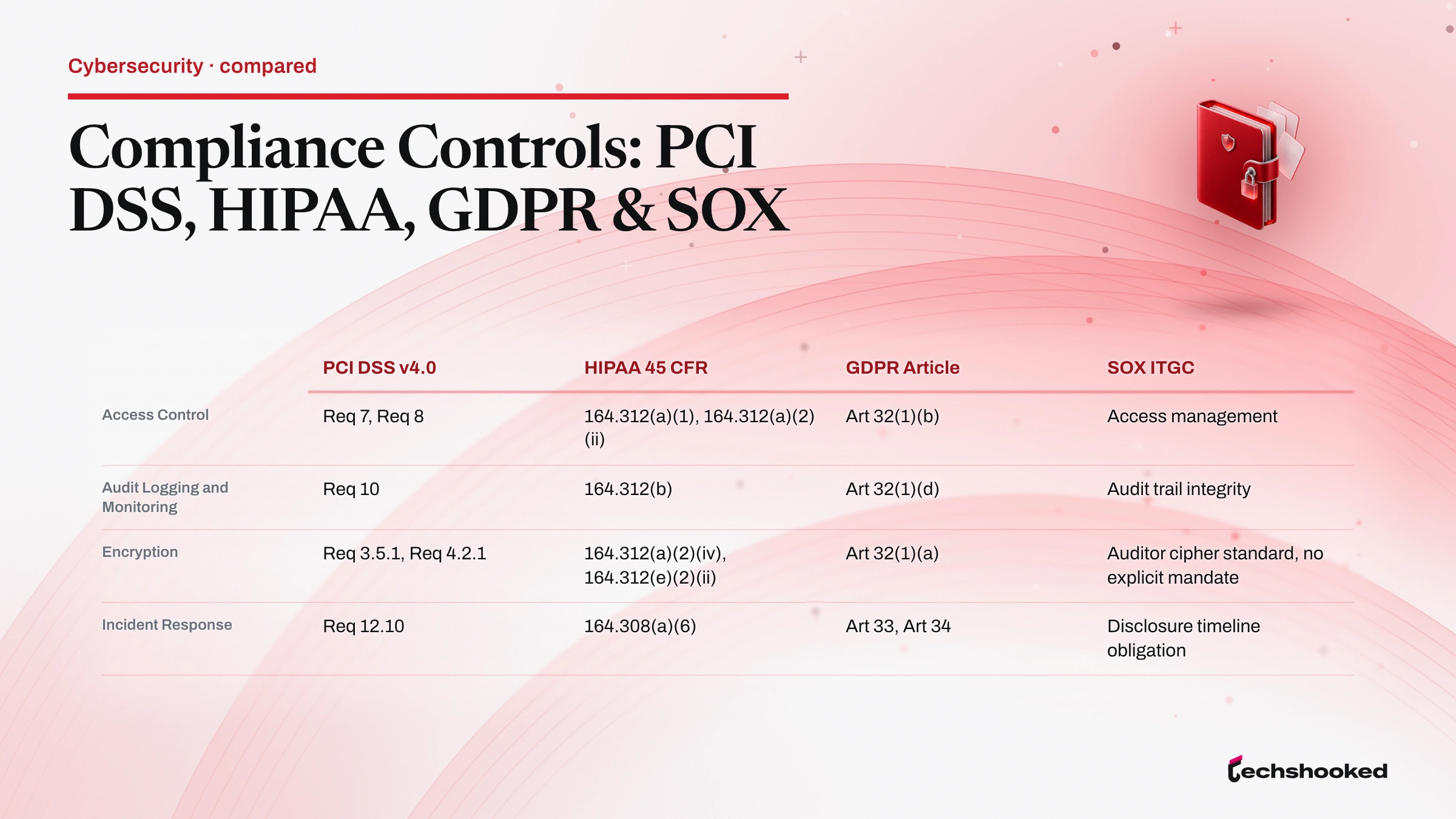
The cross-framework control map is the operative artifact of compliance control mapping. It is a control framework crosswalk whose rows are control categories drawn from NIST SP 800-53 control families and whose columns are the five regulatory regimes plus the canonical crosswalk cataloge. Each cell carries the precise requirement reference inside that framework, not a description: an auditor reading the table should see PCI DSS Req 7, HIPAA 164.312(a)(1), GDPR Art 32(1)(b), the SOX ITGC line item, and ISO A.5.15 sitting in one row labeled Access Control.
Five NIST SP 800-53 control families carry the cleanest cross-framework crosswalk coverage and form the backbone rows of the table: Access Control (AC), Audit and Accountability (AU), System and Communications Protection (SC), Incident Response (IR), and Risk Assessment plus System and Information Integrity (RA/SI). Each row in the table below represents one control category, one implementation, and one audit evidence package that satisfies all five frameworks simultaneously.
| Control Category | NIST 800-53 Family | PCI DSS v4.0 | HIPAA 45 CFR | GDPR Article | SOX ITGC | ISO 27001 Annex A |
|---|---|---|---|---|---|---|
| Access Control | AC family | Req 7, Req 8 | 164.312(a)(1), 164.312(a)(2)(ii) | Art 32(1)(b) | Access management | A.5.15, A.5.18, A.8.2 |
| Audit Logging and Monitoring | AU family | Req 10 | 164.312(b) | Art 32(1)(d) | Audit trail integrity | A.8.15, A.8.16 |
| Encryption (data at rest and in transit) | SC family | Req 3.5.1, Req 4.2.1 | 164.312(a)(2)(iv), 164.312(e)(2)(ii) | Art 32(1)(a) | Auditor cipher standard, no explicit mandate | A.8.24, A.5.33 |
| Incident Response | IR family | Req 12.10 | 164.308(a)(6) | Art 33, Art 34 | Disclosure timeline obligation | A.5.24, A.5.26 |
| Vulnerability and Change Management | RA, SI families | Req 6, Req 11 | 164.308(a)(8) | Art 32(1)(d) | Change management ITGC | A.8.8, A.8.32 |
Each row in this control framework crosswalk is one control, not five. The Access Control row, for example, is satisfied by one identity-and-access-management program that enforces unique IDs, role-based authorization, quarterly user-access reviews, and termination workflows. The same program output (the access review report, the role matrix, the deprovisioning logs) sits in one audit evidence package that the QSA, the HIPAA security official, the data protection officer, and the SOX auditor each consume against their own requirement reference. Audit logging and monitoring is similarly one capability: SIEM tooling decisions, including Splunk vs QRadar pricing, are the implementation layer that produces the AU-family evidence consumed by all five frameworks. The SaaS scope variant, where access control and encryption land inside vendor consoles rather than on-premises infrastructure, is covered in how to secure SaaS applications at scale.
Two caveats on the table. SOX ITGCs do not impose an explicit cipher mandate the way PCI DSS Req 3.5.1 does; the SOX auditor evaluates encryption sufficiency under generally accepted information-security standards, which in practice means the auditor expects AES-256 because PCI DSS or HIPAA already drive that choice in the same system, anchoring the data encryption at rest baseline at the strongest available bar. And GDPR Article 32(1)(d) is the regular testing clause that covers vulnerability management, but the formal GDPR security assessment for it lives inside the DPIA, not inside the technical control row. The ISO/IEC 27001:2022 Annex A control numbers above are the 2022-revision identifiers; if a program is still operating against the 2013 revision, the Annex A numbers shift and the crosswalk needs a re-mapping pass.
Control Deduplication: Eliminating Redundant Audit Work
Compliance control mapping pays off at the deduplication step. When two frameworks demand functionally identical controls under different terminology, the implementation lands once, the evidence is collected once, and the audit evidence package carries a list of framework citations rather than a single citation. The PCI DSS Req 7.2.1 quarterly access-control review is byte-identical in scope to the HIPAA periodic review under 164.312(a)(2)(ii) and satisfies the ISO A.5.15 review requirement at the same time. One meeting, one report, three framework citations.
The unit of control deduplication is the artifact, not the policy text. A typical audit evidence package for a single deduplicated control contains five files:
- Policy reference. One written control statement that names the control at the technical level (not the framework level), so multiple framework citations can attach to the same statement.
- Technical configuration export. The firewall rule, IAM role binding, encryption-at-rest setting, or other concrete configuration that implements the control. Pulled directly from the system, not transcribed.
- Log sample or scan result. Evidence the control actually ran in production over the audit window: a log export, a configuration drift scan, or a vulnerability assessment report.
- Owner-signed review record. A dated and signed record showing the named control owner reviewed the control within the framework-required cadence (quarterly for PCI DSS access reviews, annually for HIPAA risk analysis, and so on).
- Risk assessment line item. A single entry that lists every framework requirement the control satisfies, so the auditor reads one row and resolves multiple framework citations.
The CISA Cross-Sector Cybersecurity Performance Goals publish a baseline that most auditors accept as the minimum threshold for what each artifact must contain. Multi-factor authentication, covered in MFA vs SSO: A Comprehensive Comparison, is the canonical evidence reuse example: one MFA deployment generates a single artifact set tagged to PCI DSS Req 8.4, HIPAA 164.312(d), and GDPR Article 32(1)(b). The credential-vault layer that sits beneath that policy, including enterprise password managers, produces the same kind of reusable artifact at the secret-storage tier.
Not everything reuses. Some attestation artifacts are framework-specific by statute and cannot be substituted across regimes. The definition list below splits the reusable from the non-reusable so the control set scope is unambiguous:
- Reusable across frameworks
- Technical control implementations (firewall configurations, encryption settings, IAM role bindings); evidence artifacts (log exports, scan reports, configuration screenshots, access-review minutes); a single risk assessment that lists each framework's overlapping requirement next to the control; policy statements written at the control level rather than the framework level. Evidence reuse at this layer is the largest source of audit-cost reduction in a mature program.
- Not reusable across frameworks
- PCI DSS Report on Compliance signed by a Qualified Security Assessor; SOX Section 404(b) attestation signed by the external auditor; GDPR Data Protection Impact Assessment approved by a Data Protection Officer; HIPAA Security Rule risk analysis signed by the covered entity's designated security official; ISO 27001 Statement of Applicability signed by the certified-body lead auditor.
- Partially reusable
- Penetration test reports (a single test satisfies PCI DSS Req 11.4, HIPAA 164.308(a)(8), and ISO A.8.8, but each framework may demand a separate management-response letter); vendor security assessment questionnaires (one filled questionnaire seeds multiple framework supplier reviews, but each framework's supplier-risk sign-off is signed by a different role).
The deduplication discipline is enforced at the control register, where each control row carries a multi-framework citation list. When a new framework lands (a new state privacy law, a new ISO revision), the control register adds a citation column rather than a new control statement, and the audit evidence package picks up the new framework with zero engineering rework.
Audit Calendar Synchronization Across Frameworks
Compliance control mapping breaks down at the calendar if each framework runs its own audit cycle in isolation. PCI DSS demands an annual QSA assessment plus quarterly approved scanning vendor (ASV) scans; HIPAA imposes a periodic security review without a fixed cadence; SOX Section 404 lands an annual external attestation tied to the fiscal year; ISO 27001 runs a three-year certification cycle with annual surveillance audits. Without audit calendar synchronization, the security team executes the same control test four times a year for four different auditors. With audit calendar synchronization, each control test runs once and feeds every audit cycle that consumes it.
The master compliance calendar phases evidence collection so each quarter's deliverables serve at least two frameworks. A typical year for an organization carrying PCI DSS, HIPAA, SOX, and ISO 27001 obligations looks like this:
- Q1: Annual penetration test plus risk register refresh. One penetration test report covers PCI DSS Req 11.4, ISO A.8.8, the SOX ITGC vulnerability-management line, and HIPAA 164.308(a)(8). The annual risk assessment update is the input to the QSA assessment and the ISO surveillance audit later in the year.
- Q2: Quarterly access-control review and Q1 ASV scan reconciliation. The access review report serves PCI DSS Req 7.2.1, HIPAA 164.312(a)(2)(ii), the SOX access-management ITGC, and ISO A.5.15. ASV-scan remediation evidence rolls into the same audit evidence package.
- Q3: QSA assessment fieldwork plus ISO 27001 surveillance audit window. The QSA and the ISO certification body each read the same control register and the same evidence artifacts; only their attestation outputs differ. Schedule both engagements inside a 60-day window to compress fieldwork burden on engineering teams.
- Q4: SOX Section 404 testing and Q4 quarterly access-control review. The external SOX auditor tests the ITGC sample, drawing the same access-management, change-management, and computer-operations evidence the QSA already consumed in Q3. The Q4 access review closes the calendar and feeds the next year's baseline.
The NIST Cybersecurity Framework 2.0 GOVERN function, added in the 2024 revision, gives this calendar its governance backbone: the GOVERN.OC and GOVERN.RM categories tell the compliance program how to track multi-framework obligations as a single risk register rather than four parallel ones. GDPR sits outside the fixed-calendar pattern; supervisory authority inspections are event-triggered, so the DPIA review trigger list (system architecture change, breach event, regulatory change) is integrated into the master calendar as a standing review agenda item rather than an annual date. Zero-trust segmentation, covered in Zero Trust Network Architecture, often functions as the recurring evidence source for the Q2 and Q4 access-control review rows. Tooling that automates evidence collection across the calendar, including enterprise privacy tools, is what makes the synchronized calendar maintainable past year one.
When Framework Requirements Conflict: Resolution Hierarchy
Multi-framework compliance produces occasional collisions where two frameworks impose controls that cannot be satisfied with a single implementation. The canonical example: PCI DSS Req 3.5.1 mandates that primary account numbers be rendered unreadable at rest using strong one-way hashes, truncation, index tokens, or strong cryptography. HIPAA does not mandate a specific cipher for PHI at rest; it requires that the chosen mechanism be reasonable and appropriate against the documented risk analysis. When the same database column holds payment card data inside the cardholder data environment and protected health information at the same time, the PCI DSS mandate wins because it is the more restrictive bar and its data encryption at rest requirement satisfies the HIPAA threshold simultaneously.
The principle behind that resolution is straightforward: when two frameworks cover the same data, the most restrictive control that satisfies every overlapping requirement governs the implementation. Four decision rules operationalise that principle inside a multi-framework compliance program:
- Identify the most restrictive requirement across all applicable frameworks. For each control category in the cross-framework crosswalk, compare the cipher minimum, the review frequency, the key-rotation interval, and the retention floor across every framework that touches the data. The highest bar becomes the design target.
- Implement that single most-restrictive mechanism. One technical control, one configuration, one operational owner. Avoid parallel implementations that satisfy each framework independently; they create reconciliation debt at every audit cycle and defeat control deduplication.
- Document each framework's requirement reference next to the single implemented control. The control register row carries PCI DSS Req 3.5.1 and HIPAA 45 CFR 164.312(a)(2)(iv) and GDPR Article 32(1)(a) as a citation list, with the AES-256 configuration evidence as the shared artifact.
- Note in the risk assessment that the selected control exceeds the lower-bar frameworks rather than merely meeting them. This protects against the auditor question, "why is this stronger than HIPAA requires," and confirms that the over-specification is a deliberate deduplication choice, not an unjustified expense.
The mechanism-selection decision underneath rule one is its own engineering question. For co-located payment card data and PHI, the difference between encryption and tokenization often determines whether the system stays in CDE scope or exits it, which changes the entire control set the deduplication exercise consumes.
Related Reading
The application-layer technical controls that feed the access control and encryption rows of the crosswalk come from the OWASP Application Security Verification Standard, whose Section 2 (authentication), Section 3 (session management), and Section 8 (data protection) chapters produce verifiable test procedures auditors accept as evidence. The HIPAA implementation guidance most US controllers cite when interpreting 164.312 sits in NIST SP 800-66 Rev 2.
Further reading
- Difference Between Encryption and Tokenization (hub guide on the mechanism-selection decision underneath the SC-family row of the crosswalk)
- Splunk vs QRadar Pricing (SIEM tooling for the AU-family audit logging row)
- MFA vs SSO: A Comprehensive Comparison (canonical deduplicable access-control evidence)
- Conducting a Data Privacy Impact Assessment (GDPR Article 32 scoping input to the control map)
Frequently Asked Questions
Which framework takes precedence when PCI DSS, HIPAA, and GDPR impose conflicting controls on the same data?
When multiple frameworks impose conflicting controls on the same regulated data, the most restrictive applicable requirement governs the implementation. For co-located payment card data (PCI DSS scope) and EU personal data (GDPR scope), PCI DSS v4.0 Requirement 3.5.1 mandates that primary account numbers be rendered unreadable at rest using AES-256 or equivalent; GDPR Article 32 requires appropriate encryption without specifying a cipher. Implementing AES-256 satisfies both requirements simultaneously, and the control documentation should cite both framework references against a single technical configuration. When the more restrictive requirement is not technically compatible with a less restrictive requirement, organizations must implement both discrete controls in parallel and document the compliance boundary explicitly in their security posture record.
What counts as reusable evidence across compliance frameworks, and what does not?
Technical control artifacts are reusable across frameworks when the underlying control implementation is functionally identical; formal attestations and framework-specific sign-offs are not reusable. A quarterly access-control review report, a penetration test result, an encryption configuration screenshot, and an audit log export can each be tagged to multiple framework requirement references without modification. What cannot be reused: a PCI DSS Report on Compliance (RoC) signed by a Qualified Security Assessor, a SOX Section 404(b) attestation signed by the external auditor, a GDPR Data Protection Impact Assessment approved by a Data Protection Officer, and a HIPAA Security Rule risk analysis signed by the covered entity's designated security official. Each framework's formal attestation has its own signatory requirement and cannot be substituted by an equivalent from another framework.
How do you handle HIPAA's flexible reasonable and appropriate standard in a cross-framework control set?
HIPAA's reasonable and appropriate standard under 45 CFR 164.306(b) is satisfied by demonstrating that the selected control was chosen based on a documented risk analysis, not by meeting a specific technical threshold. In a multi-framework compliance control set, this works in the organization's favor: if PCI DSS Req 3.5.1 mandates AES-256 for cardholder data at rest and the same system holds PHI, the HIPAA risk analysis can document that AES-256 was selected because it was required by PCI DSS, that the security assessment confirmed it exceeds the PHI encryption threshold, and that no alternative mechanism provides an equivalent security level at lower cost. The HIPAA covered entity or business associate signs off on this rationale. The result is one encryption control implementation with a PCI DSS Requirement 3.5.1 citation and a HIPAA 45 CFR 164.312(a)(2)(iv) citation mapped to the same artifact.